Kirjojen hintavertailu. Mukana 11 627 220 kirjaa ja 12 kauppaa.

Kirjahaku

Etsi kirjoja tekijän nimen, kirjan nimen tai ISBN:n perusteella.

6 kirjaa tekijältä Rowena Murray

Murray, How to Write a Thesis 5e

Murray, How to Write a Thesis 5e

Rowena Murray

OPEN UNIVERSITY PRESS
2025
nidottu
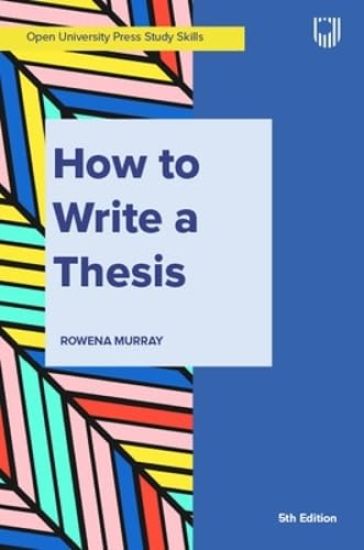
“I have been drawing upon Rowena’s work and this book specifically for many years now, both in my own thesis writing as well as with the students I now support. This is a fantastic and most welcome resource as the new chapters on AI and neurodiversity, as well as further developments and resources on other sections bring it right up to date. Not only is it a very informative and useful resource, it also provides lots of excellent tasks and tools to employ that are a significant benefit to the writing processes at this level.”Joseph Allison, Lecturer in Clinical Education and Visiting Specialist, Plymouth Peninsula Medical School, UK“A must read for students and supervisors alike! This book has become a brilliant companion to navigating the complexities of academic writing. Writing my own thesis often felt like climbing a mountain, but Rowena’s book became my map. Packed with practical advice, support, and confidence-building strategies, it helped me reach the summit!”Michelle Smith, Lecturer in Sport and Exercise Psychology, University of Stirling, UK“The first edition of How to Write a Thesis was essential in my own PhD journey, providing a comprehensive oversight of thesis requirements that demystified the complex process of academic writing. Twenty years later, the latest iteration of the book remains vital reading. A must-buy book for PhD students.”Martin A Sharp, Director of Postgraduate Research, Edinburgh Napier University, UKThis fully updated edition of the classic guide to thesis writing will help you to write your thesis and make the most of the experience. It will also be useful for supervisors who want to help students develop their writing skills and strategies. This book breaks the writing of a thesis down into manageable tasks, offering routines for productive writing and drawing on research in different fields to help you discover the strategies that work best for you. Arguing that social writing activities such as writing retreats are key to getting started and staying motivated, this book will equip you to write regularly, maintain your confidence as you write and revise, respond to feedback, and create a community of writers as you go.New to this edition:1. Brand new content on neurodiversity and wellbeing2. How to write for different audiences and purposes3. How to write about research impact4. How to tackle the last phase of your thesisRowena Murray is former Professor in Education at the University of the West of Scotland and Honorary Visiting Scholar at Liverpool University Management School, is an Independent Scholar, Adjunct Professor at Strathclyde Business School, Visiting Senior Research Fellow at the University of Leeds and Principal Fellow of the UK Higher Education Academy. She works freelance for universities across the UK and in other countries
Writing for Academic Journals 4e

Writing for Academic Journals 4e

Rowena Murray

Open University Press
2019
nidottu
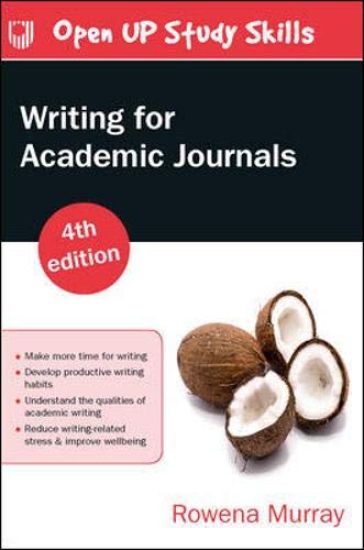
This comprehensive guide to writing journal articles addresses all the stages and recurring challenges, from targeting a journal to dealing with reviewer feedback. Drawing on many years of running ‘Writing for Publication’ workshops, Murray explores not only style and structure but also behaviours and emotions. As a key component of both research courses and careers, this timely text also addresses the struggle to make time for high quality academic writing and how to ensure a writing-life balance.Examining a variety of approaches, relevant to many different academic disciplines, this core text demystifies and defines writing practices and makes this form of high-stakes academic writing seem manageable. Writing for journals has never been more competitive, and writers, researchers, practitioners and students need expert guidance on productive practices and ways of maintaining focus and motivation, which Murray provides. This latest edition is completely updated and more relevant than ever for clinicians, practitioners and students. "This book was already a classic, but the update makes it even more useful. From finding time to write, doing a short literature review and identifying scam journals, Rowena Murray provides an excellent, concise and accessible companion for writing academic journal papers, which is appropriate for both students and working academics."Associate Professor Inger Mewburn, Director of Research Training, The Australian National University, Australia “Rowena Murray has approached publishing in a journal with scientific rigour. Following this book’s recommendations will make it impossible to find a convincing excuse for failure to publish. She herself writes with a high level of artisanal skill; this book is fast paced, stylish and highly readable. Her own extensive experience in supporting journal article writers tempers this book with the credibility of a seasoned veteran. Best of all, there is a wealth of wisdom here—in advising on how to publish, Murray is also advising on how to live a satisfying life as a writer.”Associate Professor Susan Carter, University of Auckland, New Zealand“In Writing for Academic Journals (4th edition), Rowena Murray’s voice is direct, down-to-earth and wise. Drawing on a depth of practical experience as both published author and writing teacher, she conveys the message that, yes, publishing in academic journals is demanding, but it’s also very possible. And that once you are successful, there is still much to be learned from reading books like this one and hanging out with others in writing groups and workshops. To that end, the book is a trove of tips and techniques helpful to all who pursue the challenging craft of (good) academic writing.”Barbara Grant, Associate Professor in the School of Critical Studies in Education at the University of Auckland, New Zealand, and author of Academic writing retreats: A facilitator's uide
How to Write a Thesis

How to Write a Thesis

Rowena Murray

Open University Press
2017
nidottu
Moving beyond the basics of thesis writing, the book introduces practical writing techniques such as freewriting, generative writing and binge writing. Issues such as working out the criteria for your thesis, writer's block, writing a literature review and making notes into a draft are also covered.Useful summaries and checklists help students to stay on track or regain their way. Learn how to: Develop good writing habitsOvercome writer’s blockUnderstand the assessment processGet the most from your SupervisorNew to this edition:New visual map of your thesis to track your progress through the writing processAdvice on using social media productively and avoiding potential distractions during your writingMore support on writing in a second language Using writing retreats and micro-groups to benefit from writing alongside othersNew material on how to finesse your thesis by "back-revising" at the final stages Advice on writing schedules for part-time studentsNew chapter summaries to aid reflection and give pointers for next steps
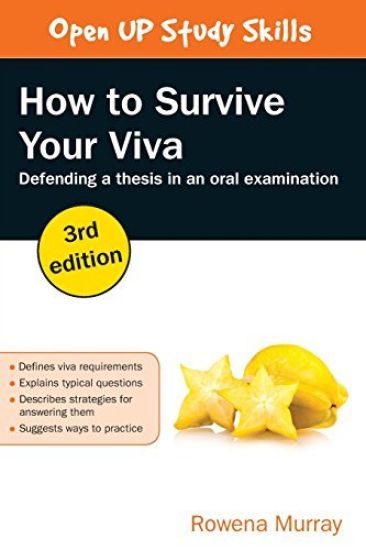
How to Survive Your Viva: Defending a Thesis in an Oral Examination
***** Amazon reviews for the second edition:"Again, Rowena Murray nails it! A perfectly balanced guide outlining truly useful tips to getting through your viva from someone who knows." "This is an excellent book. I found the book helpful in giving me a good understanding of what to expect, how to start with focusing on the specific areas suggested and how to develop my own style in marking up my thesis ... It certainly reduced my nerves going in knowing I had suggested areas fully prepared. A must have for anyone doing a viva!"How to Survive Your Viva 3e is a concise, practical introduction that equips students with the skills they need to defend their thesis or dissertation. The oral examination requires the highest standard of communication skills. The book ensures you are ready for what can be a complex and intimidating experience, telling you what to expect, how to practise and prepare, what questions you might be asked and how to ensure your responses support your thesis. Written in an accessible style, this book draws on the tried and trusted material and activities created for viva preparation workshops run by the author over many years.Thoroughly updated but retaining its well-loved style, this 3rd edition provides:Planning tools for you to employ, plus summaries at the start of each chapter to help you prepareChecklists of how to do well in your oral examination, with action points to clarify what you should do nextExample questions with samples of strong and weak answers, plus narratives of students’ real viva experiences More on research into viva questions and different types of questions you may be asked, including specialist ones in your disciplineAdvice on condensing your rationale, framework, methods and findings into a short verbal statementNew material on maintaining positive body language, posture and eye contact for an assertive and calm viva The third edition is the essential handbook for all students and researchers anticipating an undergraduate, Masters or doctoral examination. It is also an invaluable reference for supervisors, tutors and examiners.
Writing in Social Spaces

Writing in Social Spaces

Rowena Murray

Routledge
2014
sidottu
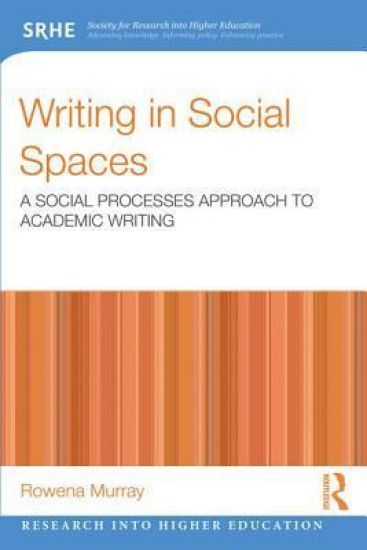
Writing in Social Spaces addresses the problem of making time and space for writing in academic life and work of the professionals and practitioners who do academic writing'. Even those who want to write, who know how to write well and who have quality publications, report that they cannot find enough time for writing. Many supervisors are unsure about how to help postgraduates improve their writing for thesis and publication. Whilst the problem does presents through concerns with ‘time’, it is also partly about writing practices, academic identities and lack of motivation. This book provides a research-based, theorised approach to the skill of writing whilst retaining a link to writing practices and giving immediate yet sustainable solutions to the writing problem. It supplies new theory and practice on: socializing writing-in-progress and writing with others exploring the alternation of conscious and unconscious, internal and external processes in academic writing whilst in a social grouping Applying social processes in the writing process Using case studies and vignettes of writing in social spaces to illustrate the theory in practice, This book is a valuable resource for academics, scholars, professionals and practitioners, as well as researchers at all stages of their career, and in all disciplines.
Writing in Social Spaces

Writing in Social Spaces

Rowena Murray

Routledge
2014
nidottu
Writing in Social Spaces addresses the problem of making time and space for writing in academic life and work of the professionals and practitioners who do academic writing'. Even those who want to write, who know how to write well and who have quality publications, report that they cannot find enough time for writing. Many supervisors are unsure about how to help postgraduates improve their writing for thesis and publication. Whilst the problem does presents through concerns with ‘time’, it is also partly about writing practices, academic identities and lack of motivation. This book provides a research-based, theorised approach to the skill of writing whilst retaining a link to writing practices and giving immediate yet sustainable solutions to the writing problem. It supplies new theory and practice on: socializing writing-in-progress and writing with others exploring the alternation of conscious and unconscious, internal and external processes in academic writing whilst in a social grouping Applying social processes in the writing process Using case studies and vignettes of writing in social spaces to illustrate the theory in practice, This book is a valuable resource for academics, scholars, professionals and practitioners, as well as researchers at all stages of their career, and in all disciplines.