Kirjojen hintavertailu. Mukana 11 806 343 kirjaa ja 12 kauppaa.

Kirjahaku

Etsi kirjoja tekijän nimen, kirjan nimen tai ISBN:n perusteella.

13 kirjaa tekijältä Rupert Read

Wittgenstein’s Liberatory Philosophy
In this book, Rupert Read offers the first outline of a resolute reading, following the highly influential New Wittgenstein ‘school’, of the Philosophical Investigations. He argues that the key to understanding Wittgenstein’s later philosophy is to understand its liberatory purport. Read contends that a resolute reading coincides in its fundaments with what, building on ideas in the later Gordon Baker, he calls a liberatory reading. Liberatory philosophy is philosophy that can liberate the user from compulsive (and destructive) patterns of thought, freeing one for possibilities that were previously obscured. Such liberation is our prime goal in philosophy. This book consists in a sequential reading, along these lines, of what Read considers the most important and controversial passages in the Philosophical Investigations: 1, 16, 43, 95 & 116 & 122, 130–3, 149–151, 186, 198–201, 217, and 284–6. Read claims that this liberatory conception is simultaneously an ethical conception. The PI should be considered a work of ethics in that its central concern becomes our relation with others. Wittgensteinian liberations challenge widespread assumptions about how we allegedly are independent of and separate from others. Wittgenstein’s Liberatory Philosophy will be of interest to scholars and advanced students working on Wittgenstein, and to scholars of the political philosophy of liberation and the ethics of relation.
Wittgenstein’s Liberatory Philosophy

Wittgenstein’s Liberatory Philosophy

Rupert Read

TAYLOR FRANCIS LTD
2022
nidottu
In this book, Rupert Read offers the first outline of a resolute reading, following the highly influential New Wittgenstein ‘school’, of the Philosophical Investigations. He argues that the key to understanding Wittgenstein’s later philosophy is to understand its liberatory purport. Read contends that a resolute reading coincides in its fundaments with what, building on ideas in the later Gordon Baker, he calls a liberatory reading. Liberatory philosophy is philosophy that can liberate the user from compulsive (and destructive) patterns of thought, freeing one for possibilities that were previously obscured. Such liberation is our prime goal in philosophy. This book consists in a sequential reading, along these lines, of what Read considers the most important and controversial passages in the Philosophical Investigations: 1, 16, 43, 95 & 116 & 122, 130–3, 149–151, 186, 198–201, 217, and 284–6. Read claims that this liberatory conception is simultaneously an ethical conception. The PI should be considered a work of ethics in that its central concern becomes our relation with others. Wittgensteinian liberations challenge widespread assumptions about how we allegedly are independent of and separate from others. Wittgenstein’s Liberatory Philosophy will be of interest to scholars and advanced students working on Wittgenstein, and to scholars of the political philosophy of liberation and the ethics of relation.
A Film-Philosophy of Ecology and Enlightenment
Inspired by the philosophy of Wittgenstein and his idea that the purpose of real philosophical thinking is not to discover something new, but to show in a strikingly different light what is already there, this book provides philosophical readings of a number of ‘arthouse’ and Hollywood films. Each chapter contains a discussion of two films—one explored in greater detail and the other analyzed as a minor key which reveals the possibility for the book's ideas to be applied across different films, registers, and genres. The readings are not only interpretive, but they offer a way of thinking and feeling about, with, and through films which is genuinely transformative. Rupert Read’s main contention is that certain films can bring about a change in how we see the world. He advocates an ecological approach to film-philosophy analysis, arguing that film can re-shape the viewer’s relationship to the environment and other living beings. The transformative 'wake-up call' of these films is enlightenment in its true sense. The result is a book that ambitiously aims to change, though film, how we think of ourselves and our place in the world, at a time when such change is more needed than ever before.
Do you want to know the truth? The surprising rewards of climate honesty
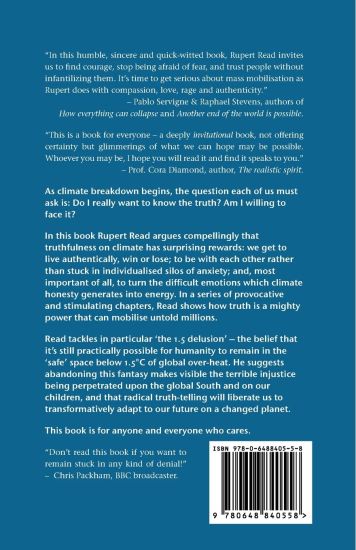
"In this humble, sincere and quick-witted book, Rupert Read invites us to find courage, stop being afraid of fear, and trust people without infantilizing them. It's time to get serious about mass mobilisation as Rupert does with compassion, love, rage and authenticity." - Pablo Servigne & Raphael Stevens, authors of How everything can collapse and Another end of the world is possible."This is a book for everyone - a deeply invitational book, not offering certainty but glimmerings of what we can hope may be possible. Whoever you may be, I hope you will read it and find it speaks to you." - Prof. Cora Diamond, author, The realistic spirit.As climate breakdown begins, the question each of us must ask is: Do I really want to know the truth? Am I willing to face it?In this book Rupert Read argues compellingly that truthfulness on climate has surprising rewards: we get to live authentically, win or lose; to be with each other rather than stuck in individualised silos of anxiety; and, most important of all, to turn the difficult emotions which climate-honesty generates into energy. In a series of provocative and stimulating chapters, Read shows how truth is a mighty power that can mobilise untold millions.Read tackles in particular 'the 1.5 delusion' - the belief that it's still practically possible for humanity to remain in the 'safe' space below 1.5 C of global over-heat. He suggests abandoning this fantasy makes visible the terrible injustice being perpetrated upon the global South and on our children, and that radical truth-telling will liberate us to transformatively adapt to our future on a changed planet.This book is for anyone and everyone who cares."Don't read this book if you want to remain stuck in any kind of denial " - Chris Packham, BBC broadcaster.
A Wittgensteinian Way with Paradoxes

A Wittgensteinian Way with Paradoxes

Rupert Read

Lexington Books
2012
sidottu
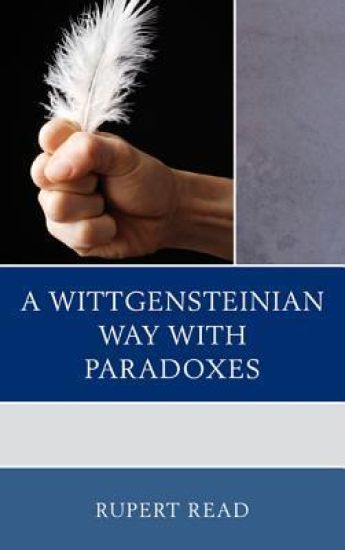
A Wittgensteinian Way with Paradoxes examines how some of the classic philosophical paradoxes that have so puzzled philosophers over the centuries can be dissolved. Read argues that paradoxes such as the Sorites, Russell’s Paradox and the paradoxes of time travel do not, in fact, need to be solved. Rather, using a resolute Wittgensteinian ‘therapeutic’ method, the book explores how virtually all apparent philosophical paradoxes can be diagnosed and dissolved through examining their conditions of arising; to loosen their grip and therapeutically liberate those philosophers suffering from them (including oneself). The book contrasts such paradoxes with real, ‘lived paradoxes’: paradoxes that are genuinely experienced outside of the philosopher’s study, in everyday life. Thus Read explores instances of lived paradox (such as paradoxes of self-hatred and of denial of other humans’ humanity) and the harm they can cause, psychically, morally or politically. These lived paradoxes, he argues, sometimes cannot be dissolved using a Wittgensteinian treatment. Moreover, in some cases they do not need to be: for some, such as the paradoxical practices of Zen Buddhism (and indeed of Wittgenstein himself), can in fact be beneficial. The book shows how, once philosophers’ paradoxes have been exorcized, real lived paradoxes can be given their due.
Applying Wittgenstein

Applying Wittgenstein

Rupert Read

Continuum International Publishing Group Ltd.
2007
sidottu
A key development in Wittgenstein Studies over recent years has been the advancement of a resolutely therapeutic reading of the Tractatus. Rupert Read offers the first extended application of this reading of Wittgenstein, encompassing Wittgenstein's later work too, to examine the implications of Wittgenstein's work as a whole upon the domains especially of literature, psychopathology, and time. Read begins by applying Wittgenstein's remarks on meaning to language, examining the consequences our conception of philosophy has for the ways in which we talk about meaning. He goes on to engage with literary texts as Wittgensteinian, where 'Wittgensteinian' does not mean expressive of a Wittgenstein philosophy, but involves the literature in question remaining enigmatic, and doing philosophical work of its own. He considers Faulkner's work as productive too of a broadly Wittgensteinian philosophy of psychopathology. Read then turns to philosophical accounts of time, finding a link between the division of time into discrete moments and solipsism of the present moment as depicted in philosophy on the one hand and psychopathological states on the other. This important book positions itself at the forefront of a revolutionary movement in Wittgenstein studies and philosophy in general and offers a new and dynamic way of using Wittgenstein's works.
Philosophy for Life

Philosophy for Life

Rupert Read

Continuum International Publishing Group Ltd.
2007
nidottu
"Philosophy for Life" is a bold call for the practice of philosophy in our everyday lives. Philosopher and writer Rupert Read explores a series of important and often provocative contemporary political and cultural issues from a philosophical perspective, arguing that philosophy is not a body of doctrine, but a practice, a vantage point from which life should be analysed and, more importantly, acted upon. "Philosophy for Life" is a personal journey that explores four key areas of society today: Politics, Religion, Art, and the Environment. Taking tangible examples from modern politics, from climate change to the war on terror, and culture, from Peter Jackson's "Lord of the Rings" film trilogy to the poetry of TS Eliot, Read shows that philosophy is already an active part of today's world. This captivating and timely book offers a philosophical response to some of the key questions facing today's society and encourages us to use philosophy as a kind of therapy. "Philosophy for Life" shows that we can improve our perspective on the world and our place in it by doing philosophy everyday.
Philosophy for Life

Philosophy for Life

Rupert Read

Continuum International Publishing Group Ltd.
2007
sidottu
Philosophy for Life is a bold call for the practice of philosophy in our everyday lives. Philosopher and writer Rupert Read explores a series of important and often provocative contemporary political and cultural issues from a philosophical perspective, arguing that philosophy is not a body of doctrine, but a practice, a vantage point from which life should be analysed and, more importantly, acted upon. Philosophy for Life is a personal journey that explores four key areas of society today:Politics, Religion, Art, and the Environment. Taking tangible examples from modern politics, from climate change to the war on terror, and culture, from Peter Jackson's Lord of the Rings film trilogy to the poetry of T.S. Eliot, Read shows that philosophyis already an active part of today's world. This captivating and timelybook offers a philosophical response to some of the key questions facing today's society and encourages us to use philosophy as a kind of therapy. Philosophy for Lifeshows that we canimprove our perspective on the world and our place in it by doing philosophy everyday.
A Film-Philosophy of Ecology and Enlightenment
Inspired by the philosophy of Wittgenstein and his idea that the purpose of real philosophical thinking is not to discover something new, but to show in a strikingly different light what is already there, this book provides philosophical readings of a number of ‘arthouse’ and Hollywood films. Each chapter contains a discussion of two films—one explored in greater detail and the other analyzed as a minor key which reveals the possibility for the book's ideas to be applied across different films, registers, and genres. The readings are not only interpretive, but they offer a way of thinking and feeling about, with, and through films which is genuinely transformative. Rupert Read’s main contention is that certain films can bring about a change in how we see the world. He advocates an ecological approach to film-philosophy analysis, arguing that film can re-shape the viewer’s relationship to the environment and other living beings. The transformative 'wake-up call' of these films is enlightenment in its true sense. The result is a book that ambitiously aims to change, though film, how we think of ourselves and our place in the world, at a time when such change is more needed than ever before.
Why Climate Breakdown Matters

Why Climate Breakdown Matters

Rupert Read

BLOOMSBURY PUBLISHING PLC
2022
nidottu
Climate change and the destruction of the earth is the most urgent issue of our time. We are hurtling towards the end of civilisation as we know it. With an unflinching honest approach, Rupert Read asks us to face up to the fate of the planet. This is a book for anyone who wants their philosophy to deal with reality and their climate concern to be more than a displacement activity.As people come together to mourn the loss of the planet, we have the opportunity to create a grounded, hopeful response. This meaningful hopefulness looks to the new communities created around climate activism. Together, our collective mourning enables us to become human in ways previously unknown.Why Climate Breakdown Matters is a practical guide on how to be a radical, responsible climate activist.
Why Climate Breakdown Matters

Why Climate Breakdown Matters

Rupert Read

BLOOMSBURY PUBLISHING PLC
2022
sidottu
Climate change and the destruction of the earth is the most urgent issue of our time. We are hurtling towards the end of civilisation as we know it. With an unflinching honest approach, Rupert Read asks us to face up to the fate of the planet. This is a book for anyone who wants their philosophy to deal with reality and their climate concern to be more than a displacement activity.As people come together to mourn the loss of the planet, we have the opportunity to create a grounded, hopeful response. This meaningful hopefulness looks to the new communities created around climate activism. Together, our collective mourning enables us to become human in ways previously unknown.Why Climate Breakdown Matters is a practical guide on how to be a radical, responsible climate activist.
Parents for a Future

Parents for a Future

Rupert Read

UEA Publishing Project
2021
nidottu
That our ecological future appears grave can no longer come as any surprise. And yet we have so far failed, collectively and individually, to begin the kind of action necessary to shift our path away from catastrophic climate collapse. In this stark and startling little book, Rupert Read helps us to understand the direness of our predicament while showing us a metaphor and a method – a way of thinking – by which we might transform it. From the relatively uncontroversial starting point that we love our own children, we are introduced to a logic of care that iterates far into the future: in caring for our own children, we are committed to caring for the whole of human future; in caring for the whole of human future, we are committed to caring for the future of the natural world. Out of such thinking, hope emerges. As Read demonstrates in this urgent call to action, accepting that we care for our own offspring commits us to a struggle on behalf of us all.