Kirjojen hintavertailu. Mukana 11 717 486 kirjaa ja 12 kauppaa.

Kirjahaku

Etsi kirjoja tekijän nimen, kirjan nimen tai ISBN:n perusteella.

3 kirjaa tekijältä Russell J. Leng

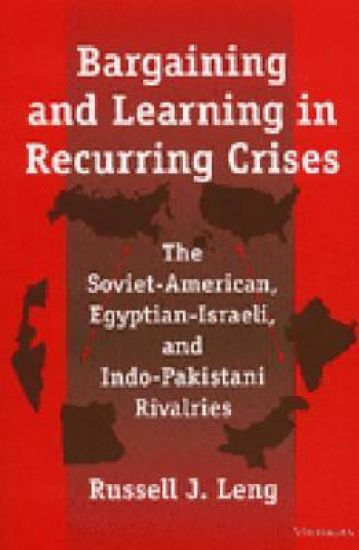
Bargaining and Learning in Recurring Crises

Bargaining and Learning in Recurring Crises

Russell J. Leng

The University of Michigan Press
2000
sidottu
The rivalries between the Soviet Union and the United States, Egypt and Israel, and India and Pakistan produced twelve major crises and seven wars during the quarter-century following World War II. A disproportionate share of international crises and wars occur between long-term rivals. Why could not the leaders of these states learn to manage their disputes without severe crises or war? Russell J. Leng finds that the lessons leaders of those states drew from their experiences most often led to bargaining tactics that only increased the level of hostility and the likelihood of war in subsequent disputes.The author uses theoretical work on learning and the role of belief systems on foreign policy-making as the basis to explore the history of each rivalry. Detailed narrative accounts of each of the crises are augmented by tables and figures describing the escalation of each crisis and the behavior of participant states. The approach allows for comparisons of behavior and learning across the three rivalries, as well as a consideration of the influence that the Soviet-American rivalry exerted on the Middle East and South Asian rivalries. The concluding chapter illustrates how the influence of realpolitik beliefs on learning across the three rivalries predisposed policymakers to draw lessons from their crisis experience that weakened conflict management in subsequent crises. The author also shows how superpower mediation in Middle East and South Asian crises and wars had the perverse effect of encouraging greater risk-taking by the participant states in subsequent crises.The book will be of particular interest to political scientists and historians who study international relations, as well as those interested in decision-making and learning by policymakers.Russell J. Leng is Professor of Political Science, Middlebury College, and the author of Interstate Crisis Behavior 1816-1980: Realism versus Reciprocity and numerous articles.
Interstate Crisis Behavior, 1816–1980

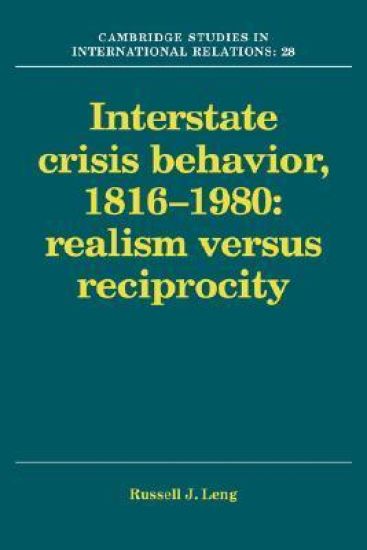
Interstate Crisis Behavior, 1816–1980

Russell J. Leng

Cambridge University Press
1993
sidottu
Why have some interstate crises escalated to war when other have not? Are there patterns of behavior that war-prone disputes share in common? These are some of the questions considered by Russell Leng as he examines the behavior of nations in forty militarised crises occurring between 1816 and 1980. Leng considers the conditions under which crises are more or less likely to escalate to war or be resolved peacefully and compares the descriptive and prescriptive validity of two competing perspectives on conflict behavior: classical realism and the psychological approaches of behavioral scientists. The author concludes that elements of both realist and psychological perspectives are necessary for an adequate understanding of interstate crisis behavior and that the most effective approach to crisis bargaining combines each perspective in a firm-but-flexible 'reciprocating' strategy. The epilogue presents a provocative critique of the bargaining strategies pursued by the United States and Iraq during the Gulf Crisis of 1990–1991.
Bargaining and Learning in Recurring Crises

Bargaining and Learning in Recurring Crises

Russell J. Leng

The University of Michigan Press
2000
nidottu
The rivalries between the Soviet Union and the United States, Egypt and Israel, and India and Pakistan produced twelve major crises and seven wars during the quarter-century following World War II. A disproportionate share of international crises and wars occur between long-term rivals. Why could not the leaders of these states learn to manage their disputes without severe crises or war? Russell J. Leng finds that the lessons leaders of those states drew from their experiences most often led to bargaining tactics that only increased the level of hostility and the likelihood of war in subsequent disputes. The author uses theoretical work on learning and the role of belief systems on foreign policy-making as the basis to explore the history of each rivalry. Detailed narrative accounts of each of the crises are augmented by tables and figures describing the escalation of each crisis and the behavior of participant states. The approach allows for comparisons of behavior and learning across the three rivalries, as well as a consideration of the influence that the Soviet-American rivalry exerted on the Middle East and South Asian rivalries. The concluding chapter illustrates how the influence of realpolitik beliefs on learning across the three rivalries predisposed policymakers to draw lessons from their crisis experience that weakened conflict management in subsequent crises. The author also shows how superpower mediation in Middle East and South Asian crises and wars had the perverse effect of encouraging greater risk-taking by the participant states in subsequent crises. The book will be of particular interest to political scientists and historians who study international relations, as well as those interested in decision-making and learning by policymakers. Russell J. Leng is Professor of Political Science, Middlebury College, and the author of Interstate Crisis Behavior 1816-1980: Realism versus Reciprocity and numerous articles.