Kirjojen hintavertailu. Mukana 11 342 296 kirjaa ja 12 kauppaa.

Kirjahaku

Etsi kirjoja tekijän nimen, kirjan nimen tai ISBN:n perusteella.

8 kirjaa tekijältä Russell Thornton

We Shall Live Again

We Shall Live Again

Russell Thornton

Cambridge University Press
2006
pokkari
This study of the 1870 and 1890 Ghost Dance movements among North American Indians offers an innovative theory about why these movements arose when they did. Emphasizing the demographic situation of American Indians prior to the movements, Professor Thornton argues that the Ghost Dances were deliberate efforts to accomplish a demographic revitalization of American Indians following their virtual collapse. By joining the movements, he contends, tribes sought to assure survival by increasing their numbers through returning the dead to life. Thornton supports this thesis empirically by closely examining the historical context of the two movements and by assessing tribal participation in them, revealing particularly how population size and decline influenced participation among and within American Indian tribes. He also considers American Indian population change after the Ghost Dance periods and shows that participation in the movements actually did lead the way to a demographic recovery for certain tribes.
We Shall Live Again

We Shall Live Again

Russell Thornton

Cambridge University Press
1986
sidottu
This study of the 1870 and 1890 Ghost Dance movements among North American Indians offers an innovative theory about why these movements arose when they did. Emphasizing the demographic situation of American Indians prior to the movements, Professor Thornton argues that the Ghost Dances were deliberate efforts to accomplish a demographic revitalization of American Indians following their virtual collapse. By joining the movements, he contends, tribes sought to assure survival by increasing their numbers through returning the dead to life. Thornton supports this thesis empirically by closely examining the historical context of the two movements and by assessing tribal participation in them, revealing particularly how population size and decline influenced participation among and within American Indian tribes. He also considers American Indian population change after the Ghost Dance periods and shows that participation in the movements actually did lead the way to a demographic recovery for certain tribes. This occurred, Thornton argues, not, of course, by returning dead American Indians to life, but by creating enhanced tribal solidarity. This solidarity enabled participating tribes to maintain their membership at a historical point when American Indians were socially and biologically ‘migrating’ away from tribal populations. As well as being of intrinsic interest, Thornton’s findings have broad implications for the study of revitalization and other social movements. They are particularly important with regard to the circumstances fostering social movements and the rational basis of social movement participation.
The Cherokees

The Cherokees

Russell Thornton

University of Nebraska Press
1992
pokkari
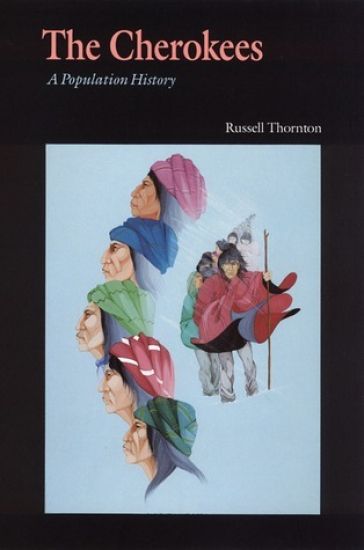
The Cherokees: A Population History is the first full-length demographic study of an American Indian group from the protohistorical period to the present. Thornton shows the effects of disease, warfare, genocide, miscegenation, removal and relocation, and destruction of traditional lifeways on the Cherokees. He discusses their mysterious origins, their first contact with Europeans (prob-ably in 1540), and their fluctuation in population during the eighteenth century, when the Old World brought them smallpox. The toll taken by massive relocations in the following century, most notably the removal of the Cherokees from the Southeast to In-dian Territory, and by warfare, predating the American Revolution and including the Civil War, also enters into Thornton's calculations. He goes on to measure the resurgence of the Cherokees in the twentieth century, focusing on such population centers as North Carolina, Oklahoma, and California.
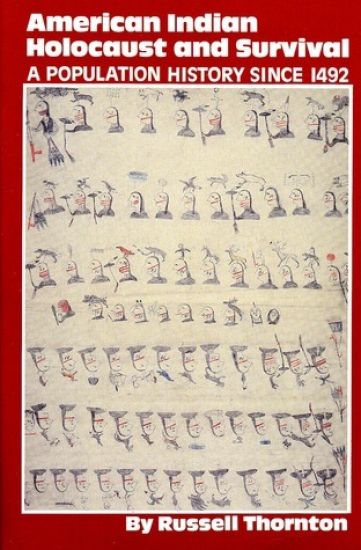
American Indian Holocaust and Survival

American Indian Holocaust and Survival

Russell Thornton

University of Oklahoma Press
1990
nidottu
This demographic overview of North American Indian history describes in detail the holocaust that, even today, white Americans tend to dismiss as an unfortunate concomitant of Manifest Destiny. They wish to forget that, as Euro-Americans invaded North America and prospered in the ""New World,"" the numbers of native peoples declined sharply; entire tribes, often in the space of a few years, were ""wiped from the face of the earth."" The fires of the holocaust that consumed American Indians blazed in the fevers of newly encountered diseases, the flash of settlers' and soldiers' guns, the ravages of ""firewater,"" and the scorched-earth policies of the white invaders. Russell Thornton describes how the holocaust had as its causes disease, warfare and genocide, removal and relocation, and destruction of aboriginal ways of life. Until recently most scholars seemed reluctant to speculate about North American Indian populations in 1492. In this book Thornton discusses in detail how many Indians there were, where they had come from, and how modern scholarship in many disciplines may enable us to make more accurate estimates of aboriginal populations.
House Built of Rain

House Built of Rain

Russell Thornton

Harbour Publishing
2003
pokkari
Russell Thornton has the rare ability to be both keenly observant of the minute details of his environment and intensely introspective. His poetry is full of startling images that will stay with you long after turning the final page.In "House Built of Rain," Thornton takes his readers on a dizzying journey of human experience - from the yearning of a young child to the sorrow of an adult losing a loved one to Alzheimer's. He covers a lot of ground along the way, witnessing prostitutes "counting out their smiles, / and hiding in their pupils" or hiking to the mouth of the Capilano River where "the gulls know how the waters of this place can run two ways at once."Thornton writes about extremes: the moment of conception and the moment of death, tranquil forests and smoky urban bars, abuse and tenderness. Concerned but never pessimistic, fierce but compassionate, narrative but lyrical, "House Built of Rain" is a balanced collection of work that reveals Thornton's considerable talents as a wordsmith. Though his poems are often dark and edgy, he shows us beauty in a scream, ecstasy in violence and, in a dying breath, the universe.
The Broken Face

The Broken Face

Russell Thornton

Harbour Publishing
2019
pokkari
The poems in The Broken Face explore a sacramental, imaginative vision within contexts of crime, perception, memory and love. In this collection, Russell Thornton returns to the vital themes of intimacy and family, loss, fear and hope, bringing to each poem the essential quality of a myth or incantation. Reverent and revealing, within those familiar relationships he ushers in a connection with something transcendent: "A man has come floundering late in the night / to stand alone at the shore of a sleeping infant's face." The poems capture life at the periphery, whether describing homelessness or incarceration, or even the universal experiences of aging and mortality, love and fear of love, all of which bring the speaker into a detached yet energized state of watching and waiting: "the door that was my grandfather into our passing lives / will arrive at a house where each of us is his own door / that opens on our first selves, fundamental together." With intense lyricism, Thornton displays a mastery of craft so complete as to be nearly invisible. While stunningly beautiful, his imagery is also in such complete service to the deeper emotional resonance of each poem that it feels inevitable, making the collection deeply moving.
Answer to Blue

Answer to Blue

Russell Thornton

Harbour Publishing
2022
pokkari
A masterful new collection by award-winning poet Russell Thornton. In "Greek Fire," one of the poems in Russell Thornton's astonishing new collection, the central image is of fire burning through water: "water is a bridge / for a fire to come into the world." This image also illuminates the driving force that animates the poems in Answer to Blue. The stillness and quiet depth characteristic of Thornton's poetry are here shot through with an irresistible vitality, a flame of mythic resonance. The past, both ancient and recent, exerts a gravitational pull throughout the collection, with Greek myths, family histories and biblical passages unearthed and examined, forgotten and returned to, giving way in a cyclical rhythm to the transient presence of young children and the death of a parent. With a clarity that pierces through the mist of daily routine, Thornton gives attention to transitional states, pausing at the often rushed-through moments of change, and also examines the phenomenon of perception itself. This collection's response to D.H. Lawrence's question--"Oh what in you can answer to this blueness?"--is both an answer and a challenge, an achievement of beauty that contains the seed of something more enduring and sacred.
The White Light of Tomorrow

The White Light of Tomorrow

Russell Thornton

Harbour Publishing
2024
pokkari
A masterful new collection from award-winning poet Russell Thornton. With intense lyricism, Thornton records his imaginative movement between the element of water, waking to "the aloneness of water," and the phenomenon of light, comprehending "light" as "fate" and "love" as "memory of light." In the process, Thornton highlights how hard lives can manifest beauty and affirmation. A mother transcends degrading circumstances through laughter. A long-lost father's drafting set case is a "coffin," its tools a "skeleton;" his "ashes are buried" in the poet's "arm." Revelations of nature abound. Thornton's rainy locale lifts onto the mythical level, water "wrapping around" him, "holding" him "complete / as within womb water about to break." Herons' wings "span the countless characters" of a creek." A description of an ancient BC site is a rapt engagement with Indigenous petroglyphs. An exploration of a Song of Songs passage details "light ... one with turns of the yarn" of a shawl, "a touch within a touch." Classical myth informs a poem about a power outage; the speaker enters "the elsewhere of the night" to build a fire. Passionate and moving, this collection marks a fine advance in Thornton's expanding poetic output.