Kirjojen hintavertailu. Mukana 11 710 849 kirjaa ja 12 kauppaa.

Kirjahaku

Etsi kirjoja tekijän nimen, kirjan nimen tai ISBN:n perusteella.

26 kirjaa tekijältä Ry Deshpande

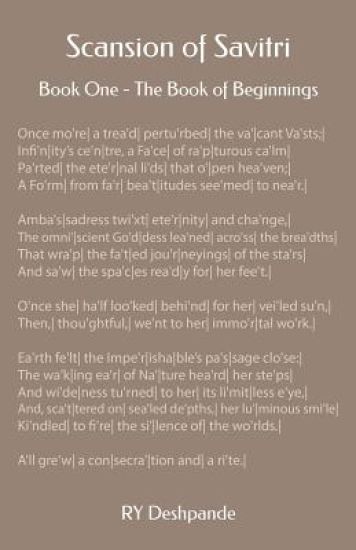
Scansion of Savitri: Book One - The Book of Beginnings
Sri Aurobindo considered Savitri as his "main work" and out of his precious time allotted two and a half hours every day for its composition. This was in the late 1940s when the tempo of the work had speeded up considerably. In fact he was otherwise engaged with it almost for fifty years though with some long gaps in between. Today we have a poem written in pentametric blank verse form running roughly into twenty-four thousand lines. Divided in twelve Books, as goes the tradition for a western epic, it has forty-eight Cantos and an Epilogue. Part I consisting of the first twenty-four Cantos was published in September 1950, ten-twelve weeks before the Poet's passing away; Part II and Part III as a single volume appeared in another six months of this, in May 1951. These two volumes are roughly equal in length: respectively, number of lines are 11674 and 12137; number of sentences, 2731 and 3040; Sections 1.1 - 92.15 and 93.1 - 159.6.Sri Aurobindo worked upon Savitri again and again until he was satisfied with the kind of poetic-literary perfection that has to be there, that yogically it could become the Word of Truth-Beauty-Joy in the expression of the Spirit's artistic realisations. We have an early letter in which he says, "I used Savitri as a means of ascension." It was experimentation, experimentation to see how far poetry could be written from a higher yogic- sthetic consciousness, how that could be made creatively dynamic. It is also a record of spiritual achievements. The birth of Savitri was in the tapas-shakti of its creator. Of course, "ascension" is to be understood as climbing of common speech to transcendental speedn.For an epic there may be a story or there may not be any, there may be events and physical happenings, or there may be just episodes strewn together. An epic can be intensely subjective and can encompass in its fold the destiny of men and nations and the world. It is always meant for ripe and equipped souls ready to step into days that have left the things of the night far behind. In one of the talks with his disciples Sri Aurobindo mentioned that for an epic one requires the power of architectural construction. That is what we have in Savitri, a Shrine of Perfection housing the God of Love. One remarkable thing about this Shrine is, not only do men of wisdom and thoughtfulness visit it to offer worship to the residing deity; high gods also long to go there, at this abode lit by innumerable suns. To appreciate it, to enter into its spirit what is needed on our part are a supple quick intuitive perception and wideness of consciousness. To enter into Savitri is also to live in the presence of its creator.Many are its splendours, countless indeed, like the stars in the sky of its poetry. We may use a most powerful telescope built on the top of a mountain or put a Hubble in outer space to look into the universe which is an unbounded finite. Galaxies after galaxies speed beyond our keenest comprehension, as if to reach some mysterious Beyond glimpsed at the far edge, but of which we have no knowledge. Suddenly, in that process, we become one with the sky. Astonishment disappears and what remains is a luminous perception ever progressing towards some unseizable unspeakable realisable Unknown. In an early letter written in 1932 when Savitri had hardly existed in the form it took later, Sri Aurobindo speaks of the nature of its poetry and particularly its rhythm-structure. The letter was written to Arjava, a name gaiven by him to his mathematician-philosopher, and a poet disciple from Cambridge, JA Chadwick. "Savitri is blank verse without enjambment (except rarely) - each line a thing by itself and arranged in paragraphs of one, two, three, four, five lines (rarely a longer series), in an attempt to catch something of the Upanishadic and Kalidasian movement, so far as that is a possibility in English. You can't take that as a model - it is too difficult a rhythm-structure to be a model."
The Secret Knowledge: Savitri Book One Canto Four: A wide-ranging Study
"On a height he stood that looked at greater heights,"-this is the opening line of Section One, Canto Four, The Secret Knowledge, Book One, The Book of Beginnings of Savitri. We shall take this Canto Section-by-Section (Eight Sections) and try to study it in some quick detail in the context of the Yoga-Tapasyā of Aswapati that led him to the discovery of the cosmic working, a necessary step in his integral pursuit of the possibility of a divine manifestation upon earth. He gets the secret knowledge and steps into the world of the vast Spirit, into the worlds of the vast Spirit, becoming aware of its freedom and knowing its greatnesses. These soon become measures of his core yogic realisations, enabling him to enter into the sunbelts of knowledge and moonbelts of delight, all in widenesses of the belts of truth and consciousness and joy. A voyager launching upon unchartered routes, fronting the hazards of the unexpected and the unknown, he adventures into the countless realms of the cosmic extension, discovering space after space, realm after realm, in the richness of each domain, and moving in the thousand movements of time that endlessly unfolds the rhythms of realisation, realisation after realisation. Such is the preparation which makes possible for Aswapati to grasp in his strong yogic will the essence of this creation, of this mortal world. It is with that kind of preparation he could look into the issues haunting it, of mortality, mortality which indeed must disclose the immortal spirit on which it is founded, its powers and functionings getting objectified in it.
Savitri in Ghana Recitation: Part One: Book One - Book Two - Book Three
Here is an attempt for cyclic or repetitive reading of Savitri adopting the traditional method of Vedic recitation of ancient Sanskrit scriptures. There are eleven modes, but the most complex and rich in volume of sound with a reverberating-absorbing insistence is what is called Ghana Pāth. If the elements in it are designated as A B C D E F..., then groups of three can be formed in the order ABC BCD CDE DEF, and so on. The recitation of these groups follows the sequence AB-BA-ABC-CBA-ABC=BC-CB-BCD ... Our proposal is to bring this chanting to the poetic compositions in English, a language in its kind or intrinsic nature, swabhāva, altogether different from Sanskrit, one being accent-based in contrast to the classical with the quantity of sound each syllable holds in it. We shall see to what degree of acceptability this can be applied to Sri Aurobindo's epic Savitri. As Savitri is essentially an end-stopped pentametic blank verse composition, the obvious choice in defining the elements falls on taking its lines as these ABCs. It is on this basis we propose to do Ghana Recitation of representative passages from the great epic that is already a rich orchestra of heard and unheard notes, swaras, of softly loud and subtle sounds. New octaves of rendition can come into play in their surprising abundance and variation. It is expected that this cyclic or repetitive recitation will bring resonating and pervasive sounds to the accent-based medium for its measure of rhythmic movement. We could even have sound carrying the preciousness of substance.In the present work we have made rather a restricted selection of passages for this Ghana style of recitation. Although making such a selection is by itself a difficult task, in fact quite a perilous one, that however seems to be the only practical way of proceeding with the experiment. We have here, in Part One of Savitri, the first three Books, The Book of Beginnings, The Book of the Traveller of the Worlds, and The Book of the Divine Mother, with 24 Cantos in it, 11674 lines. Out of this huge number of lines our Ghana formulation is for 60 passages only, running merely into some 1500 lines or so, just 12% of the total. The selection certainly depends upon the partialities and penchants of the picker or chooser. Besides, he himself might have other ideas if he is to do it again in another frame of locus, in another mood. We should therefore treat this entire business only as a working draft, a draft that may need several revisions, revisions in several respects.Our consideration in Ghana recitation is to let the multi-tonal vibrations be built up, these entering our being, these bringing volumes of sound, repetitive sounds, they speaking to every part of us, within and without, every part, their force in its intensity, in its weight, in its gleaming lustrous massiveness working in us, working on us. It should be the sweep of a multi-stringed harp tuned to harmony of the multi-sounding vibrancy of the sweet and the melodious and the perfect and the powerful. It is the sound that starts building up the sense, the sound that starts building up the sense, the sound that starts building up the sense, and understanding, brings a finer sentience. It is the sound that starts building up the sense, and with that comes understanding. It is this we are looking into. This has to be the central sthesis of sense and sound coming together in the Ghana recitation.
Savitri in Ghana Recitation: Part Two: Book Four to Book Eight
Here is an attempt for cyclic or repetitive reading of Savitri adopting the traditional method of Vedic recitation of ancient Sanskrit scriptures. There are eleven modes, but the most complex and rich in volume of sound with a reverberating-absorbing insistence is what is called Ghana Pāth. If the elements in it are designated as A B C D E F..., then groups of three can be formed in the order ABC BCD CDE DEF, and so on. The recitation of these groups follows the sequence AB-BA-ABC-CBA-ABC=BC-CB-BCD ... Our proposal is to bring this chanting to the poetic compositions in English, a language in its kind or intrinsic nature, swabhāva, altogether different from Sanskrit, one being accent-based in contrast to the classical with the quantity of sound each syllable holds in it. We shall see to what degree of acceptability this can be applied to Sri Aurobindo's epic Savitri. As Savitri is essentially an end-stopped pentametic blank verse composition, the obvious choice in defining the elements falls on taking its lines as these ABCs. It is on this basis we propose to do Ghana Recitation of representative passages from the great epic that is already a rich orchestra of heard and unheard notes, swaras, of softly loud and subtle sounds. New octaves of rendition can come into play in their surprising abundance and variation. It is expected that this cyclic or repetitive recitation will bring resonating and pervasive sounds to the accent-based medium for its measure of rhythmic movement. We could even have sound carrying the preciousness of substance.In the present work we have made rather a restricted selection of passages for this Ghana style of recitation. Although making such a selection is by itself a difficult task, in fact quite a perilous one, that however seems to be the only practical way of proceeding with the experiment. We have here, in Part One of Savitri, the first three Books, The Book of Beginnings, The Book of the Traveller of the Worlds, and The Book of the Divine Mother, with 24 Cantos in it, 11674 lines. Out of this huge number of lines our Ghana formulation is for 60 passages only, running merely into some 1500 lines or so, just 12% of the total. The selection certainly depends upon the partialities and penchants of the picker or chooser. Besides, he himself might have other ideas if he is to do it again in another frame of locus, in another mood. We should therefore treat this entire business only as a working draft, a draft that may need several revisions, revisions in several respects.Our consideration in Ghana recitation is to let the multi-tonal vibrations be built up, these entering our being, these bringing volumes of sound, repetitive sounds, they speaking to every part of us, within and without, every part, their force in its intensity, in its weight, in its gleaming lustrous massiveness working in us, working on us. It should be the sweep of a multi-stringed harp tuned to harmony of the multi-sounding vibrancy of the sweet and the melodious and the perfect and the powerful. It is the sound that starts building up the sense, the sound that starts building up the sense, the sound that starts building up the sense, and understanding, brings a finer sentience. It is the sound that starts building up the sense, and with that comes understanding. It is this we are looking into. This has to be the central sthesis of sense and sound coming together in the Ghana recitation.
Sonnet-like Passages in Savitri

Sonnet-like Passages in Savitri

Ry Deshpande

Createspace Independent Publishing Platform
2012
nidottu
It may look somewhat absurd to scoop out sonnet structures from an epic narrative, but perhaps in the bright amplitude of the epic itself are present innumerable sub-realms that have their own compelling individualities. These are like different rooms and chambers and halls and verandahs in a royal palace, in the White House, in the Palace of Versailles, or more appropriately the world of South Indian Temples or the famous set of Ajanta Caves. By the very definition of an epic we can say that it has a rich abounding multidimensionality representing re-creatively the thousand moods and manners one witnesses in vibrancy of the life of man, its setting having the theme of men and nations or the world or the universe, or the foundational issue of the creation. There are essences of aesthetic delight or rasas, there are evocations and moods and bhavas, there are echoes and reflections, persuasive sounds and soft winning music, there is the dhwani which only an occult ear can hear, the sound of the roots of the words, unheard melodies, anahat nad, there are orchestral grandeurs and there are quiet concerts in well-tapestried chambers. It is these individualities that we are trying to see in that greatness, an act which need not reduce the greatness of the great. In an attempt to preserve the epic grandeur of one's life at times one thinks of one's qualities in pieces, pieces which shine out, diamond-like, in their distinctive facets. Our affiliation with sonnets could be of that nature. A sonnet is essentially a lyrical composition in fourteen lines, these lines grouped in different ways but together describing a single theme in the terseness of thought and feeling. Although it started as a sonet or sonetto, a "little song" or "little sound", it has in it the strong presence of idea-force and idea-vision as much as idea-sound. It is at times said that a sonnet deals with thoughts or emotions sharply standing against each other, but also leads to an evocative resolution. This is done differently in the three types that are prevalent in the traditional genre of sonnet literature. The Italian or Petrarcan or later Miltonic sonnet is divided into two sections, octave and sestet, signifying two aspects of the theme being presented. There is a change also occurring in the rhyming scheme, though the metre throughout is mostly iambic pentameter. The transition where the change takes place is called the volta or the turn. This volta brings about a very suggestive if not a powerful dramatic effect, an unexpected well-defined thematic or imagistic slant, spin, revelation, even wonder and amazement. To quote a critic: "The octave bears the burden; a doubt, a problem, a reflection, a query, an historical statement, a cry of indignation or desire, a Vision of the ideal. The sestet eases the load, resolves the problem or doubt, answers the query, solaces the yearning, realizes the vision." In the Spenserian sonnet the pattern is of four-line groups or stanzas, each developing a specific idea, culminating with a couplet which forms a kind of commentary. Again, the volta occurs exactly as in the Italian sonnet, at line nine. In the third category, the English or Shakespearian sonnet there is a great degree of simplicity and flexibility, a naturalness which goes with the English language. The ideas developed in the three quatrains flow smoothly from one into the other, the volta if it can be called so, or culmination taking place in the last two lines, in the couplet, though it can be after the first two quatrains. A prosodist of yester-years says that the Shakespearean form is the best suited to English, one which is "absolutely genuine and orthodox", though the great Miltonic is "susceptible of great beauty, but has no prerogative, still less any primogeniture".
An Atrocious Biography

An Atrocious Biography

Ry Deshpande

Createspace Independent Publishing Platform
2014
nidottu
The Lives of Sri Aurobindo authored by Peter Heehs and published by the Columbia University Press is utter falsification of the vision and work of Sri Aurobindo. It revels in lurid details. About spiritual experiences it voices half-truths. It calls Sri Aurobindo's main work Savitri a "fictional creation". There is the constant doublespeak in the biography. Everywhere the intention is to denigrate the Master-Yogi. Peter Heehs follows Freud's royal road to the unconscious. In this presentation he is actually toeing the line of the Chicago School of Wendy Doniger to downgrade Indian tradition and all that is noble and Indian. Its objective seems to be to offer to a certain brand of intellectuals sleazy soap-operas that can provide aberrant entertainment. Yet why should one like Mr Heehs? 'cause he can cause more drama than a "naked chick in the Vatican" or, for that matter, in the editorial room of Auroville Today.
Savitri's Swapna Yoga: A dream disclosed to her the cosmic past

Savitri's Swapna Yoga: A dream disclosed to her the cosmic past

Ry Deshpande

Createspace Independent Publishing Platform
2015
nidottu
Immediately Savitri enters into the Dream or Swapna Yoga, when to her is revealed the entire cosmic Past, Past since the beginning of things out of the extraordinary all-potent Void of the manifesting Spirit. She has re-lived the psychic memory of the evolutionary unfoldment in the long process of time. She sees how the Past has arrived at the Present and also begins to perceive the Future's prospects. In this stream of consciousness she recognises that Man is not the culmination of these epochal happenings, and that a greater superior being, a being first governed by the Mind of Light, Surhomme, Overman, must emerge and take the lead of the evolutionary march. A portion of the divine Savitri enters into her and puts adiamond seal of this materialisation on a bright course of the coming events. A high note is already struck in the gains of her Yoga.
Colloqui a Santa Maria in Acone

Colloqui a Santa Maria in Acone

Ry Deshpande

Createspace Independent Publishing Platform
2016
nidottu
In occasione della sua visita in Italia, RY Deshpande ha tenuto seminari e conferenze su Sri Aurobindo e il Suo poema epico Savitri - un capolavoro letterario, la suprema rivelazione della Sua visione, una documentazione della Sua ricerca yogica e spirituale, delle Sue conquiste e realizzazioni. Questo libro tratto dalle giornate trascorse a Santa Maria in Acone, luogo situato ad est di Firenze, dove Deshpande stato invitato dal Prof. Guidalberto Bormolini - monaco della comunit "I ricostruttori nella preghiera" e antropologo - a introdurre Sri Aurobindo, M re e la Loro missione. L'incontro si svolto in due giorni, ciascuno dei quali articolato in tre sessioni. Sabato 16 maggio 2015 Nella prima sessione l'autore introduce Sri Aurobindo e M re: la Loro vita e il lavoro yogico che hanno compiuto insieme. Successivamente illustra i cinque aspetti essenziali che costituiscono l'individuo e sottolinea l'importanza di scoprire la nostra anima; ognuno di noi deve, quindi, imparare ad aprirsi per ricevere l'aiuto, la Forza divina necessaria. Questo avviene per mezzo di tre movimenti psicologici: l'aspirazione, il rifiuto e il surrender (dono di s ), come spiega dettagliatamente Sri Aurobindo nei Suoi scritti. Vengono esposti, inoltre, i seguenti argomenti: la crescita dell'anima, il significato di progresso e il ruolo positivo della morte - sia nel cammino dell'individuo verso lo Spirito che nell'espressione delle possibilit spirituali in lui. Durante la seconda sessione Deshpande approfondisce il concetto di anima (chiamata da Sri Aurobindo 'Essere Psichico') e descrive la disciplina da seguire, lo sforzo personale richiesto se vogliamo scoprire il nostro vero essere. Ma c' un problema di base, presente a livello universale: la nostra non-consapevolezza del Divino; durante le varie epoche sono esistiti Esseri eccezionali che ci hanno aiutato ad avvicinare Colui che la Religione chiama Dio. In particolare viene citato il Cristo attraverso alcuni passi di Savitri dove Sri Aurobindo descrive l'arduo e immane compito del Redentore, il Suo messaggio, la Sua crocifissione - Cristo, Emanazione Divina, un aspetto dell'Amore. Nella terza sessione viene sviluppato il tema della morte, in particolare della nostra paura di essa. Ci possiamo avvalere di cinque metodi per poterla affrontare: il metodo razionale, quello della ricerca interiore, la fede mistica in Dio, il metodo del guerriero - dove la morte come un'abitudine da combattere - e il metodo occulto - che, forse, solo per Esseri eccezionali. Successivamente vengono descritti i vari determinismi e le forze che operano in noi, che hanno un ruolo fondamentale in relazione al momento della nostra morte. La sessione termina con la delucidazione della missione di Savitri. Domenica 17 maggio 2015 Durante la prima sessione viene illustrata brevemente la descrizione di Sri Aurobindo della Creazione - del processo della Creazione - di come questa emerga dalla Madre Divina: la prima emanazione stata Satcitananda, la Manifestazione Trascendentale, alla quale seguita la Manifestazione Cosmica - con le 'quattro grandi Personalit del Potere Divino' che operano nell'Universo - e, infine, la Manifestazione individuale. Dentro di noi esistono latenti questi Poteri, queste qualit divine, ma le nostre qualit individuali non sono ancora arrivate alla piena espressione. Tra i quattro Poteri che operano nell'Universo, le nostre quattro qualit e i quattro principali sentieri dello Yoga esiste una corrispondenza ed molto importante che questi quattro Poteri lavorino armoniosamente insieme sia a livello cosmico che in noi. Vi sono anche altri Poteri e Personalit della Madre Divina, ma fino a questo momento non si sono ancora manifestati. Sri Aurobindo ci dice che adesso il Potere Superiore dell'Amore Divino ci che deve divenire attivo in questa Creazione: la Madre Divina Colei che render possibile la vita divina sulla Terra - l'
Al Ritiro a Motrano Il Libro Della Madre Divina

Al Ritiro a Motrano Il Libro Della Madre Divina

Ry Deshpande

Createspace Independent Publishing Platform
2016
nidottu
Questo libro raccoglie il lavoro di due giorni sul poema epico di Sri Aurobindo, Savitri, che si svolto in Toscana a Motrano, nei pressi di Colle Val D'Elsa, nel Ritiro che il professor Deshpande, in visita in Italia dallo Sri Aurobindo Ashram di Pondicherry-India, ha tenuto nella primavera 2015 con un gruppo spirituale che segue l'insegnamento dello Yoga Integrale. Savitri si pu considerare uno dei testi pi importanti di Sri Aurobindo(Calcutta 1872-Pondicherry 1950), grande yogi, poeta e filosofo indiano, che concep fin dai tempi della giovinezza e in varie versioni, cui lavor rielaborandolo durante tutto il corso della sua vita e che complet alla fine della sua esistenza terrena. Da lui definito"una leggenda e un simbolo", tratto da una storia presente nel grande poema epico indiano Mahabharata, in cui secondo le parole di Sri Aurobindo stesso, "l'amore di una donna, sola nel suo terribile silenzio e forza, che si oppone alla Morte, il dio]che separa le anime "riesce a strapparLe l'anima del marito Satyavan. Simbolicamente la vittoria sulla Morte che attende l'umanit nel futuro destino spirituale. Savitri raccoglie e descrive poeticamente il lavoro ed esperienze dello Yoga Integrale di Sri Aurobindo e della Madre, volte a questa trasformazione. Il commento e le spiegazioni del Professore hanno riguardato principalmente il Libro Terzo di Savitri, Il Libro della Madre Divina, con qualche accenno ad altre parti del poema. In questo Libro il padre di Savitri, Aswapati, nella sua ascesa yogica volta alla purificazione e trasformazione necessarie per ricevere in dono dall'alto la figlia tanto auspicata, al cospetto della Madre Divina, da cui otterr la grazia dell'incarnazione umana di Savitri, Sua emanazione, che riuscir a cambiare il destino della Terra. In quel momento il Re si offre e si consacra a Lei, "un vasto abbandono era l'unica sua forza." Si tratta di un Libro particolarmente importante nel contesto dell'intero poema, in cui si intravede, nel terzo canto intitolato La Dimora dello Spirito e La Nuova Creazione, quello che sar il meraviglioso futuro destino umano, quando il "Sovracosciente diverr cosciente sulla terra". Il lavoro, molto intenso e profondo, si svolto in sessioni di lettura accompagnate dalle relative spiegazioni da parte del Professor Desphande, alternato a momenti di meditazione.