Kirjojen hintavertailu. Mukana 11 244 527 kirjaa ja 12 kauppaa.

Kirjahaku

Etsi kirjoja tekijän nimen, kirjan nimen tai ISBN:n perusteella.

4 kirjaa tekijältä Samuel C. Rickless

Berkeley's Argument for Idealism

Berkeley's Argument for Idealism

Samuel C. Rickless

Oxford University Press
2016
nidottu
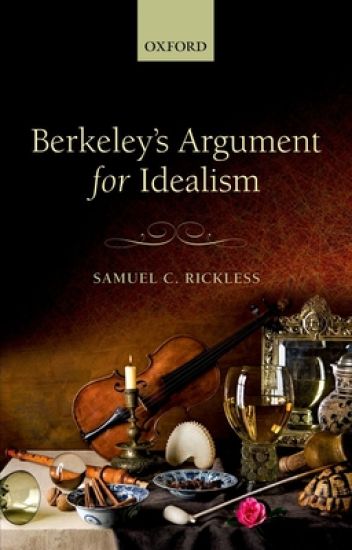
Samuel C. Rickless presents a novel interpretation of the thought of George Berkeley. In A Treatise Concerning the Principles of Human Knowledge (1710) and Three Dialogues Between Hylas and Philonous (1713), Berkeley argues for the astonishing view that physical objects (such as tables and chairs) are nothing but collections of ideas (idealism); that there is no such thing as material substance (immaterialism); that abstract ideas are impossible (anti-abstractionism); and that an idea can be like nothing but an idea (the likeness principle). It is a matter of great controversy what Berkeley's argument for idealism is and whether it succeeds. Most scholars believe that the argument is based on immaterialism, anti-abstractionism, or the likeness principle. In Berkeley's Argument for Idealism, Rickless argues that Berkeley distinguishes between two kinds of abstraction, 'singling' abstraction and 'generalizing' abstraction; that his argument for idealism depends on the impossibility of singling abstraction but not on the impossibility of generalizing abstraction; and that the argument depends neither on immaterialism nor the likeness principle. According to Rickless, the heart of the argument for idealism rests on the distinction between mediate and immediate perception, and in particular on the thesis that everything that is perceived by means of the senses is immediately perceived. After analyzing the argument, Rickless concludes that it is valid and may well be sound. This is Berkeley's most enduring philosophical legacy.
Berkeley's Argument for Idealism

Berkeley's Argument for Idealism

Samuel C. Rickless

Oxford University Press
2013
sidottu
Samuel C. Rickless presents a novel interpretation of the thought of George Berkeley. In A Treatise Concerning the Principles of Human Knowledge (1710) and Three Dialogues Between Hylas and Philonous (1713), Berkeley argues for the astonishing view that physical objects (such as tables and chairs) are nothing but collections of ideas (idealism); that there is no such thing as material substance (immaterialism); that abstract ideas are impossible (anti-abstractionism); and that an idea can be like nothing but an idea (the likeness principle). It is a matter of great controversy what Berkeley's argument for idealism is and whether it succeeds. Most scholars believe that the argument is based on immaterialism, anti-abstractionism, or the likeness principle. In Berkeley's Argument for Idealism, Rickless argues that Berkeley distinguishes between two kinds of abstraction, 'singling' abstraction and 'generalizing' abstraction; that his argument for idealism depends on the impossibility of singling abstraction but not on the impossibility of generalizing abstraction; and that the argument depends neither on immaterialism nor the likeness principle. According to Rickless, the heart of the argument for idealism rests on the distinction between mediate and immediate perception, and in particular on the thesis that everything that is perceived by means of the senses is immediately perceived. After analyzing the argument, Rickless concludes that it is valid and may well be sound. This is Berkeley's most enduring philosophical legacy.
Plato's Forms in Transition

Plato's Forms in Transition

Samuel C. Rickless

Cambridge University Press
2009
pokkari
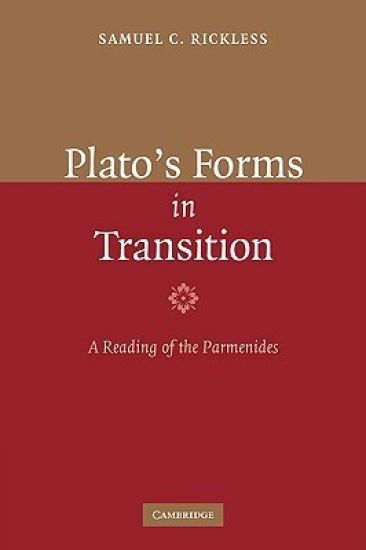
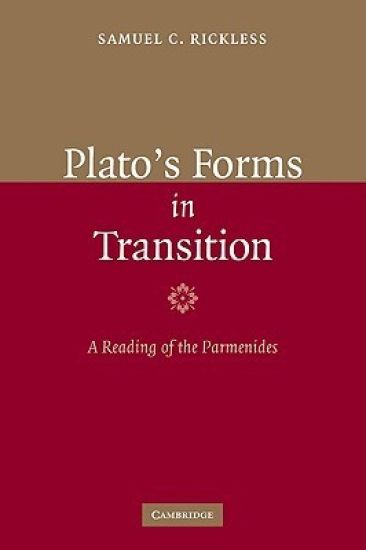
There is a mystery at the heart of Plato's Parmenides. In the first part, Parmenides criticizes what is widely regarded as Plato's mature theory of Forms, and in the second, he promises to explain how the Forms can be saved from these criticisms. Ever since the dialogue was written, scholars have struggled to determine how the two parts of the work fit together. Did Plato mean us to abandon, keep or modify the theory of Forms, on the strength of Parmenides' criticisms? Samuel Rickless offers something that has never been done before: a careful reconstruction of every argument in the dialogue. He concludes that Plato's main aim was to argue that the theory of Forms should be modified by allowing that forms can have contrary properties. To grasp this is to solve the mystery of the Parmenides and understand its crucial role in Plato's philosophical development.
Plato's Forms in Transition

Plato's Forms in Transition

Samuel C. Rickless

Cambridge University Press
2006
sidottu
There is a mystery at the heart of Plato's Parmenides. In the first part, Parmenides criticizes what is widely regarded as Plato's mature theory of Forms, and in the second, he promises to explain how the Forms can be saved from these criticisms. Ever since the dialogue was written, scholars have struggled to determine how the two parts of the work fit together. Did Plato mean us to abandon, keep or modify the theory of Forms, on the strength of Parmenides' criticisms? Samuel Rickless offers something that has never been done before: a careful reconstruction of every argument in the dialogue. He concludes that Plato's main aim was to argue that the theory of Forms should be modified by allowing that forms can have contrary properties. To grasp this is to solve the mystery of the Parmenides and understand its crucial role in Plato's philosophical development.