This volume in the popular Interpretation series presents the book of Leviticus. It focuses on the history of Israel during this time when Israel's life was marked by the various ritual sacrifices and observances commanded by God for the ordering of the nation's life.Interpretation: A Bible Commentary for Teaching and Preaching is a distinctive resource for those who interpret the Bible in the church. Planned and written specifically for teaching and preaching needs, this critically acclaimed biblical commentary is a major contribution to scholarship and ministry.
Balentine invites the reader to consider several aspects of prayer in the Hebrew Bible: prayer and the depiction of character, prayer and the characterization of God, prayers for divine justice, the lament tradition, sensible praise, prayer in Old Testament theology, and the motif of the church as a house of prayer.
This volume in the popular Interpretation series presents the book of Leviticus. It focuses on the history of Israel during this time when Israel's life was marked by the various ritual sacrifices and observances commanded by God for the ordering of the nation's life.Interpretation: A Bible Commentary for Teaching and Preaching is a distinctive resource for those who interpret the Bible in the church. Planned and written specifically for teaching and preaching needs, this critically acclaimed biblical commentary is a major contribution to scholarship and ministry.
If the fear of the Lord is the beginning of wisdom formed in the life of faith, its end is nothing less than the shaping of a moral self and community attuned to the character of God. This pursuit of wisdom is an ongoing journey, never a simple arrival. For the wisdom writings of the Old Testament, the pursuit of wisdom calls for the ongoing attainment of instruction, insight, shrewdness, knowledge, prudence, learning, and skill. And persons who attain wisdom think more deeply, are more discerning, and have a keener insight into the complexities and nuances of decision making. For a world-perspective that assumes the power and reality of divinity, being wise means living ethically - and to live ethically, one must be in a constant intellectual pursuit of meaning. The book details the structure, themes, and contribution to both ancient and modern society of Job, Proverbs, and Ecclesiastes. The chapters on Sirach and the Wisdom of Solomon will discuss the consonance and dissonance with "canonical wisdom," giving special attention to the development of their core ideas. The book will conclude with a chapter on Wisdom's abiding legacy.
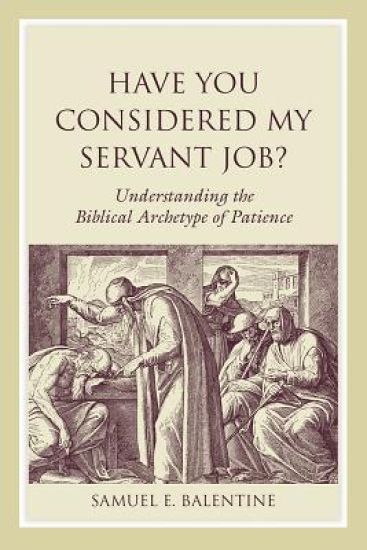
The question that launches Job’s story is posed by God at the outset of the story: “Have you considered my servant Job?” (1:8; 2:3). By any estimation the answer to this question must be yes. The forty-two chapters that form the biblical story have in fact opened the story to an ongoing practice of reading and rereading, evaluating and reevaluating. Early Greek and Jewish translators emphasized some aspects of the story and omitted others; the Church Fathers interpreted Job as a forerunner of Christ, while medieval Jewish commentators debated conservative and liberal interpretations of God’s providential love. Artists, beginning at least in the Greco-Roman period, painted and sculpted their own interpretations of Job. Novelists, playwrights, poets, and musicians - religious and irreligious, from virtually all points of the globe - have added their own distinctive readings.In Have You Considered My Servant Job?, Samuel E. Balentine examines this rich and varied history of interpretation by focusing on the principal characters in the story - Job, God, the satan figure, Job’s wife, and Job’s friends. Each chapter begins with a concise analysis of the biblical description of these characters, then explores how subsequent readers have expanded or reduced the story, shifted its major emphases or retained them, read the story as history or as fiction, and applied the morals of the story to the present or dismissed them as irrelevant.Each new generation of readers is shaped by different historical, cultural, and political contexts, which in turn require new interpretations of an old yet continually mesmerizing story. Voltaire read Job one way in the eighteenth century, Herman Melville a different way in the nineteenth century. Goethe’s reading of the satan figure in Faust is not the same as Chaucer’s in The Canterbury Tales, and neither is fully consonant with the Testament of Job or the Qur’an. One need only compare the descriptions of God in the biblical account with the imaginative renderings by Herman Melville, Walt Whitman, and Franz Kafka to see that the effort to understand why God afflicts Job “for no reason” (2:3) continues to be both compelling and endlessly complicated.
The discourse of prayer responds to the abiding lure of transcendence. From Gilgamesh to the primordial human beings in Eden to Odysseus, the quest for ultimate truths has summoned forth all manner of human effort - courageous, desperate, pious, impious, successful, failed, invited, forbidden - and like all such lures, one can never be certain whether the glimmer of transcendence is that of a bright and shining star that illuminates the shadows or only a shiny object that seduces one into an inescapable darkness (a fishing lure, for example). In this study, Samuel E. Balentine demonstrates how prayer's invocation of God transgresses the limits of human beings. The author shows how inviting, let alone commanding God to speak may be the "acme of bardic pretention," but in the ancient world such transgression characterizes the audacity of prayer.
This collection of eighteen essays addresses critical theological and ethical issues in the book of Job: (1) Prologue: From Eden to Uz; (2) Job and His Friends: "What Provokes You that You Keep on Talking?"; (3) Job and the Priests: "Look At Me and Be Appalled;" (4) Traumatizing Job: "God Has Worn Me Out;" (5) Out of the Whirlwind: "Can You Thunder with A Voice Like God's?"; (6) Preaching Job and Job's God: "Listen Carefully to My Words;" (7) Epilogue: "All's Well That Ends Well" ... or Is it? The lead essay raises the question that lingers over the entire book: What are we to think of a God who is complicit in the death of seven sons and three daughters "for no reason"?