Kirjojen hintavertailu. Mukana 11 627 067 kirjaa ja 12 kauppaa.

Kirjahaku

Etsi kirjoja tekijän nimen, kirjan nimen tai ISBN:n perusteella.

23 kirjaa tekijältä Samuel Hollander

The Sources of Increased Efficiency

The Sources of Increased Efficiency

Samuel Hollander

MIT Press
2003
pokkari
An extraordinary opportunity offered by the Du Pont Company gave Professor Hollander free access both to all detailed cost and much investment data related to rayon manufacture at a number of plants, covering a period of thirty years and to a wide range of informed personnel and officers. These data enabled Professor Hollander to make an unprecedented study of a large industrial firm for the purpose of measuring the contribution of various sources of improvement to increased efficiency. From the mass of information available, he has selected sound technical details and concepts, excluded all irrelevant material, and presented a carefully organized case study showing how technical change accounts for a very high proportion of the increases in productivity. Specifically, this information includes descriptions of the contributions of various types of technical change to production cost reductions, quantitative estimates of the contributions of technical change and economies of scale to increased efficiency, and analyses of the relation between technical change and investment and of the sources of new technology.The microeconomic approach is related to certain macrostudies of productivity increase, and several policy implications are drawn.This study should be of great interest to a wide audience including economists, economic historians, and technologists. All those concerned with the problems of economic growth, industrial structure, patent protection, technical invention, research and development, and the general progress of civilian industrial technology will find this book a valuable addition to their libraries.
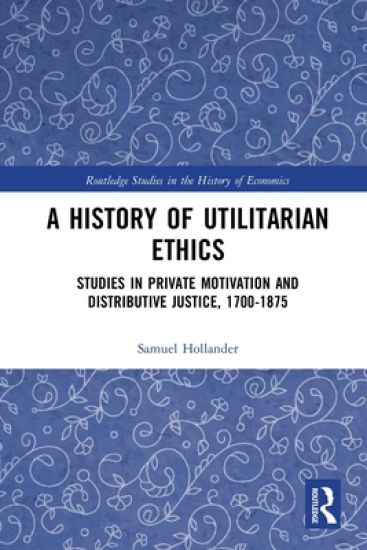
A History of Utilitarian Ethics

A History of Utilitarian Ethics

Samuel Hollander

Routledge
2019
sidottu
In this landmark volume, Samuel Hollander presents a fresh and compelling history of moral philosophy from Locke to John Stuart Mill, showing that a ‘moral sense’ can actually be considered compatible with utilitarianism. The book also explores the link between utilitarianism and distributive justice. Hollander engages in close textual exegesis of the works relating to individual authors, while never losing sight of the intellectual relationships between them. Tying together the greatest of the British moral philosophers, this volume reveals an unexpected unity of eighteenth and nineteenth century ethical doctrine at both the individual and social level. Essential reading for advanced students and researchers of the history of economic thought, political economy, history of ethics, history of political thought and intellectual history.
A History of Utilitarian Ethics

A History of Utilitarian Ethics

Samuel Hollander

Routledge
2021
nidottu
In this landmark volume, Samuel Hollander presents a fresh and compelling history of moral philosophy from Locke to John Stuart Mill, showing that a ‘moral sense’ can actually be considered compatible with utilitarianism. The book also explores the link between utilitarianism and distributive justice. Hollander engages in close textual exegesis of the works relating to individual authors, while never losing sight of the intellectual relationships between them. Tying together the greatest of the British moral philosophers, this volume reveals an unexpected unity of eighteenth and nineteenth century ethical doctrine at both the individual and social level. Essential reading for advanced students and researchers of the history of economic thought, political economy, history of ethics, history of political thought and intellectual history.
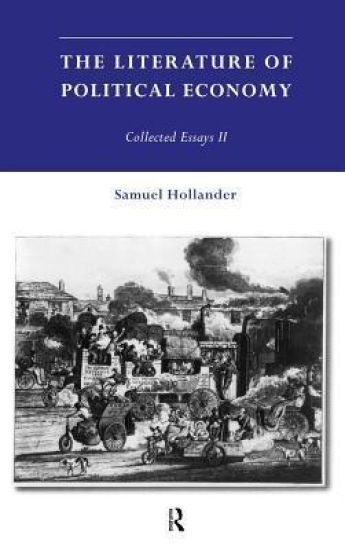
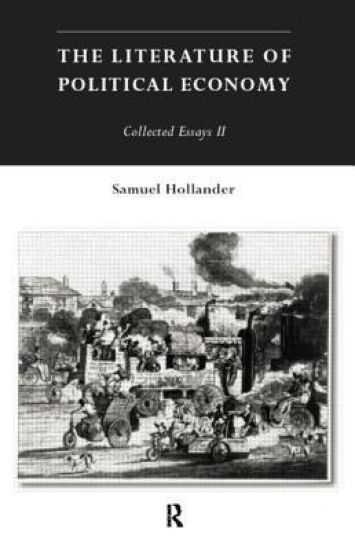
The Literature of Political Economy

The Literature of Political Economy

Samuel Hollander

Routledge
1997
sidottu
Samuel Hollander is widely recognized as one of the most important and controversial historians of economic thought. This second volume collects together essays extending beyond classical economics, the subject with which he is most associated. This collection includes: * studies in Scholastic, Smithian and Marshallian literature * papers on the Corn-Law pamphlet literature of 1815, the post-Ricardian dissension, and the marginal revolution * essays on T.R. Malthus, including four bibliographical studies The volume also includes an autobiographical section and reviews of a broad range of important books published in the last thirty years.
Ricardo - The New View

Ricardo - The New View

Samuel Hollander

Routledge
1996
sidottu
Samuel Hollander's interpretation of Ricardo has attracted apoplectic responses from both Right and Left. This volume collects together the material needed to evaluate these responses. His basic position - that Ricardo stands in a continuous analytical line leading from Adam Smith to Alfred Marshall - is seen to antagonise both those who argue for a 'marginal revolution' and a sharp divide between classical and neo-classical economics, and those who want to champion Ricardo as a forerunner of Sraffa.
Jean-Baptiste Say and the Classical Canon in Economics
This book explores the perceived paradigmatic conflict within British classical economics between the so called 'Ricardo School' and the contemporary French Economics of Jean-Baptiste Say. Samuel Hollander provides the reader with extensive evidence, utilizing all editions of Say's main texts and his lesser-known writings in order to demonstrate his adherence to much of Ricardian theory. This intriguing book focuses on selected doctorinal issues and surrounding debates, and will interest all serious historians of economic thought, finding a place on the bookshelves of many economists across the world.
Essays on Classical and Marxian Political Economy
Samuel Hollander’s work has been provoking debate for over four decades. This book brings together key contributions of recent years, in addition to some brand new pieces. The essays are introduced by a Preface in which Hollander reflects on his past work and reactions to it.Highlights include two issues of particular current relevance. Conspicuous is an extensive chapter regarding Adam Smith’s often neglected arguments for government intervention in the economy to correct market failures, and his critical view of the business class as an anti-social force. Important economists considered in relation to Adam Smith’s position on the role of the state include Jeremy Bentham and the Scottish-Canadian John Rae. Similarly of high present-day interest is a re-examination of Karl Marx’s theory of exploitation, or the notion of profits as "embezzlement," demonstrating Marx’s effective abandonment of this perspective in the case of the small active businessman as distinct from the major joint-stock corporation.Other papers demonstrate the close intellectual relationship between David Ricardo and Thomas Robert Malthus; the extensive common ground between the British school and the French under the leadership of Jean-Baptiste Say; the failure of a so-called anti-Ricardian opposition in Britain represented by Samuel Bailey; and the denial of a sharp discontinuity between "classical" and later "neo-classical" economics.Finally, several biographical essays are included as well as an extension of the autobiographical account appearing in Collected Essays II.
Jean-Baptiste Say and the Classical Canon in Economics
This book explores the perceived paradigmatic conflict within British classical economics between the so called 'Ricardo School' and the contemporary French Economics of Jean-Baptiste Say. Samuel Hollander provides the reader with extensive evidence, utilizing all editions of Say's main texts and his lesser-known writings in order to demonstrate his adherence to much of Ricardian theory. This intriguing book focuses on selected doctorinal issues and surrounding debates, and will interest all serious historians of economic thought, finding a place on the bookshelves of many economists across the world.
The Literature of Political Economy

The Literature of Political Economy

Samuel Hollander

Routledge
2015
nidottu
Samuel Hollander is widely recognized as one of the most important and controversial historians of economic thought. This second volume collects together essays extending beyond classical economics, the subject with which he is most associated. This collection includes: * studies in Scholastic, Smithian and Marshallian literature * papers on the Corn-Law pamphlet literature of 1815, the post-Ricardian dissension, and the marginal revolution * essays on T.R. Malthus, including four bibliographical studies The volume also includes an autobiographical section and reviews of a broad range of important books published in the last thirty years.
Ricardo - The New View

Ricardo - The New View

Samuel Hollander

Routledge
2014
nidottu
Samuel Hollander's interpretation of Ricardo has attracted apoplectic responses from both Right and Left. This volume collects together the material needed to evaluate these responses. His basic position - that Ricardo stands in a continuous analytical line leading from Adam Smith to Alfred Marshall - is seen to antagonise both those who argue for a 'marginal revolution' and a sharp divide between classical and neo-classical economics, and those who want to champion Ricardo as a forerunner of Sraffa.
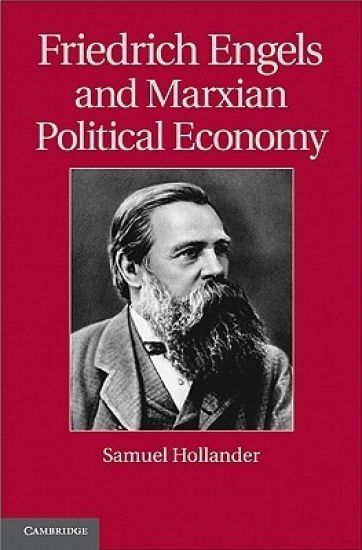
Friedrich Engels and Marxian Political Economy

Friedrich Engels and Marxian Political Economy

Samuel Hollander

Cambridge University Press
2011
sidottu
This book rejects the commonly encountered perception of Friedrich Engels as perpetuator of a 'tragic deception' of Marx, and the equally persistent body of opinion treating him as 'his master's voice'. Engels' claim to recognition is reinforced by an exceptional contribution in the 1840s to the very foundations of the Marxian enterprise, a contribution entailing not only the 'vision' but some of the building blocks in the working out of that vision. Subsequently, he proved himself to be a sophisticated interpreter of the doctrine of historical materialism and an important contributor in his own right. This volume serves as a companion to Samuel Hollander's The Economics of Karl Marx (Cambridge University Press, 2008).
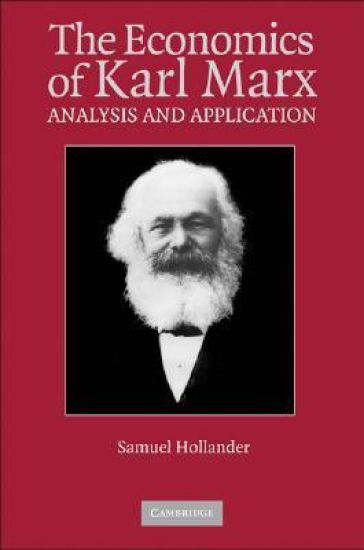
The Economics of Karl Marx

The Economics of Karl Marx

Samuel Hollander

Cambridge University Press
2008
sidottu
Presents an account and technical assessment of Marx's economic analysis in Capital, with particular reference to the transformation and the surplus-value doctrine, the reproduction schemes, the falling real-wage and profit rates, and the trade cycle. The focus is on criticisms that Marx himself might have been expected to face in his day and age. In addition, it offers a chronological study of the evolution of that analysis from the early 1840s through three 'drafts': documents of the late 1840s, the Grundrisse of 1857–1858, and the Economic Manuscripts of 1861–1863. It also provides three studies in application, focusing on Marx's 'evolutionary' orientation in his evaluation of the transition to communism and his rejection of 'egalitarianism' under both capitalist and communist regimes; his evolving perspective on the role of the industrial 'entrepreneur'; and his evolving appreciation of the prospects for welfare reform within capitalism.
The Economics of Karl Marx

The Economics of Karl Marx

Samuel Hollander

Cambridge University Press
2008
pokkari
Presents an account and technical assessment of Marx's economic analysis in Capital, with particular reference to the transformation and the surplus-value doctrine, the reproduction schemes, the falling real-wage and profit rates, and the trade cycle. The focus is on criticisms that Marx himself might have been expected to face in his day and age. In addition, it offers a chronological study of the evolution of that analysis from the early 1840s through three 'drafts': documents of the late 1840s, the Grundrisse of 1857–1858, and the Economic Manuscripts of 1861–1863. It also provides three studies in application, focusing on Marx's 'evolutionary' orientation in his evaluation of the transition to communism and his rejection of 'egalitarianism' under both capitalist and communist regimes; his evolving perspective on the role of the industrial 'entrepreneur'; and his evolving appreciation of the prospects for welfare reform within capitalism.
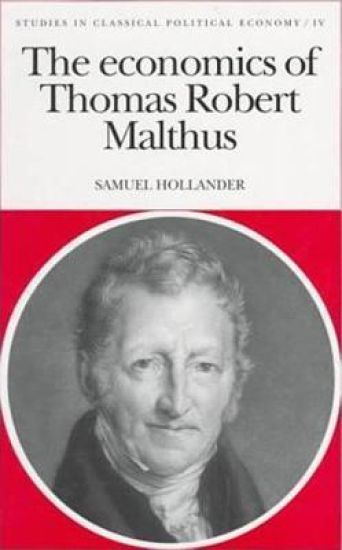
The Economics of Thomas Robert Malthus

The Economics of Thomas Robert Malthus

Samuel Hollander

University of Toronto Press
1997
sidottu
Samuel Hollander provides the first in-depth study of Malthus's achievement as an economist. Malthus's message has been largely misrepresented by decades of careless and biased interpretation. In this volume, Samuel Hollander re-examines these interpretations and presents a full and coherent picture of Malthus's economics. He evaluates John Maynard Keynes's famous dichotomy between the Ricardian and Malthusian methods, proving that the two were far closer to each other than is generally supposed. The relation of Malthus's ideas to those of his predecessors is thoroughly examined, for example, his roots in the Wealth of Nations are demonstrated and the physiocratic and Sraffian dimensions of his work are brought to light. Hollander extends his analysis to biographical factors; he discounts the textbook perspective on Malthus as a social-welfare pessimist and dispels the common notion of Malthus as spokesman of the land-owning classes. The standard charges against Malthus of inconsistency and intellectual dishonesty are also challenged. Samuel Hollander has produced the definitive study of Thomas Robert Malthus. A major contribution to the history of economic theory, the study has much broader appeal as a portrait of a central figure in early nineteenth-century debates over social policy -particularly those having to do with the role of government in relation to social welfare, economic growth, and trade protection.
Economics of J S Mill

Economics of J S Mill

Samuel Hollander

University of Toronto Press
1985
sidottu
J.S. Mill plays a central role in the development of classical political economy in the nineteenth century. Hollander follows the course of that development over fifty years of Mill's career, from the death of David Ricardo in 1823 to Mill's own death in 1873. As in Hollander's acclaimed works on Adam Smith and David Ricardo, this studey emphasizes economic methodology and social philosophy, examined in light of Mill's own preoccupations. He argues that Mill's methodological principle and practice are consistent from 1830 onwards, a position that disputes currently held opinion. He also demonstrates that Mill denied the predictive ability of economic science, and thereby dismisses as irrelevant the charges of some critics that Mill championed 'scientism.' Throughout his study, Hollander places Mill within appropriate intellectual contexts. He identifies Mill's debts to Ricardo and to James Mill, examines his reactions to the Cambridge inductivist critics of orthodoxy and to the later 'historical' school writers, and his attitude towards the beginnings of mathematical economics. The central chapters on theory focus on allocation (including international trade) and economic growth, and the connection between the two. Hollander analyses Mill's remarkable investigation of the process of price formation under competitive and non-competitive conditions and his qualifications to the law of markers and the quantity theory. Other chapters deal with the roles of governments and economic organization, monetary policy, and social philosophy. Hollander has produced a study that will stand for many years on the economic thought of John Stuart Mill.
The Economics of Adam Smith

The Economics of Adam Smith

Samuel Hollander

University of Toronto Press
1973
pokkari
The renewed interest in the works of the great classical economists reflects in part a recognition that there is still much to be learned from them about the operation of the economy. This volume is the first in a series of four in which Professor Hollander will provide an analytical and critical assessment of the thought of the British school of classical economists; later volumes will elucidate the thought of Ricardo and Malthus, Mill, and Marx. This study relates Smith's theoretical position to contemporary history and economic practice. It pays particular attention to Smith's vision of the process of industrialization during the mid-eighteenth century, his approach to British colonial policies, and his view of the desirability of economic development. Coming in time for the bicentennial celebrations of The Wealth of Nations, this work should interest all economists with a sense of the evolution and purpose of their discipline, and should commend itself as a detailed and careful reinterpretation of what Adam Smith was thinking about. One authoritative reader has called it: 'one of the most distinguished essays in the history of economic thought of the last quarter century.' (Studies in Classical Political Economy)
Classical Economics

Classical Economics

Samuel Hollander

University of Toronto Press
1992
pokkari
In this unconventionial and sharply written text, Hollander introduces the work of Smith, Ricardo, and Mill, and, on specific topics: Malthus and Marx. He leads the student through the nuances of the arguments, making clear how he agrees with or challenges recieved ideas about their writings. Attention is given to the precursors of the classics, to their immediate successors, and to the Sraffian system.
Immanuel Kant and Utilitarian Ethics

Immanuel Kant and Utilitarian Ethics

Samuel Hollander

TAYLOR FRANCIS LTD
2022
sidottu
Adopting a view of utilitarian ethics in which motivation in the public interest takes on greater weight than is generally appreciated, this book explores the extent to which the philosophy of Immanuel Kant is consistent with this nuanced version of utilitarianism.Kant’s requirement that full ethical merit needs an agent to act purely ‘from duty’ to forward ‘the universal end of happiness’ rather than from a personal inclination to achieve that end clearly distinguishes his position from the version of utilitarian ethics adopted here. But this book also demonstrates, by reference to his formal ethical works and his lectures on ethics and anthropology, Kant’s approval of a secondary category of conduct – conduct ‘in conformity with’ duty – entailing other-regarding or ‘sympathetic’ motivation to advance general happiness, differing from the utilitarian position only in its meriting a qualified degree of ethical credit. After comparing Kant with eighteenth-century utilitarian writers from Locke to Smith, and also with Bentham and Malthus, the book evaluates reactions to Kant by J.S. Mill and Karl Marx and proposes Michel de Montaigne (1533–1592) as a ‘precursor’ for maintaining a ‘Kantian’ doctrine of conduct ‘from duty’ and for other shared features. In terms of public policy, the work demonstrates Kant’s justification of poor relief and reduced inequality, his proposal for a state education plan and his opposition to paternalism.This book provides essential reading for academic specialists and students concerned with the interface of political economy and ethics, as well as the history of economic thought, history of political thought and intellectual history.
Immanuel Kant and Utilitarian Ethics

Immanuel Kant and Utilitarian Ethics

Samuel Hollander

TAYLOR FRANCIS LTD
2024
nidottu
Adopting a view of utilitarian ethics in which motivation in the public interest takes on greater weight than is generally appreciated, this book explores the extent to which the philosophy of Immanuel Kant is consistent with this nuanced version of utilitarianism.Kant’s requirement that full ethical merit needs an agent to act purely ‘from duty’ to forward ‘the universal end of happiness’ rather than from a personal inclination to achieve that end clearly distinguishes his position from the version of utilitarian ethics adopted here. But this book also demonstrates, by reference to his formal ethical works and his lectures on ethics and anthropology, Kant’s approval of a secondary category of conduct – conduct ‘in conformity with’ duty – entailing other-regarding or ‘sympathetic’ motivation to advance general happiness, differing from the utilitarian position only in its meriting a qualified degree of ethical credit. After comparing Kant with eighteenth-century utilitarian writers from Locke to Smith, and also with Bentham and Malthus, the book evaluates reactions to Kant by J.S. Mill and Karl Marx and proposes Michel de Montaigne (1533–1592) as a ‘precursor’ for maintaining a ‘Kantian’ doctrine of conduct ‘from duty’ and for other shared features. In terms of public policy, the work demonstrates Kant’s justification of poor relief and reduced inequality, his proposal for a state education plan and his opposition to paternalism.This book provides essential reading for academic specialists and students concerned with the interface of political economy and ethics, as well as the history of economic thought, history of political thought and intellectual history.
Hegel on Ethics, the State and Public Policy

Hegel on Ethics, the State and Public Policy

Samuel Hollander

TAYLOR FRANCIS LTD
2024
sidottu
Drawing on a wide range of Hegel’s writings, this book analyses the Hegelian position on ethical action. This position is systematically compared with that of Immanuel Kant, the comparison emphasizing Hegel’s insistence on a morality grounded in an ‘ethical’ context which essentially refers to the state rather than the agent’s private will. The argument proceeds to the relationship between the state and the various components of civil society, and to the interaction between the state and the individual, and feeds into the debate regarding Hegel’s status in relation to Utilitarian Ethics and liberalism. This book carries further the researches published in A History of Utilitarian Ethics and Immanuel Kant and Utilitarian Ethics and will be of interest to readers in the history of political economy, political science, philosophy and ethics.