Kirjojen hintavertailu. Mukana 11 244 527 kirjaa ja 12 kauppaa.

Kirjahaku

Etsi kirjoja tekijän nimen, kirjan nimen tai ISBN:n perusteella.

3 kirjaa tekijältä Samuel J. Watson

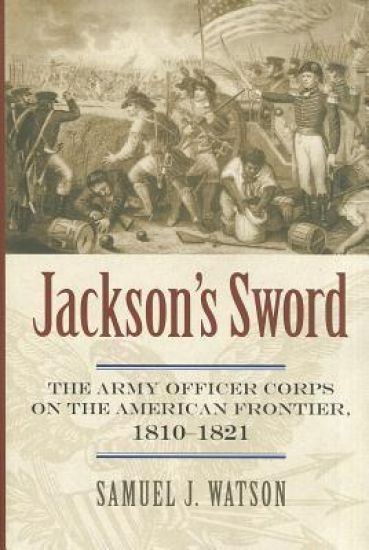
Jackson's Sword

Jackson's Sword

Samuel J. Watson

University Press of Kansas
2012
sidottu
Jackson’s Sword is the initial volume in a monumental study that provides a sweeping panoramic view of the U.S. Army and its officer corps from the War of 1812 to the War with Mexico, the first such study in more than forty years. Watson’s chronicle shows how the officer corps played a crucial role in stabilising the frontiers of a rapidly expanding nation, while gradually moving away from military adventurism toward a professionalism subordinate to civilian authority. Jackson’s Swordexplores problems of institutional instability, multiple loyalties, and insubordination as it demonstrates how the officer corps often undermined—and sometimes supplanted—civilian authority with regard to war-making and diplomacy on the frontier. Watson shows that army officers were often motivated by regionalism and sectionalism, as well as antagonism toward Indians, Spaniards, and Britons. The resulting belligerence incited them to invade Spanish Florida and Texas without authorisation and to pursue military solutions to complex intercultural and international dilemmas. Watson focuses on the years when Andrew Jackson led the Division of the South—often contrary to orders from his civilian superiors—examining his decade-long quasi-war with Spaniards and Indians along the northern border of Florida. Watson explores differences between army attitudes toward the Texas and Florida borders to explain why Spain ceded Florida but not Texas to the United States. He then examines the army’s shift to the western frontier of white settlement by focusing on expeditions to advance U.S. power up the Missouri River and drive British influence from the Louisiana Purchase. More than merely recounting campaigns and operations, Watson explores civil-military relations, officer socialisation, commissioning, resignations, and assignments, and sets these in the context of social, political, economic, technological, military, and cultural changes during the early republic and the Age of Jackson. He portrays officers as identifying with frontiersmen and southern farmers and lacking respect for civilian authority and constitutional processes—but having little sympathy for civilian adventurers—and delves deeply into primary sources that reveal what they thought, wrote, and did on the frontier. Jackson’s Sword captures an era on the eve of military professionalism to shed new light on the military’s role in the early republic.
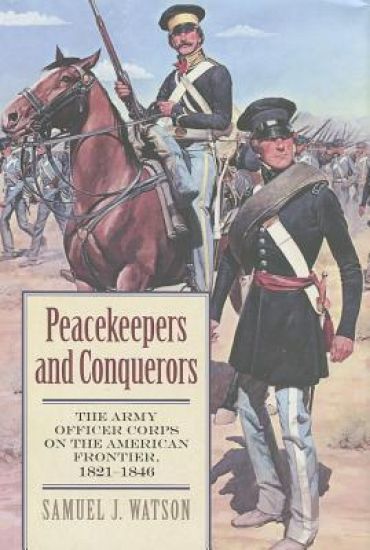
Peacekeepers and Conquerors

Peacekeepers and Conquerors

Samuel J. Watson

University Press of Kansas
2013
sidottu
In Jackson’s Sword, Samuel Watson showed how the U.S. Army officer corps played a crucial role in stabilising the frontiers of a rapidly expanding nation. In this sequel volume, he chronicles how the corps’ responsibilities and leadership along the young nation’s borders continued to grow. In the process, he shows, officers reflected an increasing commitment to professionalism, insulation from partisanship, and deference to civilian authority—all tempered in the forge of frustrating, politically complex operations and diplomacy along the nation’s frontiers.Watson now focuses on the quarter-century between the Army’s reduction in force in 1821 and the Mexican War. He examines a broad swath of military activity beginning with campaigns against southeastern Indians, notably the dispossession of the Creeks remaining in Georgia and Alabama from 1825 to 1834; the expropriation of the Cherokee between 1836 and 1838; and the Second Seminole War. He also explores peacekeeping on the Canadian border, which exploded in rebellion against British rule at the end of 1837, prompting British officials to applaud the U.S. Army for calming tensions and demonstrating its government’s support for the international state system. He then follows the gradual extension of U.S. sovereignty in the Southwest through military operations west of the Missouri River and along the Louisiana-Texas border from 1821 to 1838 and through dragoon expeditions onto the central and southern Plains between 1834 and 1845. Throughout his account, Watson shows how military professionalism did not develop independent of civilian society, nor was it simply a matter of growing expertise in the art of conventional warfare. Indeed, the government trusted career army officers to serve as federal, international, and interethnic mediators, national law enforcers, and de facto intercultural and international peacekeepers. He also explores officers’ attitudes toward Britain, Oregon, Texas, and Mexico to assess their values and priorities on the eve of the first conventional war the United States had fought in more than three decades. Watson’s detailed study delves deeply into sources that reveal what officers actually thought, wrote, and did in the frontier and border regions. By examining the range of operations over the course of this quarter-century, he shows that the processes of peacekeeping, coercive diplomacy, and conquest were intricately and inextricably woven together.