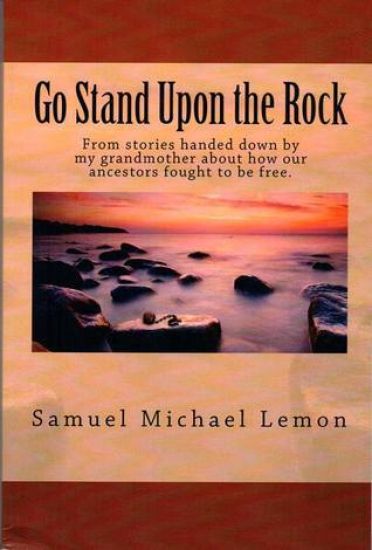
Go Stand Upon the Rock
Samuel Michael Lemon Ed D.
Createspace Independent Publishing Platform
2014
nidottu
Go Stand Upon the Rock is a deeply moving story based on real people and events in the lives of a runaway slave and his family, who witness some of the most compelling moments in antebellum American history. It is a tale of unsettling plantation life, courageous women, dramatic Civil War battles, heroes and hoodoo, and the indomitable strength of the human spirit. This novel is based on the family history handed down to me by my maternal grandmother, Maud Ray Ridley Ortiga - the granddaughter of former runaway slaves. Fiercely proud of our ancestors, I spent countless hours at my grandmother's table, committing this history to memory as we poured over a trove of antique family photographs. I grew to love these forebears who died long before I was born, and I eventually became the family historian. This made me determined to achieve two lifelong goals. The first was to see that my ancestors no longer rested in unmarked graves. The second was to solve the mysteries of who we were, where we came from and how we came to be. After my ancestors escaped from slavery in the mid-1860s, no one in my family had ever returned to our places of origin -- in fact, no one even knew where they were. What began as a noble quest to uncover my roots became a cultural detective story, with only the names of the plantations and slave quarters serving as paltry clues. As I grew into adulthood, I discovered the remarkable accuracy of the age-old family tradition of oral history, and everything my beloved grandmother told me proved to be true. I added to this body of knowledge through historical and genealogical research at the National Archives, the U.S. Census, and countless books and websites, all of which enabled me to turn my love of family history into a doctoral dissertation at one of the most distinguished academic institutions in America -- the University of Pennsylvania -- where I earned a doctorate in Education, Culture, and Society in 2007. The story begins on the Bonnie Doon plantation in Southampton County, Virginia, where my ancestor Cornelius Ridley -- the mulatto son of his wealthy, slavemaster/father -- was born in 1839 - eight years after Nat Turner's Rebellion. But no rosy or revisionist retrospective on genteel plantation society, this book examines the historical events and complex social and sometimes biological relationships between masters and slaves. Go Stand Upon the Rock is a tapestry of interwoven stories of a remarkable family's journey through history that began with my great-great grandfather Cornelius Ridley's epic 300 mile walk to freedom in the North to escape from bondage on his putative father's plantation. It also follows his wife Martha Jane Parham, as she strives to escape her horrible fate as a breeding woman on the neighboring Fortsville Plantation. Learning what she endured made an indelible impact on me. Unlike her husband who was able to pass for white, they were forced to escape separately. And the story follows her perilous flight with two young children, to the safety of a company of U.S. Colored Troops, where she meets a young black soldier from Pennsylvania who is wounded during one of the bloodiest battles of the Civil War - the Battle of New Market Heights - who has an unexpected role in her life half a century later. This first part of the Ridley family saga draws to a close with Cornelius and Martha Jane's brilliant son William - a pioneering African American law student - who miraculously survives a hail of bullets in the midst of a dangerous political dispute in Chester, Pennsylvania, that nearly ends his life and legal career captured in detail in local contemporary newspaper accounts just one month before his marriage to an elegant, mysterious clairvoyant woman from the Danish West Indies in October 1889.Telling the story of my ancestors is a debt I have longed owed them, because they are giants upon whose shoulders I stand today. And there is much more of their saga to tell.