Kirjojen hintavertailu. Mukana 11 244 527 kirjaa ja 12 kauppaa.

Kirjahaku

Etsi kirjoja tekijän nimen, kirjan nimen tai ISBN:n perusteella.

409 kirjaa tekijältä Samuel Taylor Coleridge

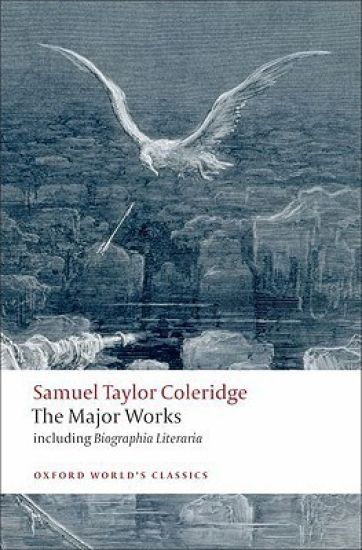
Samuel Taylor Coleridge - The Major Works

Samuel Taylor Coleridge - The Major Works

Samuel Taylor Coleridge

Oxford University Press
2008
nidottu
This authoritative edition was originally published in the acclaimed Oxford Authors series under the general editorship of Frank Kermode. It brings together a unique combination of Coleridge's poetry and prose - all the major poems, complemented by important criticism, letters, and marginalia - to give the essence of his work and thinking. Samuel Taylor Coleridge, poet, critic, and radical thinker, exerted an enormous influence over contemporaries as different as Wordsworth, Southey and Lamb. He was also a dedicated reformer, and set out to use his reputation as a public speaker and literary philosopher to change the course of English thought. This collection represents the best of Coleridge's poetry from every period of his life, particularly his prolific early years, which produced The Rime of the Ancient Mariner, Christabel, and Kubla Khan. The central section of the book is devoted to his most significant critical work, Biographia Literaria, and reproduces it in full. It provides a vital background for both the poetry section which precedes it and for the shorter prose works which follow. There is also a generous sample of his letters, notebooks, and marginalia, some recently discovered, which show a different, more spontaneous side to his fascinating and complex personality. ABOUT THE SERIES: For over 100 years Oxford World's Classics has made available the widest range of literature from around the globe. Each affordable volume reflects Oxford's commitment to scholarship, providing the most accurate text plus a wealth of other valuable features, including expert introductions by leading authorities, helpful notes to clarify the text, up-to-date bibliographies for further study, and much more.
Samuel Taylor Coleridge

Samuel Taylor Coleridge

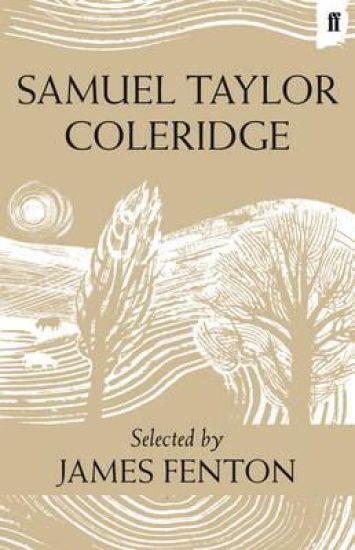
Samuel Taylor Coleridge

Faber Faber
2006
nidottu
In this series, a contemporary poet selects and introduces a poet of the past. By their choice of poems and by the personal and critical reactions they express in their prefaces, the editors offer insights into their own work as well as providing an accessible and passionate introduction to the most important poets in our literature.Samuel Taylor Coleridge (1772-1834) was born in Ottery St Mary, Devon, the youngest son of a clergyman. He was educated at Christ's Hospital School, London where he began his friendship with Charles Lamb, and Jesus College, Cambridge. He first met Dorothy and William Wordsworth in 1797 and a close association developed between them, issuing in their groundbreaking joint-publication, Lyrical Ballads, in 1799. Coleridge subsequently settled in the Lake District, and thereafter in London, where he lectured on Shakespeare and published his literary and philosophical theories in the Biographia Literaria (1817). He died in 1834 having overseen a final edition of his Poetical Works. As poet, philosopher and critic, Coleridge stands as one of the seminal figures of his time.
Samuel Taylor Coleridge

Samuel Taylor Coleridge

Samuel Taylor Coleridge

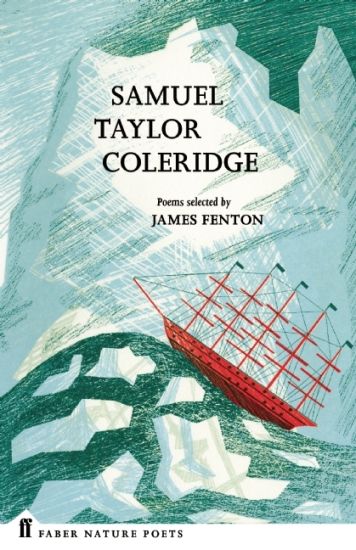
Faber Faber
2011
sidottu
In this series, a contemporary poet selects and introduces a poet of the past. By their choice of poems and by the personal and critical reactions they express in their prefaces, the editors offer insights into their own work as well as providing an accessible and passionate introduction to the most important poets in our literature.In Xanadu did Kubla KhanA stately pleasure-dome decree:Where Alph, the sacred river, ranThrough caverns measureless to manDown to a sunless sea.-- Kubla Khan
Samuel Taylor Coleridge

Samuel Taylor Coleridge

Samuel Taylor Coleridge

Faber Faber
2016
sidottu
Features a contemporary poet who selects and introduces a poet of the past. By their choice of poems and by the personal and critical reactions they express in their prefaces, the authors offer insights into their own work as well as providing an accessible and passionate introduction to the most important poets in our literature.
The Collected Works of Samuel Taylor Coleridge, Vol. 16, Part 1

The Collected Works of Samuel Taylor Coleridge, Vol. 16, Part 1

Samuel Taylor Coleridge

Princeton University Press
2001
sidottu
Poetry in its many guises is at the center of Coleridge's multifarious interests, and this long-awaited new edition of his complete poetical works marks the pinnacle of the Bollingen Collected Coleridge. The three parts of Volume 16 confirm and expand the sense of the Coleridge who has emerged over the past half-century, with implications for English Romantic writing as a whole. Setting new standards of comprehensiveness in the presentation of Romantic texts, they will interest historians and editorial theorists, as well as readers and students of poetry. They represent a work of truly monumental importance. The first part presents the reading texts of 706 poems in chronological sequence. Its blend of newly discovered and newly collected poems, presented in light of all known evidence and where practicable in unrevised forms, offers a fresh and original Coleridge: less inhibited by Victorian ideas about what poetry should be, moving easily and productively between genres and levels of seriousness. In texts that remained fluid and exploratory to the end, Coleridge alternates between lyric and satire, prophecy and conversation, symbol and allegory. Each poem is accompanied by a headnote and commentary that together provide its historical-biographical context and offer key textual variants. The book opens with an introduction and chronological tables. The three appendixes position individual poems in the contexts in which they appeared during Coleridge's lifetime. Illustrations such as contemporary scenes and portraits bring this rich collection, like the companion volumes, all the more to life.
The Collected Works of Samuel Taylor Coleridge, Vol. 16, Part 2

The Collected Works of Samuel Taylor Coleridge, Vol. 16, Part 2

Samuel Taylor Coleridge

Princeton University Press
2001
sidottu
Poetry in its many guises is at the center of Coleridge's multifarious interests, and this long-awaited new edition of his complete poetical works marks the pinnacle of the Bollingen Collected Coleridge. The three parts of Volume 16 confirm and expand the sense of the Coleridge who has emerged over the past half-century, with implications for English Romantic writing as a whole. Setting new standards of comprehensiveness in the presentation of Romantic texts, they will interest historians and editorial theorists, as well as readers and students of poetry. They represent a work of truly monumental importance. The second part presents the same 706 poems as the first, in the same chronological sequence, but differently records in each case all known textual information in collated form--allowing for alternative construals of the reading texts. An additional 135 items are inserted into the same sequence, comprising poems mistakenly ascribed to Coleridge or of dubious authenticity and poems that remained only in the planning stage or that are referred to but have not been recovered. The index of titles and first lines incorporates the full range of variants. All told, the Collected Coleridge variorum sequence collates over a third more additional texts--in more detailed and accurate form--than those found in the previous standard edition, by E.H. Coleridge. The presentation method in this second part will interest editorial theorists as well as those interested primarily in Coleridge and/or the making of poetry. The unusually detailed textual information also reveals changes in such areas as linguistic and grammatical usage, patterns of transcription and circulation among anthologists, and contemporary publishers' house styles.
The Collected Works of Samuel Taylor Coleridge, Volume 7

The Collected Works of Samuel Taylor Coleridge, Volume 7

Samuel Taylor Coleridge

Princeton University Press
1985
pokkari
Biographia Literaria has emerged over the last century as a supreme work of literary criticism and one of the classics of English literature. Into this volume poured 20 years of speculation about the criticism and uses of poetry and about the psychology of art. Following the text of the 1817 edition, the editors offer the first completely annotated edition of the highly allusive work.
The Collected Works of Samuel Taylor Coleridge, Volume 8

The Collected Works of Samuel Taylor Coleridge, Volume 8

Samuel Taylor Coleridge

Princeton University Press
2000
sidottu
During the winter of 1818-1819, Samuel Taylor Coleridge gave fourteen lectures on the history of philosophy. A shorthand writer took down twelve of them in the most detailed version of Coleridge's lectures known to exist. The transcriptions are imperfect and inaccurate in various ways, but, when they are combined with Coleridge's own notes, as in this edition, the result is a coherent and largely complete whole. The lectures contain Coleridge's interpretation of the history of philosophy. He opposed the idea, widely accepted at the time, that the philosophy of the Enlightenment had advanced by conquering religion. He believed that this view had doomed philosophy to the low esteem in which it was held in Britain, and he wanted to counter it by showing that the philosophy of the Enlightenment was largely derivative and that neither philosophy nor religion could stand alone. This series of lectures was his most systematic attempt to survey the relationship of philosophy to religion from Thales to Kant. The edition presents a fully annotated and indexed text of the lecture series, and it provides in addition the complete texts of the shorthand reports and of Coleridge's own notes (which were omitted from the Coleridge Notebooks), along with newspaper and manuscript reports by people who attended the lectures. The volume includes an appendix by Owen Barfield, which is drawn from his incomplete manuscript edition of the lectures.
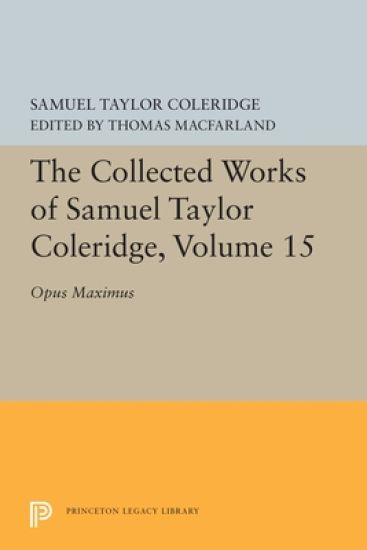
The Collected Works of Samuel Taylor Coleridge, Volume 15

The Collected Works of Samuel Taylor Coleridge, Volume 15

Samuel Taylor Coleridge

Princeton University Press
2002
sidottu
The Opus Maximum gathers the last major body of unpublished prose writings by Samuel Taylor Coleridge. Consisting primarily of fragments dictated to Joseph Henry Green, probably between 1819 and 1823, these writings represent all that exists of what Coleridge considered to be "the principal Labour" and "the great Object" of his life, which he called variously the Logosophia and Magnum Opus. Dedicated to "the reconcilement of the moral faith with the Reason," Coleridge's envisioned Magnum Opus was supposed to "reduce all knowledges into harmony." While such a synthesis finally eluded him, and the Magnum Opus remained unfinished, the surviving fragments nonetheless bear powerful witness to Coleridge's engagement with theology, moral philosophy, natural philosophy, and logic, among other disciplines. Among the subjects that will particularly interest readers are Coleridge's criticisms of Epicureanism, pantheism, and German Naturphilosophie; his attempt to ground reason in faith; and his reflections on personhood (especially in the relationship between mother and child), on will, on language, and on the Logos. Previously unknown to all but a handful of scholars, the manuscripts presented here provide valuable insight into a crucial period of Coleridge's intellectual development, as he became increasingly dissatisfied with Naturphilosophie and struggled to affirm Trinitarian Christianity on a rational basis. With this volume, The Collected Works of Samuel Taylor Coleridge, begun forty years ago under the sponsorship of the Bollingen Foundation and the editorship of the late Kathleen Coburn, is now complete.
The Collected Works of Samuel Taylor Coleridge, Vol. 16, Part 3

The Collected Works of Samuel Taylor Coleridge, Vol. 16, Part 3

Samuel Taylor Coleridge

Princeton University Press
2001
sidottu
Poetry in its many guises is at the center of Coleridge's multifarious interests, and this long-awaited new edition of his complete poetical works marks the pinnacle of the Bollingen Collected Coleridge. The three parts of Volume 16 confirm and expand the sense of the Coleridge who has emerged over the past half-century, with implications for English Romantic writing as a whole. Setting new standards of comprehensiveness in the presentation of Romantic texts, they will interest historians and editorial theorists, as well as readers and students of poetry. They represent a work of truly monumental importance. Coleridge's plays form a vital part of his poetic achievement. This part covers all of them--twelve altogether, including collaborations, adaptations, and plays left unrevised or in note form. It considers his drama translations as well. Coleridge's practical engagement with theater over a span of twenty years influenced his approach to other, lyric forms as well as, for example, his assessments of Shakespeare and of public taste. As in the first and second parts, all known manuscript, printed, and annotated versions have been collated to produce reading texts, and much new information, historical as well as textual, is presented in the commentary. The index covers proper names and prominent themes and features of all three parts. The presentation of four plays is of particular interest. Coleridge's translations of Schiller's Piccolomini and Death of Wallenstein are accompanied by facing texts of the German originals (the first reconstructed by Joyce Crick, the second from a manuscript authorized by Schiller himself) so that, for the first time, Coleridge's practice as translator can be properly assessed. Secondly, Remorse is presented in stage and printed-text versions; the former demonstrates how Coleridge's play evolved in the course of the rehearsal process and during performance, how it was received and how it enjoyed an afterlife in contemporary theatres, whereas the printed-text version developed quite differently. This authoritative volume offers a revealing and comprehensive portrait of Coleridge's work in the dramatic form.
The Notebooks of Samuel Taylor Coleridge, Volume 5

The Notebooks of Samuel Taylor Coleridge, Volume 5

Samuel Taylor Coleridge

Princeton University Press
2002
sidottu
This final volume of Bollingen Series L covers the material Coleridge wrote in his notebooks between January 1827 and his death in 1834. In these years, Coleridge made use of the notebooks for his most sustained and far-reaching inquiries, very little of which resulted in publication in any form during his lifetime. Twenty-eight notebooks are here published in their entirety for the first time; entries dated 1827 or later from several more notebooks also appear in this volume. Following previous practice for the edition, notes appear in a companion volume. Coleridge's intellectual interests were wide, encompassing not only literature and philosophy but the political crises of his time, scientific and medical breakthroughs, and contemporary developments in psychology, archaeology, philology, biblical criticism, and the visual arts. In these years, he met and conversed with eminent writers, scholars, scientists, churchmen, politicians, physicians, and artists. He planned a major work on Logic (still unpublished at his death), and an outline of Christian doctrine, also unfinished, though his work toward this project contributed to On the Constitution of the Church and State (1830) and the revised Aids to Reflection (1831). The reader of these notebooks has the opportunity to see what one of the most admired minds of the English-speaking world thought on several issues--such as race and empire, science and medicine, democracy (particularly in reaction to the Reform Bills introduced in 1831 and 1832), and the authority of the Bible--when he wrote without fear of public disapprobation or controversy.
The Collected Works of Samuel Taylor Coleridge, Vol. 12, Part 5

The Collected Works of Samuel Taylor Coleridge, Vol. 12, Part 5

Samuel Taylor Coleridge

Princeton University Press
1999
sidottu
In his introduction to this edition of Coleridge's Marginalia, the late George Whalley wrote, "There is no body of marginalia--in English, or perhaps in any other language--comparable with Coleridge's in range and variety and in the sensitiveness, scope, and depth of his reaction to what he was reading." The Princeton edition of the Marginalia, of which this is the fifth volume, will bring together over eight thousand notes, many never before printed, varying from a single word to substantial essays. In alphabetical order of authors, the notes are presented literatim from the original manuscripts whenever the annotated volumes can be found. Each note is preceded by the passage of the original text that appears to have provoked Coleridge's comment. Texts in foreign languages are followed by translations. The present volume comprises annotations on more than sixty books (from Sherlock to "Unidentified"), including well-known works by Sir Philip Sidney, Southey, Spinoza, Swift, and Tennyson. There are extensive notes on texts by Heinrich Steffens, Emanuel Swedenborg, and Jeremy Taylor; on two histories of philosophy by Thomas Stanley and W. G. Tennemann; and also on the writings of St. Teresa of Avila. The subjects addressed range from literature and philosophy through religion, politics, history, and biography, to travel-writing and science.
The Collected Works of Samuel Taylor Coleridge, Volume 15

The Collected Works of Samuel Taylor Coleridge, Volume 15

Samuel Taylor Coleridge

Princeton University Press
2020
pokkari
The Opus Maximum gathers the last major body of unpublished prose writings by Samuel Taylor Coleridge. Consisting primarily of fragments dictated to Joseph Henry Green, probably between 1819 and 1823, these writings represent all that exists of what Coleridge considered to be "the principal Labour" and "the great Object" of his life, which he called variously the Logosophia and Magnum Opus. Dedicated to "the reconcilement of the moral faith with the Reason," Coleridge's envisioned Magnum Opus was supposed to "reduce all knowledges into harmony." While such a synthesis finally eluded him, and the Magnum Opus remained unfinished, the surviving fragments nonetheless bear powerful witness to Coleridge's engagement with theology, moral philosophy, natural philosophy, and logic, among other disciplines. Among the subjects that will particularly interest readers are Coleridge's criticisms of Epicureanism, pantheism, and German Naturphilosophie; his attempt to ground reason in faith; and his reflections on personhood (especially in the relationship between mother and child), on will, on language, and on the Logos. Previously unknown to all but a handful of scholars, the manuscripts presented here provide valuable insight into a crucial period of Coleridge's intellectual development, as he became increasingly dissatisfied with Naturphilosophie and struggled to affirm Trinitarian Christianity on a rational basis. With this volume, The Collected Works of Samuel Taylor Coleridge, begun forty years ago under the sponsorship of the Bollingen Foundation and the editorship of the late Kathleen Coburn, is now complete.