Kirjojen hintavertailu. Mukana 12 390 323 kirjaa ja 12 kauppaa.

Kirjahaku

Etsi kirjoja tekijän nimen, kirjan nimen tai ISBN:n perusteella.

3 kirjaa tekijältä Sandra Arlinghaus

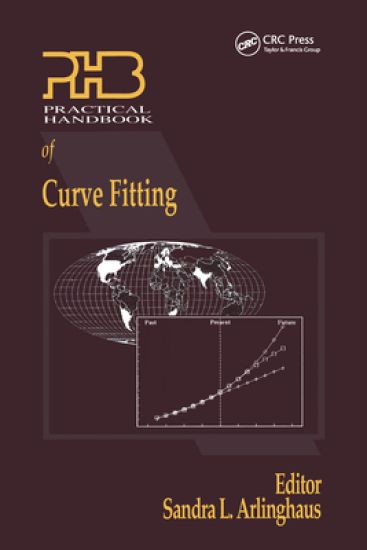
Practical Handbook of Curve Fitting

Practical Handbook of Curve Fitting

Sandra Arlinghaus

CRC Press
2020
nidottu
Practical Handbook of Curve Fitting is a reference work assembled by Arlinghaus and a set of editors with well over a century of combined experience in various disciplines and activities related to curve fitting. The book demonstrates how to analyze World data bases and graph and map the results. Default settings in software packages can produce attractive graphs of data imported into the software. Often, however, the default graph has no equation associated with it and cannot therefore be used as a tool for further analysis or projection of the data. The same software can often be used to generate curves from equations. The reader is shown directly, and in a series of steps, how to fit curves to data using Lotus 1-2-3. There are traditional unbounded curve fitting techniques-lines of least squares, exponentials, logistic curves, and Gompertz curves. There is the bounded curve fitting technique of cubic spline interpolation. Beyond these, there is a detailed application of Feigenbaum's graphical analysis from chaos theory, and there is a hint as to how fractal geometry might come into play. Curve fitting algorithms take on new life when they are actually used on real-world data. They are used in numerous worked examples drawn from electronic data bases of public domain information from the Stars data base of The World Bank and from the WRD data base of the World Resources Institute. The applications are current and reflect a state-of-the-art interest in the human dimensions of global change.
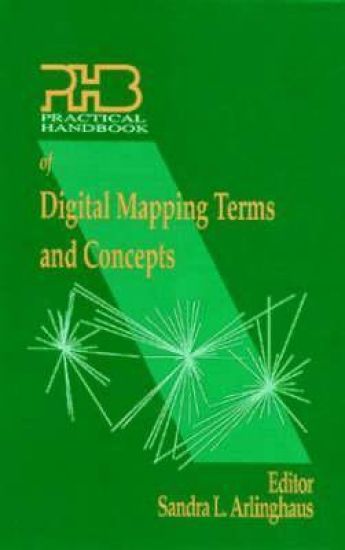
Practical Handbook of Digital Mapping Terms and Concepts
The Practical Handbook of Digital Mapping Terms and Concepts offers easy-to-read, alphabetically cross-referenced terms, illustrated with maps (including 8 pages in full color) produced through digital mapping technology. Thorough explanations provide novices and experts alike with the most comprehensive study of its kind, drawing together terms and concepts from the business, academic, and development communities. One of the book's unique features is a practical introduction to digital mapping, explaining its original application in the international development community and the third world issue of guinea worm. This study is balanced by theoretical perspectives on digital mapping as well as possible directions for future exploration. Internally cross-referenced appendices cover topics often ignored in the conventional academic curriculum, but which are critical to success in other digital mapping arenas. These appendices discuss railroad terminology, desktop digital mapping (with French translation), maps on CD-ROM (with French translation), tools used in the global positioning system (with French translation), and Intelligent Vehicle Highway Systems.
Practical Handbook of Curve Fitting

Practical Handbook of Curve Fitting

Sandra Arlinghaus

CRC Press Inc
1994
sidottu
Practical Handbook of Curve Fitting is a reference work assembled by Arlinghaus and a set of editors with well over a century of combined experience in various disciplines and activities related to curve fitting. The book demonstrates how to analyze World data bases and graph and map the results. Default settings in software packages can produce attractive graphs of data imported into the software. Often, however, the default graph has no equation associated with it and cannot therefore be used as a tool for further analysis or projection of the data. The same software can often be used to generate curves from equations. The reader is shown directly, and in a series of steps, how to fit curves to data using Lotus 1-2-3. There are traditional unbounded curve fitting techniques-lines of least squares, exponentials, logistic curves, and Gompertz curves. There is the bounded curve fitting technique of cubic spline interpolation. Beyond these, there is a detailed application of Feigenbaum's graphical analysis from chaos theory, and there is a hint as to how fractal geometry might come into play. Curve fitting algorithms take on new life when they are actually used on real-world data. They are used in numerous worked examples drawn from electronic data bases of public domain information from the Stars data base of The World Bank and from the WRD data base of the World Resources Institute. The applications are current and reflect a state-of-the-art interest in the human dimensions of global change.