Kirjojen hintavertailu. Mukana 11 342 296 kirjaa ja 12 kauppaa.

Kirjahaku

Etsi kirjoja tekijän nimen, kirjan nimen tai ISBN:n perusteella.

4 kirjaa tekijältä Savithri Preetha Nair

Raja Serfoji II

Raja Serfoji II

Savithri Preetha Nair

Routledge India
2012
nidottu
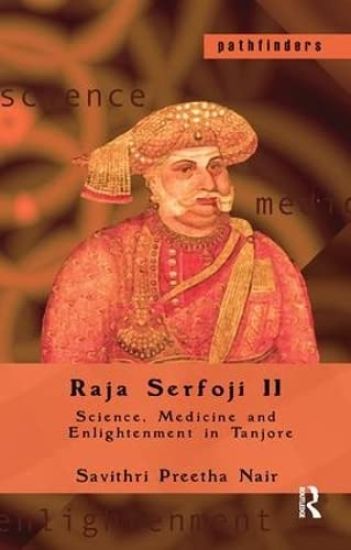
In the early nineteenth century, the south Indian kingdom of Tanjore, which had come under the control of the East India Company, flourished as a ‘centre’ of enlightenment. This book traces the contours of the Tanjore enlightenment, which produced a knowledge that was at once modern and deeply rooted in the indigenous tradition. The chief protagonist of this first ever full-length study on Tanjore at the turn of the nineteenth century is Raja Serfoji II (r. 1798–1832), in whose world science and God coexisted comfortably. Tanjore at this time was a thriving contact-zone, linked to several centres through extensive local and global networks. Its court attracted a great number of visitors, including Christian missionaries, high-ranking Company officials, princely contemporaries, naturalists, and medical practitioners. Dwelling on the locatedness of science and enlightenment modernity in the context of the colonial periphery, the book describes how the Raja deployed certain ‘vectors of assemblage’ — an array of practices, instruments, theories and people, including his vast collection of manuscripts, books and scientific instruments, a Devanagari printing press, a menagerie, health establishments and a large retinue of trained experts and artists — to invent Tanjore as a contemporary ‘centre’. Shunning reductionist and diffusionist explanations of the transmission of Western science in colonial settings, the study uses hitherto unexplored archival sources to reconstruct the Tanjore enlightenment as the outcome of globally situated cross-cultural exchanges. It celebrates the openness and confidence with which European science was engaged with, assimilated, translated and reinvented in a ‘contact-zone’ located in the colonial backwaters of south India. The book will be of interest to historians, sociologists and those interested in history of science and medicine, anthropologists, cultural studies scholars, as well as the general reader.
Chromosome Woman, Nomad Scientist

Chromosome Woman, Nomad Scientist

Savithri Preetha Nair

TAYLOR FRANCIS LTD
2022
sidottu
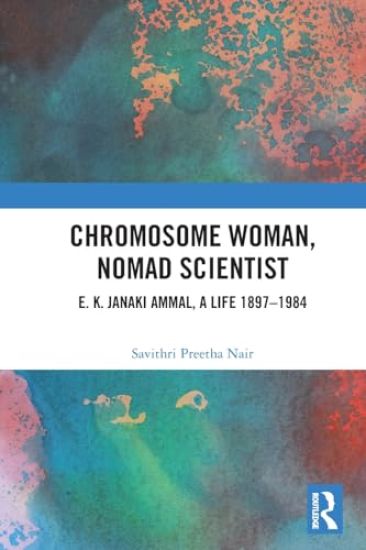
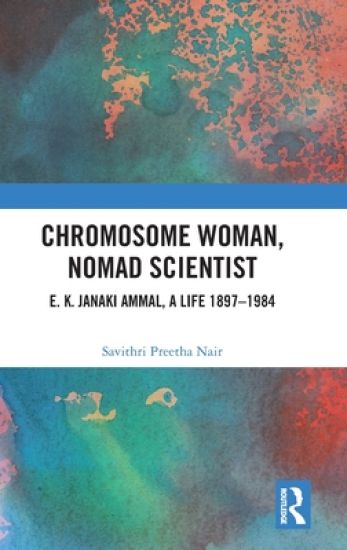
This is the first in-depth and analytical biography of an Asian woman scientist—Edavaleth Kakkat Janaki Ammal (1897–1984). Using a wide range of archival sources, it presents a dazzling portrait of the twentieth century through the eyes of a pioneering Indian woman scientist, who was highly mobile, and a life that intersected with several significant historical events—the rise of Nazi Germany and World War II, the struggle for Indian Independence, the social relations of science movement, the Lysenko affair, the green revolution, the dawn of environmentalism and the protest movement against a proposed hydro-electric project in the Silent Valley in the 1970s and 1980s.The volume brings into focus her work on mapping the origin and evolution of cultivated plants across space and time, to contribute to a grand history of human evolution, her works published in peer-reviewed Indian and international journals of science, as well as her co-authored work, Chromosome Atlas of Cultivated Plants (1945), considered a bible by practitioners of the discipline. It also looks at her correspondence with major personalities of the time, including political leaders like Jawaharlal Nehru, biologists like Cyril D. Darlington, J. B. S. Haldane and H. H. Bartlett, geographers like Carl Sauer and social activists like Hilda Seligman, who all played significant roles in shaping her world view and her science.A story spanning over North America, Europe and Asia, this biography is a must-have for scholars and researchers of science and technology studies, gender studies, especially those studying women in the sciences, history and South Asian studies. It will also be a delight for the general reader.
Chromosome Woman, Nomad Scientist

Chromosome Woman, Nomad Scientist

Savithri Preetha Nair

TAYLOR FRANCIS LTD
2024
nidottu
This is the first in-depth and analytical biography of an Asian woman scientist—Edavaleth Kakkat Janaki Ammal (1897–1984). Using a wide range of archival sources, it presents a dazzling portrait of the twentieth century through the eyes of a pioneering Indian woman scientist, who was highly mobile, and a life that intersected with several significant historical events—the rise of Nazi Germany and World War II, the struggle for Indian Independence, the social relations of science movement, the Lysenko affair, the green revolution, the dawn of environmentalism and the protest movement against a proposed hydro-electric project in the Silent Valley in the 1970s and 1980s.The volume brings into focus her work on mapping the origin and evolution of cultivated plants across space and time, to contribute to a grand history of human evolution, her works published in peer-reviewed Indian and international journals of science, as well as her co-authored work, Chromosome Atlas of Cultivated Plants (1945), considered a bible by practitioners of the discipline. It also looks at her correspondence with major personalities of the time, including political leaders like Jawaharlal Nehru, biologists like Cyril D. Darlington, J. B. S. Haldane and H. H. Bartlett, geographers like Carl Sauer and social activists like Hilda Seligman, who all played significant roles in shaping her world view and her science.A story spanning over North America, Europe and Asia, this biography is a must-have for scholars and researchers of science and technology studies, gender studies, especially those studying women in the sciences, history and South Asian studies. It will also be a delight for the general reader.
Raja Serfoji II

Raja Serfoji II

Savithri Preetha Nair

Routledge India
2017
sidottu
In the early nineteenth century, the south Indian kingdom of Tanjore, which had come under the control of the East India Company, flourished as a ‘centre’ of enlightenment. This book traces the contours of the Tanjore enlightenment, which produced a knowledge that was at once modern and deeply rooted in the indigenous tradition. The chief protagonist of this first ever full-length study on Tanjore at the turn of the nineteenth century is Raja Serfoji II (r. 1798–1832), in whose world science and God coexisted comfortably. Tanjore at this time was a thriving contact-zone, linked to several centres through extensive local and global networks. Its court attracted a great number of visitors, including Christian missionaries, high-ranking Company officials, princely contemporaries, naturalists, and medical practitioners. Dwelling on the locatedness of science and enlightenment modernity in the context of the colonial periphery, the book describes how the Raja deployed certain ‘vectors of assemblage’ — an array of practices, instruments, theories and people, including his vast collection of manuscripts, books and scientific instruments, a Devanagari printing press, a menagerie, health establishments and a large retinue of trained experts and artists — to invent Tanjore as a contemporary ‘centre’. Shunning reductionist and diffusionist explanations of the transmission of Western science in colonial settings, the study uses hitherto unexplored archival sources to reconstruct the Tanjore enlightenment as the outcome of globally situated cross-cultural exchanges. It celebrates the openness and confidence with which European science was engaged with, assimilated, translated and reinvented in a ‘contact-zone’ located in the colonial backwaters of south India. The book will be of interest to historians, sociologists and those interested in history of science and medicine, anthropologists, cultural studies scholars, as well as the general reader.