

Kirjahaku
Etsi kirjoja tekijän nimen, kirjan nimen tai ISBN:n perusteella.
5 kirjaa tekijältä Severo Sarduy

Severo Sarduy was among the most important figures in twentieth-century Latin American fiction and a major representative of the literary tendency to which he gave the name Neobaroque. While most of Sarduy's literary work is available in English, his theoretical writings have largely remained untranslated. This volume—presenting Sarduy's central theoretical contribution, Barroco (1974), alongside other related works—remedies that oversight. Barroco marks a watershed in postwar thought on the Baroque, both in French post-structuralism and in the Latin American context. Sarduy traces a double history, reading events in the history of science alongside developments in the history of art, architecture, and literature. What emerges is a theory of the Baroque as decentering and displacement, as supplement and excess, a theory capacious enough to account for the old European Baroque as well as its queer, Latin American and global futures. In addition to Barroco, this volume includes texts spanning Sarduy's career, from 1960s essays published originally in Tel Quel to late works from the 1980s and '90s. It thus offers a complete picture of Sarduy's thinking on the Baroque.

Severo Sarduy was among the most important figures in twentieth-century Latin American fiction and a major representative of the literary tendency to which he gave the name Neobaroque. While most of Sarduy's literary work is available in English, his theoretical writings have largely remained untranslated. This volume—presenting Sarduy's central theoretical contribution, Barroco (1974), alongside other related works—remedies that oversight. Barroco marks a watershed in postwar thought on the Baroque, both in French post-structuralism and in the Latin American context. Sarduy traces a double history, reading events in the history of science alongside developments in the history of art, architecture, and literature. What emerges is a theory of the Baroque as decentering and displacement, as supplement and excess, a theory capacious enough to account for the old European Baroque as well as its queer, Latin American and global futures. In addition to Barroco, this volume includes texts spanning Sarduy's career, from 1960s essays published originally in Tel Quel to late works from the 1980s and '90s. It thus offers a complete picture of Sarduy's thinking on the Baroque.

The late Severo Sarduy was one of the most outrageous and baroque of the Latin American Boom writers of the sixties and seventies, and here bound back to back are his two finest creations. Cobra (1972) recounts the tale of a transvestite named Cobra, star of the Lyrical Theater of the Dolls, whose obsession is to transform his/her body. She is assisted in her metamorphosis by the Madam and Pup, Cobra's dwarfish double. They too change shape, through the violent ceremonies of a motorcycle gang, into a sect of Tibetan lamas seeking to revive Tantric Buddhism.Maitreya (1978) continues the theme of metamorphosis, this time in the person of Luis Leng, a humble Cuban-Chinese cook, who becomes a reincarnation of Buddha. Through Leng, Sarduy traces the metamorphosis of two hitherto incomparable societies, Tibet at the moment of the Chinese invasion, and Cuba at the moment of revolution. Transgressing genres and genders, reveling in literal and figurative transvestism, these two novels are among the most daring achievements of postmodern Latin American fiction.
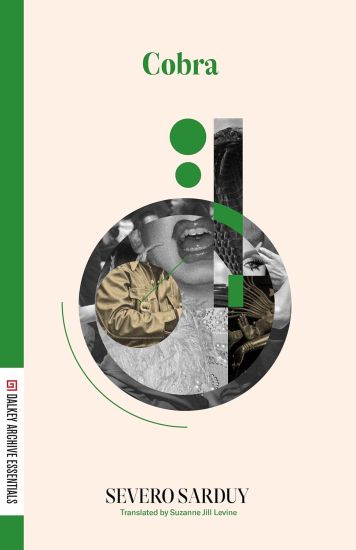
The late Severo Sarduy was one of the most outrageous and baroque of the Latin American Boom writers of the sixties and seventies, and Cobra was his finest creation. Originally published in 1972, Cobra recounts the tale of its eponymous heroine, queen of the Lyrical Theater of Dolls, whose obsession is to transform her body. She is assisted in her metamorphosis by the Madam and Pup, Cobra's dwarfish double. They, too, change shape, through the violent ceremonies of a motorcycle gang, into a sect of Tibetan lamas seeking to revive Tantric Buddhism. In its spiraling series of transmutations, Cobra constructs a labyrinthine voyage, a "magical juggling act" (New York Times Book Review). In its first edition from Dalkey Archive Press, Cobra was bound with Sarduy's novel Maitreya (1978) which furthers the theme of metamorphosis. Transgressing genres and genders, reveling in literal and figurative transvestism, Sarduy's work is among the most daring achievements of postmodern Latin American fiction.