Kirjojen hintavertailu. Mukana 11 627 220 kirjaa ja 12 kauppaa.

Kirjahaku

Etsi kirjoja tekijän nimen, kirjan nimen tai ISBN:n perusteella.

17 kirjaa tekijältä Sextus Empiricus

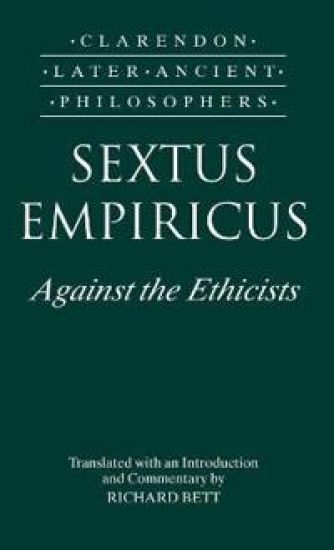
Sextus Empiricus: Against the Ethicists

Sextus Empiricus: Against the Ethicists

Sextus Empiricus

Clarendon Press
1996
sidottu
About Sextus Sextus Empiricus is one of the most important ancient philosophical writers after Plato and Aristotle. His writings are our main source for the doctrines and arguments of Scepticism. He probably lived in the second century AD. Eleven books of his writings have survived, covering logic, physics, ethics, and numerous more specialized fields. About Against the Ethicists In this unjustly neglected and misunderstood work Sextus sets out a distinctive Sceptic position in ethics. He discusses the concepts good and bad, and puts forward the sceptical argument that nothing is either good or bad by nature or intrinsically or invariably, but only relatively to persons and/or to circumstances. He then argues that the sceptic is better off than the non-sceptic. In the latter part of the book, Sextus attacks the Stoic view that there is such a thing as a `skill for life'. About this edition This volume contains a translation of Against the Ethicists in clear modern English, together with an introduction and a detailed commentary. Those who have discussed this work in the past have tended to underestimate it, often regarding its main position as essentially the same as that of Sextus' better-known Outlines of Pyrrhonism. Richard Bett shows that Against the Ethicists represents quite a distinct and coherent philosophical outlook, associated with a phase of Scepticism earlier than Sextus himself, an outlook of which little other evidence survives.
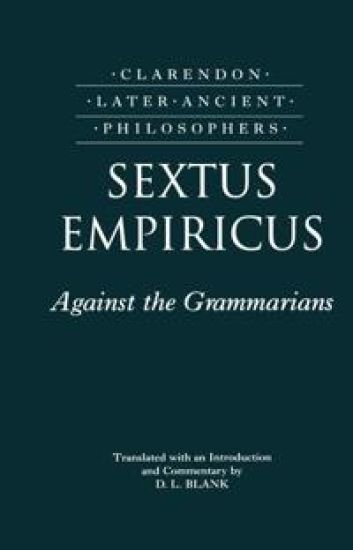
Sextus Empiricus: Against the Grammarians (Adversus Mathematicos I)
Sextus Empiricus is one of the most important ancient philosophical writers after Plato and Aristotle. His writings are our main source for the doctrines and methods of Scepticism. He probably lived in the second century AD. Eleven books of his writings have survived, covering logic, physics, ethics, and many other fields. Against the Grammarians is the first book of Sextus' Adversus Mathematicos, his broad-ranging polemic against the various liberal studies of classical learning. It is prefaced by a short general attack on the arts (included in this volume); then Sextus focuses on the grammatical writers of the classical era, categorizing, analysing, and criticizing their doctrines. The result is not only an invaluable source for ancient ideas about grammar, language, and literary technique, but an excellent example of sustained Sceptical reasoning. David Blank presents a new translation into clear modern English of this important treatise, together with the first ever commentary on the work. In an extended introduction he discusses Against the Grammarians in the broad context of Sextus' work as a whole, Scepticism in general, and the history of ancient writings in this field.
Sextus Empiricus: Against the Ethicists

Sextus Empiricus: Against the Ethicists

Sextus Empiricus

Clarendon Press
2000
nidottu
About Sextus: Sextus Empiricus is one of the most important ancient philosophical writers after Plato and Aristotle. His writings are our main source for the doctrines and arguments of Scepticism. He probably lived in the second century AD. Eleven books of his writings have survived, covering logic, physics, ethics, and numerous more specialized fields. About Against the Ethicists: In this unjustly neglected and misunderstood work Sextus sets out a distinctive Sceptic position in ethics. He discusses the concepts good and bad, and puts forward the sceptical argument that nothing is either good or bad by nature or intrinsically or invariably, but only relatively to persons and/or to circumstances. He then argues that the sceptic is better off than the non-sceptic. In the latter part of the book, Sextus attacks the Stoic view that there is such a thing as a 'skill for life'. About this edition: This volume contains a translation of Against the Ethicists into clear modern English, together with an introduction and a detailed commentary. Those who have discussed this work in the past have tended to underestimate it, often regarding its main position as essentially the same as that of Sextus' better-known Outlines of Pyrrhonism. Richard Bett shows that Against the Ethicists represents a quite distinct and coherent philosophical outlook, associated with a phase of Scepticism earlier than Sextus himself, an outlook of which little other evidence survives.
Sextus Empiricus: Outlines of Scepticism

Sextus Empiricus: Outlines of Scepticism

Sextus Empiricus

Cambridge University Press
2000
sidottu
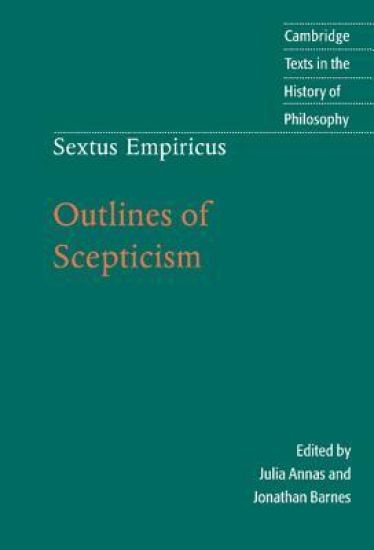
Outlines of Scepticism, by the Greek philosopher Sextus Empiricus, is a work of major importance for the history of Greek philosophy. It is the fullest extant account of ancient scepticism, and it is also one of our most copious sources of information about the other Hellenistic philosophies. Its first part contains an elaborate exposition of the Pyrrhonian variety of scepticism; its second and third parts are critical and destructive, arguing against 'dogmatism' in logic, epistemology, science and ethics - an approach that revolutionized the study of philosophy when Sextus' works were rediscovered and published in the sixteenth century. This volume presents the accurate and readable translation which was first published in 1994, together with a substantial new historical and philosophical introduction by Jonathan Barnes.
Sextus Empiricus: Outlines of Scepticism

Sextus Empiricus: Outlines of Scepticism

Sextus Empiricus

Cambridge University Press
2000
pokkari
Outlines of Scepticism, by the Greek philosopher Sextus Empiricus, is a work of major importance for the history of Greek philosophy. It is the fullest extant account of ancient scepticism, and it is also one of our most copious sources of information about the other Hellenistic philosophies. Its first part contains an elaborate exposition of the Pyrrhonian variety of scepticism; its second and third parts are critical and destructive, arguing against 'dogmatism' in logic, epistemology, science and ethics - an approach that revolutionized the study of philosophy when Sextus' works were rediscovered and published in the sixteenth century. This volume presents the accurate and readable translation which was first published in 1994, together with a substantial new historical and philosophical introduction by Jonathan Barnes.
Sextus Empiricus Complete

Sextus Empiricus Complete

Sextus Empiricus

Sophron Editor
2022
pokkari
ALL THE EXTANT WORKS. This present English edition of Sextus Empiricus by R. G. Bury contains all of his extant works as well as Diognees Laertius's chapter on Pyrrho. It is introduced, annotated, has a bibliography, a figure and an Index of Names.The writings of Sextus contain not only an exposition of Scepticism but also a critique of the doctrines of "the Dogmatists" The main task of the Sceptic is, in fact, to expose the folly of every form of positive doctrine; and consequently the bulk of these works of Sextus is controversial. Scattered through his pages there are references to almost every known name in the history of ancient Greek thought, and without some previous acquaintance with the main outlines of that history it is hardly possible to appreciate the points or estimate the value of his arguments. Accordingly, given here, for the convenience of the reader, is a short summary of the history of Greek philosophy.
Outlines of Pyrrhonism

Outlines of Pyrrhonism

Sextus Empiricus

LOEB
1933
sidottu
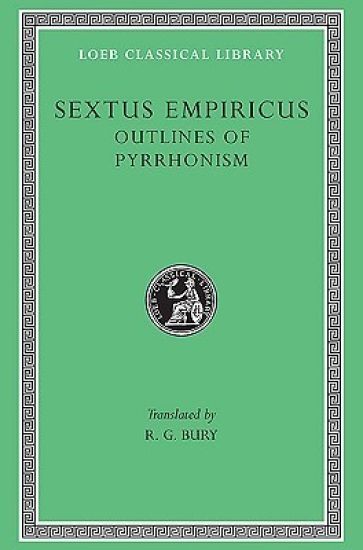
A suspicious mind.Sextus Empiricus (ca. AD 160–210), exponent of scepticism and critic of the Dogmatists, was a Greek physician and philosopher, pupil and successor of the medical sceptic Herodotus (not the historian) of Tarsus. He probably lived for years in Rome and possibly also in Alexandria and Athens. His three surviving works are Outlines of Pyrrhonism (three books on the practical and ethical scepticism of Pyrrho of Elis, ca. 360–275 BC, as developed later, presenting also a case against the Dogmatists); Against the Dogmatists (five books dealing with the Logicians, the Physicists, and the Ethicists); and Against the Professors (six books: Grammarians, Rhetors, Geometers, Arithmeticians, Astrologers, and Musicians). These two latter works might be called a general criticism of professors of all arts and sciences. Sextus’ work is a valuable source for the history of thought especially because of his development and formulation of former sceptic doctrines. The Loeb Classical Library edition of Sextus Empiricus is in four volumes.
Against Logicians

Against Logicians

Sextus Empiricus

LOEB
1935
sidottu
A suspicious mind.Sextus Empiricus (ca. AD 160–210), exponent of scepticism and critic of the Dogmatists, was a Greek physician and philosopher, pupil and successor of the medical sceptic Herodotus (not the historian) of Tarsus. He probably lived for years in Rome and possibly also in Alexandria and Athens. His three surviving works are Outlines of Pyrrhonism (three books on the practical and ethical scepticism of Pyrrho of Elis, ca. 360–275 BC, as developed later, presenting also a case against the Dogmatists); Against the Dogmatists (five books dealing with the Logicians, the Physicists, and the Ethicists); and Against the Professors (six books: Grammarians, Rhetors, Geometers, Arithmeticians, Astrologers, and Musicians). These two latter works might be called a general criticism of professors of all arts and sciences. Sextus’ work is a valuable source for the history of thought especially because of his development and formulation of former sceptic doctrines. The Loeb Classical Library edition of Sextus Empiricus is in four volumes.
Against Physicists. Against Ethicists
A suspicious mind.Sextus Empiricus (ca. AD 160–210), exponent of scepticism and critic of the Dogmatists, was a Greek physician and philosopher, pupil and successor of the medical sceptic Herodotus (not the historian) of Tarsus. He probably lived for years in Rome and possibly also in Alexandria and Athens. His three surviving works are Outlines of Pyrrhonism (three books on the practical and ethical scepticism of Pyrrho of Elis, ca. 360–275 BC, as developed later, presenting also a case against the Dogmatists); Against the Dogmatists (five books dealing with the Logicians, the Physicists, and the Ethicists); and Against the Professors (six books: Grammarians, Rhetors, Geometers, Arithmeticians, Astrologers, and Musicians). These two latter works might be called a general criticism of professors of all arts and sciences. Sextus’ work is a valuable source for the history of thought especially because of his development and formulation of former sceptic doctrines. The Loeb Classical Library edition of Sextus Empiricus is in four volumes.
Against Professors

Against Professors

Sextus Empiricus

LOEB
1949
sidottu
A suspicious mind.Sextus Empiricus (ca. AD 160–210), exponent of scepticism and critic of the Dogmatists, was a Greek physician and philosopher, pupil and successor of the medical sceptic Herodotus (not the historian) of Tarsus. He probably lived for years in Rome and possibly also in Alexandria and Athens. His three surviving works are Outlines of Pyrrhonism (three books on the practical and ethical scepticism of Pyrrho of Elis, ca. 360–275 BC, as developed later, presenting also a case against the Dogmatists); Against the Dogmatists (five books dealing with the Logicians, the Physicists, and the Ethicists); and Against the Professors (six books: Grammarians, Rhetors, Geometers, Arithmeticians, Astrologers, and Musicians). These two latter works might be called a general criticism of professors of all arts and sciences. Sextus’ work is a valuable source for the history of thought especially because of his development and formulation of former sceptic doctrines. The Loeb Classical Library edition of Sextus Empiricus is in four volumes.
How to Keep an Open Mind

How to Keep an Open Mind

Sextus Empiricus

PRINCETON UNIVERSITY PRESS
2021
sidottu
How ancient skepticism can help you attain tranquility by learning to suspend judgmentAlong with Stoicism and Epicureanism, Skepticism is one of the three major schools of ancient Greek philosophy that claim to offer a way of living as well as thinking. How to Keep an Open Mind provides an unmatched introduction to skepticism by presenting a fresh, modern translation of key passages from the writings of Sextus Empiricus, the only Greek skeptic whose works have survived.While content in daily life to go along with things as they appear to be, Sextus advocated—and provided a set of techniques to achieve—a radical suspension of judgment about the way things really are, believing that such nonjudging can be useful for challenging the unfounded dogmatism of others and may help one achieve a state of calm and tranquility. In an introduction, Richard Bett makes the case that the most important lesson we can draw from Sextus’s brand of skepticism today may be an ability to see what can be said on the other side of any issue, leading to a greater open-mindedness.Complete with the original Greek on facing pages, How to Keep an Open Mind offers a compelling antidote to the closed-minded dogmatism of today’s polarized world.
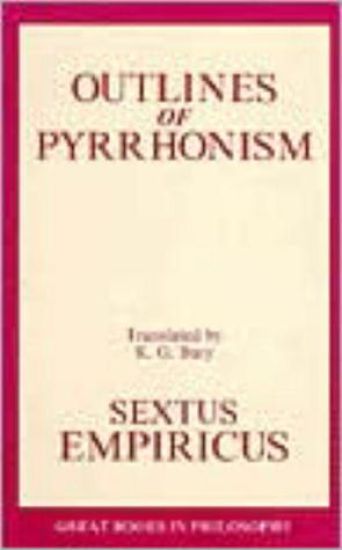
Outlines of Pyrrhonism

Outlines of Pyrrhonism

Sextus Empiricus

Prometheus Books
1990
pokkari
Throughout history philosophers have sought to define, understand, and delineate concepts important to human well-being. One such concept is "knowledge." Many philosophers believed that absolute, certain knowledge, is possible—that the physical world and ideas formulated about it could be given solid foundation unaffected by the varieties of mere opinion. Sextus Empiricus stands as an example of the "skeptic" school of thought whose members believed that knowledge was either unattainable or, if a genuine possibility, the conditions necessary to achieve it were next to impossible to satisfy. In other words, in the absence of complete knowledge, one must make do with the information provided by an imperfect world and conveyed to the mind through sense impressions that can often deceive us. Throughout his life Sextus Empiricus entered into intellectual combat with those who confidently claimed to possess indubitable knowledge. For skeptics, the best one can hope to achieve is a reasonable suspension of judgment—remaining ever mindful that claims to knowledge require careful scrutiny, thoughtful analysis, and critical review if we are to prevent ourselves and others from plunging headlong into mistaken notions.