Kirjojen hintavertailu. Mukana 11 244 527 kirjaa ja 12 kauppaa.

Kirjahaku

Etsi kirjoja tekijän nimen, kirjan nimen tai ISBN:n perusteella.

7 kirjaa tekijältä Seyoon Kim

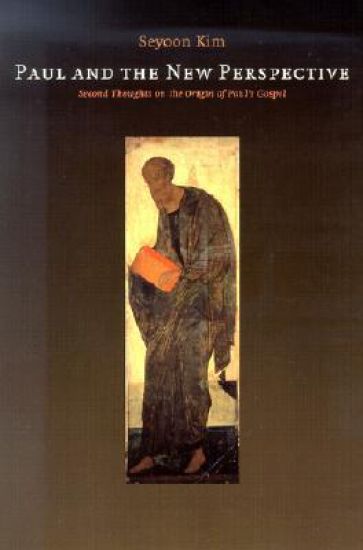
Paul and the New Perspective

Paul and the New Perspective

Seyoon Kim

William B Eerdmans Publishing Co
2002
nidottu
Understanding Paul and his conversion to Christianity is imperative for a thorough knowledge of the New Testament. In Paul and the New Perspective Seyoon Kim develops his argument that the origin of Paul's gospel lies in two places-his radical conversion at Damascus and his usage of the Jesus tradition in light of Damascus. This new way of looking at Paul further explains how Paul made strong distinctions between the Spirit and the flesh/law, with further implications for his doctrine of justification. A departure from the New Perspective School represented by James D. G. Dunn, Kim's Paul and the New Perspective offers a thorough and extensive argument for the foundation of the gospel that Paul spread in the first century.
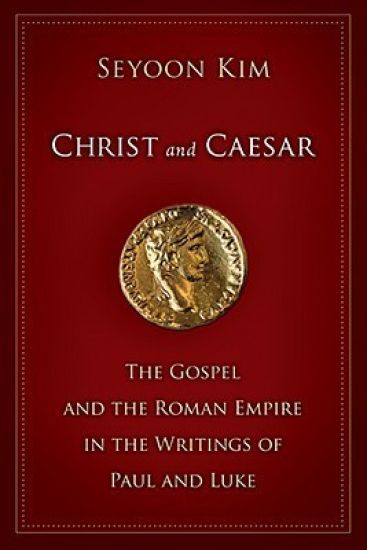
Christ and Caesar

Christ and Caesar

Seyoon Kim

William B Eerdmans Publishing Co
2008
nidottu
The slogan "Paul and the Empire" is much in vogue in New Testament scholarship today. But did Paul truly formulate his gospel in antithesis to the Roman imperial cult and ideology and seek to subvert the Empire? In Christ and Caesar Seyoon Kim first examines five epistles of Paul exegetically and shows how the dominant anti-imperial interpretation is actually difficult to sustain. Next he examines the Lukan writings (Luke-Acts) to see how Luke talks about the encounters of Paul and other gospel preachers with Roman imperialism. Kim explores why it is that Luke makes no effort to present Christ's redemption as materialized in terms of political liberation. Finally, Kim compares the exaltation Christologies of Luke, Revelation, Paul, and Hebrews and inquires about the hermeneutical possibility of developing a political Christology in our present-day context.
The Origin of Paul's Gospel

The Origin of Paul's Gospel

Seyoon Kim

Wipf Stock Publishers
2007
pokkari
In answer to Pauline scholarship that tends to explain the origin of Paul's gospel in Palestinian Judaism, Hellenistic Judaism, mystery cults, or Gnosticism, Seyoon Kim here argues that the origin lies in Paul's own testimony that he received the gospel from the revelation of Jesus Christ on the Damascus road. Only when this insistence of Paul is taken seriously, says Kim, can we really understand Paul and his theology. Kim begins his investigation of Paul's interpretation of the Damascus event by examining Paul's Rabbinic background. He then takes a more detailed look at just what occurred on the Damascus road, and follows this with a thorough discussion of Paul's gospel--the revelation, its Christology, and its soteriology--keeping in mind at all times how it relates to the Damascus event. To American readers this title will be reminiscent of 'The Origin of Paul's Religion' by J. Gresham Machen, published well over a half a century ago. As Dr. Machen took full and critical account of Pauline scholarship in his day, so Dr. Kim does today. The upshot of Dr. Kim's carefully argued study is that all the main elements in Paul's gospel represent the logical outworking of that 'revelation of Jesus Christ' which he received from God on the Damascus road. Kim's book, then, does for this generation what Dr. Machen's book did for his contemporaries. --F. F. Bruce, the late Rylands Professor of Biblical Criticism and Exegesis, University of Manchester A most impressive thesis which goes right to the heart of contemporary study of Paul's theology and can be unreservedly recommended to students in this area. --I. Howard Marshall, Honorary Research Professor of New Testament, University of Aberdeen, and author of 'Witness to the Gospel: The Theology of Acts' Seyoon Kim received his PhD (under the direction of F. F. Bruce) from the University of Manchester, England. He is Associate Dean for the Korean DMin Program and Professor of New Testament at Fuller Theological Seminary.
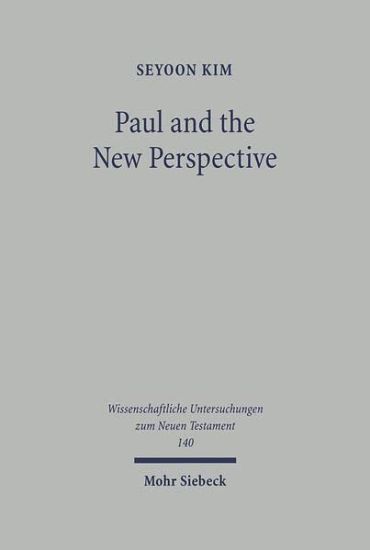
Paul and the New Perspective

Paul and the New Perspective

Seyoon Kim

Mohr Siebeck
2002
sidottu
Critical studies of the two 'test cases' for James D.G. Dunn's 'New Perspective on Paul,' Paul's Damascus experience and Gal 3:10-14, reaffirm the Reformation interpretation of Paul's doctrine of justification and confirm that Paul obtained that doctrine from his Damascus experience. The discovery that Isaiah 42 influenced Paul's interpretation of his apostolic call helps explain how Paul developed his antithesis between the Spirit and the flesh/law and why he insists on the impossibility of justification by works of the law. Contrary to the assumption of the 'New Perspective School', Seyoon Kim's studies issue a call to take Paul seriously as an important witness to his contemporary Judaism. The distinctive Pauline doctrine of Christ as the Image of God and as the Last Adam is revisited in the light of the growing interest in the apocalyptic-mystical background of Paul. The author also explicates how Paul uses the Jesus tradition in the light of the Damascus experience to develop his christology and soteriology. So, while reaffirming the significance of the Damascus event, Seyoon Kim now appreciates the Jesus tradition as equally important for the origin of Paul's gospel. Thus, the overall thesis of the book is that Paul's gospel is a child born of two parents, the Damascus revelation and the Jesus tradition.
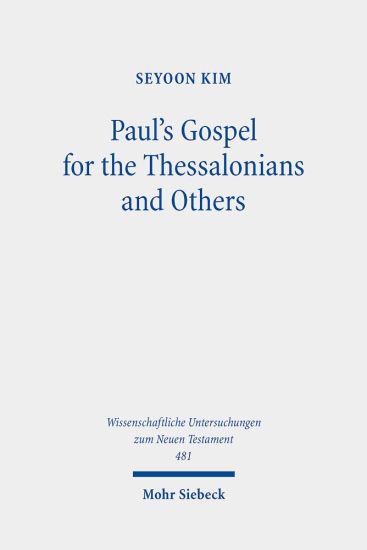
Paul's Gospel for the Thessalonians and Others
In this collection of essays, Seyoon Kim analyses the structure and function of 1 Thess 1-3, which leads to a new reading of 1 Thessalonians. He devotes several essays to a comprehensive exposition of Paul's gospel for the Thessalonians by fully unfolding several summaries of the gospel in the epistle, by detecting and analysing various Son of Man sayings of Jesus that are alluded to or echoed in it, and by a thorough discussion of the unity and continuity of Paul's gospel between this early epistle and his later epistles. This exposition is augmented by a new observation of Paul's doctrine of justification in 2 Thess 1-2 and a new explanation of t? ?at???? and ? ?at???? (2 Thess 2:3-8).