Kirjojen hintavertailu. Mukana 12 414 185 kirjaa ja 12 kauppaa.

Kirjahaku

Etsi kirjoja tekijän nimen, kirjan nimen tai ISBN:n perusteella.

9 kirjaa tekijältä Shannon King

The Politics of Safety

The Politics of Safety

Shannon King

THE UNIVERSITY OF NORTH CAROLINA PRESS
2024
sidottu
For much of the twentieth and twenty-first centuries, public officials in cities like New York, Chicago, and Baltimore have criminalized uprisings—portending Black "thugs" throwing rocks at police and plundering private property—to undermine complaints of police violence. Liberal mayors like Fiorello H. La Guardia have often been the deftest practitioners of this strategy. As the depression and wartime conditions spurred youth crime, white New Yorkers' anxieties—about crime, the movement of Black people into white neighborhoods, and headlines featuring Black "hoodlums" emblazoned all over the white media—drove their support for the expansion of police patrols in the city, especially in Harlem and Bedford-Stuyvesant. Though Blacks also called for police protection and for La Guardia to provide equitable municipal resources, they primarily received more punishment. This set the stage for the Harlem uprising of 1943.Shannon King uncovers how Black activism for safety was a struggle against police brutality and crime, highlighting how the police withholding protection operated was a form of police violence and an abridgement of their civil rights. By decentering familiar narratives of riots, King places Black activism against harm at the center of the Black freedom struggle, revealing how Black neighborhoods became occupied territories in La Guardia's New York.
The Politics of Safety

The Politics of Safety

Shannon King

THE UNIVERSITY OF NORTH CAROLINA PRESS
2024
pokkari
For much of the twentieth and twenty-first centuries, public officials in cities like New York, Chicago, and Baltimore have criminalized uprisings—portending Black "thugs" throwing rocks at police and plundering private property—to undermine complaints of police violence. Liberal mayors like Fiorello H. La Guardia have often been the deftest practitioners of this strategy. As the depression and wartime conditions spurred youth crime, white New Yorkers' anxieties—about crime, the movement of Black people into white neighborhoods, and headlines featuring Black "hoodlums" emblazoned all over the white media—drove their support for the expansion of police patrols in the city, especially in Harlem and Bedford-Stuyvesant. Though Blacks also called for police protection and for La Guardia to provide equitable municipal resources, they primarily received more punishment. This set the stage for the Harlem uprising of 1943.Shannon King uncovers how Black activism for safety was a struggle against police brutality and crime, highlighting how the police withholding protection operated was a form of police violence and an abridgement of their civil rights. By decentering familiar narratives of riots, King places Black activism against harm at the center of the Black freedom struggle, revealing how Black neighborhoods became occupied territories in La Guardia's New York.
Whose Harlem Is This, Anyway?

Whose Harlem Is This, Anyway?

Shannon King

New York University Press
2015
sidottu
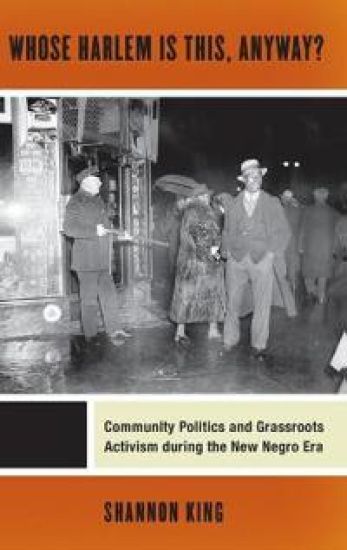
2015 Choice Outstanding Academic Title Winner of the Anna Julia Cooper/CLR James Award for Outstanding Book in Africana Studies presented by the National Council for Black Studies Demonstrates how Harlemite's dynamic fight for their rights and neighborhood raised the black community's racial consciousness and established Harlem's legendary political culture In Whose Harlem Is This, Anyway?, Shannon King vividly uncovers early twentieth century Harlem as an intersection between the black intellectuals and artists who created the New Negro Renaissance and the working class who found fought daily to combat institutionalized racism and gender discrimination in both Harlem and across the city. New Negro activists, such as Hubert Harrison and Frank Crosswaith, challenged local forms of economic and racial inequality in attempts to breakdown the structural manifestations that upheld them. Insurgent stay-at-home black mothers took negligent landlords to court, complaining to magistrates about the absence of hot water and heat in their apartment buildings. Black men and women, propelling dishes, bricks, and other makeshift weapons from their apartment windows and their rooftops, retaliated against hostile policemen harassing blacks on the streets of Harlem. From the turn of the twentieth century to the Great Depression, black Harlemites mobilized around local issues—such as high rents, jobs, leisure, and police brutality—to make their neighborhood an autonomous black community. In Whose Harlem Is This, Anyway?, Shannon King demonstrates how, against all odds, the Harlemite's dynamic fight for their rights and neighborhood raised the black community's racial consciousness and established Harlem's legendary political culture. By the end of the 1920s, Harlem had experience a labor strike, a tenant campaign for affordable rents, and its first race riot. These public forms of protest and discontent represented the dress rehearsal for black mass mobilization in the 1930s and 1940s. By studying blacks' immense investment in community politics, King makes visible the hidden stirrings of a social movement deeply invested in a Black Harlem. Whose Harlem Is This, Anyway? is a vibrant story of the shaping of a community during a pivotal time in American History.
Whose Harlem Is This, Anyway?

Whose Harlem Is This, Anyway?

Shannon King

New York University Press
2017
pokkari
2015 Choice Outstanding Academic Title Winner of the Anna Julia Cooper/CLR James Award for Outstanding Book in Africana Studies presented by the National Council for Black Studies Demonstrates how Harlemite’s dynamic fight for their rights and neighborhood raised the black community’s racial consciousness and established Harlem’s legendary political culture In Whose Harlem Is This, Anyway?, Shannon King vividly uncovers early twentieth century Harlem as an intersection between the black intellectuals and artists who created the New Negro Renaissance and the working class who found fought daily to combat institutionalized racism and gender discrimination in both Harlem and across the city. New Negro activists, such as Hubert Harrison and Frank Crosswaith, challenged local forms of economic and racial inequality in attempts to breakdown the structural manifestations that upheld them. Insurgent stay-at-home black mothers took negligent landlords to court, complaining to magistrates about the absence of hot water and heat in their apartment buildings. Black men and women, propelling dishes, bricks, and other makeshift weapons from their apartment windows and their rooftops, retaliated against hostile policemen harassing blacks on the streets of Harlem. From the turn of the twentieth century to the Great Depression, black Harlemites mobilized around local issues—such as high rents, jobs, leisure, and police brutality—to make their neighborhood an autonomous black community. In Whose Harlem Is This, Anyway?, Shannon King demonstrates how, against all odds, the Harlemite’s dynamic fight for their rights and neighborhood raised the black community’s racial consciousness and established Harlem’s legendary political culture. By the end of the 1920s, Harlem had experience a labor strike, a tenant campaign for affordable rents, and its first race riot. These public forms of protest and discontent represented the dress rehearsal for black mass mobilization in the 1930s and 1940s. By studying blacks' immense investment in community politics, King makes visible the hidden stirrings of a social movement deeply invested in a Black Harlem. Whose Harlem Is This, Anyway? is a vibrant story of the shaping of a community during a pivotal time in American History.

Creating Equity and Access for Gifted Learners

Creating Equity and Access for Gifted Learners

Anne Horak; Kimberley Daly; Shannon King

TAYLOR FRANCIS LTD
2024
nidottu
Creating Equity and Access for Gifted Learners provides an overview of how and why to implement the ExCEL Problem-based Learning Instruction Model as a change initiative in classrooms, and the impact that this model has had on gifted programs.The product of evidence from two federally-funded Jacob K. Javits grants, The ExCEL Model is a systemic, design-based, continuous improvement curriculum and professional learning program that closes equity gaps for culturally, linguistically, and economically diverse students by increasing effective problem-based learning (PBL) instruction. This book will provide readers with the background, evidence, and tools necessary to implement the program model as a change initiative in their schools. Learn how to implement effective, research-grounded professional learning, demonstrate best practices, and navigate red tape and roadblocks.Full of immediately implementable strategies and lesson examples, this book is a must have resource for district leaders, instructional leaders, and teachers ready to make their dream of implementing an equitable and effective professional learning program a reality.
Creating Equity and Access for Gifted Learners

Creating Equity and Access for Gifted Learners

Anne Horak; Kimberley Daly; Shannon King

TAYLOR FRANCIS LTD
2024
sidottu
Creating Equity and Access for Gifted Learners provides an overview of how and why to implement the ExCEL Problem-based Learning Instruction Model as a change initiative in classrooms, and the impact that this model has had on gifted programs.The product of evidence from two federally-funded Jacob K. Javits grants, The ExCEL Model is a systemic, design-based, continuous improvement curriculum and professional learning program that closes equity gaps for culturally, linguistically, and economically diverse students by increasing effective problem-based learning (PBL) instruction. This book will provide readers with the background, evidence, and tools necessary to implement the program model as a change initiative in their schools. Learn how to implement effective, research-grounded professional learning, demonstrate best practices, and navigate red tape and roadblocks.Full of immediately implementable strategies and lesson examples, this book is a must have resource for district leaders, instructional leaders, and teachers ready to make their dream of implementing an equitable and effective professional learning program a reality.