Kirjojen hintavertailu. Mukana 11 342 296 kirjaa ja 12 kauppaa.

Kirjahaku

Etsi kirjoja tekijän nimen, kirjan nimen tai ISBN:n perusteella.

8 kirjaa tekijältä Sheila Delany

Impolitic Bodies

Impolitic Bodies

Sheila Delany

Oxford University Press Inc
1998
sidottu
With Impolitic Bodies Delany breaks important ground in fifteenth century scholarship, a critical site of cultural study. Delany examines the work of English Augustinian friar Osbern Bokenham, never before written on at length, and fully explores the relations of history and literature in the particularly turbulent period in English history, beginning with "The Wars of the Roses" and during the "Hundred Years War." Delany examines the first collection of all female saints' lives in any language: Legends of Holy Women composed by Bokenham between 1443 and 1447. The book is organized around the image of the body --- a medieval procedure becoming popular once again in current attention to the social construction of the body. One emphasis is Bokenham's relation to the body of English literature, particularly Chaucer, the symbolic head of the fifteenth century. Another emphasis is a focus on the genre of saints' lives, particularly female saints' lives, with their striking use of the body of the saint to generate meaning. Finally, the image of the body politic, the controlling image of medieval political thought is here, and Bokenham's means to examine the political and dynastic crises of fifteenth-century England. Delany uses these three major concerns to explain the literary innovation of Bokenham's Legend, and the larger and political importance of that innovation.
Impolitic Bodies

Impolitic Bodies

Sheila Delany

Oxford University Press Inc
1998
nidottu
In Impolitic Bodies Delany breaks important ground in fiteenth-century scholarship, a critical site of cultural study. Delany examines the work of English Augustinian friar Osbern Bokenham, never before written on at length, and fully explores the relations of history and literature in the particularly turbulent period in English history, beginning with "The Wars of the Roses" and during the "Hundred Years War." Delany examines the first collection of all female saints' lives in any language: Legends of Holy Women composed by Bokenham between 1443 and 1447. The book is organized around the image of the body --- a medieval procedure becoming popular once again in current attention to the social construction of the body. One emphasis is Bokenham's relation to the body of English literature, particularly Chaucer, the symbolic head of the fifteenth century. Another emphasis is a focus on the genre of saints' lives, particularly female saints' lives, with their striking use of the body of the saint to generate meaning. Finally, the image of the body politic, the controlling image of medieval political thought is here, and Bokenham's means to examine the political and dynastic crises of fifteenth-century England. Delany uses these three major concerns to explain the literary innovation of Bokenham's Legend, and the larger and political importance of that innovation.
A Legend of Holy Women

A Legend of Holy Women

Sheila Delany

University of Notre Dame Press
1992
sidottu
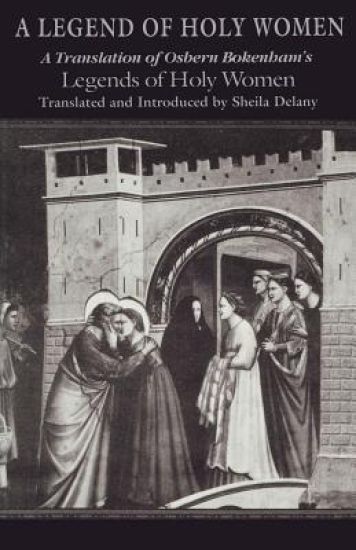
Sheila Delany's spirited translation of Osbern Bokenham's Legendys of Hooly Wummen (1443–1447) makes available in modern English the first all-female hagiography. Closely translated from elaborate, Latinate Middle English verse into fluent prose, A Legend of Holy Women contains the Augustinian friar's version of the stories of 13 women saints from gospel, apocrypha, martyrology, and high-medieval history. As Delany writes in her comprehensive introduction, "Bokenham gives us not only an all-female hagiography—an authorial decision significant in its own right—but a gallery of powerful, articulate women who are indubitably worthy to do God's work. Some of them are well-educated, some give sound political advice to a monarch, some preach, converting hundreds and thousands to Christianity, some walk on water or perform resurrection. Nor are they pacifists; on the contrary, they call for divinely inflicted vengeance and approve violence in their cause." Delany argues that Geoffrey Chaucer's Legend of Good Women provided a principle of selection and of arrangement for Bokenham's array of saints. She suggests further that the friar's choice of all-female hagiography, and his poetic representation of holy women, are closely linked to patronage and politics in fifteenth-century England. The translation is accompanied by full notes which, along with the introduction, make the book accessible to a wide audience. It will appeal to all readers interested in the representation of women in late-medieval culture as well as to scholars and students in medieval, renaissance, religious, and women's studies.
A Legend of Holy Women

A Legend of Holy Women

Sheila Delany

University of Notre Dame Press
1992
nidottu
Sheila Delany's spirited translation of Osbern Bokenham's Legendys of Hooly Wummen (1443–1447) makes available in modern English the first all-female hagiography. Closely translated from elaborate, Latinate Middle English verse into fluent prose, A Legend of Holy Women contains the Augustinian friar's version of the stories of 13 women saints from gospel, apocrypha, martyrology, and high-medieval history. As Delany writes in her comprehensive introduction, "Bokenham gives us not only an all-female hagiography—an authorial decision significant in its own right—but a gallery of powerful, articulate women who are indubitably worthy to do God's work. Some of them are well-educated, some give sound political advice to a monarch, some preach, converting hundreds and thousands to Christianity, some walk on water or perform resurrection. Nor are they pacifists; on the contrary, they call for divinely inflicted vengeance and approve violence in their cause." Delany argues that Geoffrey Chaucer's Legend of Good Women provided a principle of selection and of arrangement for Bokenham's array of saints. She suggests further that the friar's choice of all-female hagiography, and his poetic representation of holy women, are closely linked to patronage and politics in fifteenth-century England. The translation is accompanied by full notes which, along with the introduction, make the book accessible to a wide audience. It will appeal to all readers interested in the representation of women in late-medieval culture as well as to scholars and students in medieval, renaissance, religious, and women's studies.
The Naked Text

The Naked Text

Sheila Delany

University of California Press
2020
pokkari
A sequel to her seminal book on Chaucer’s House of Fame, Sheila Delany’s elegant and innovative study of Chaucer’s Legend of Good Women explores what it meant to be a reader and a writer, and to be English and a courtier, in the late fourteenth century. The richness of late medieval art, philosophy, and history are powerfully brought to bear on one of Chaucer’s most controversial works. So too are the insights of modern critical theory—semiotics, historicism, and gender studies especially—making this a unique achievement in medieval and Chaucerian studies. Delany’s strikingly original readings of Chaucer’s Orientalism, his sexual wordplay, his theological attitudes, and his treatment of sex and gender have given us a Chaucer for our time. This title is part of UC Press's Voices Revived program, which commemorates University of California Press’s mission to seek out and cultivate the brightest minds and give them voice, reach, and impact. Drawing on a backlist dating to 1893, Voices Revived makes high-quality, peer-reviewed scholarship accessible once again using print-on-demand technology. This title was originally published in 1994.
The Naked Text

The Naked Text

Sheila Delany

University of California Press
2021
sidottu
A sequel to her seminal book on Chaucer’s House of Fame, Sheila Delany’s elegant and innovative study of Chaucer’s Legend of Good Women explores what it meant to be a reader and a writer, and to be English and a courtier, in the late fourteenth century. The richness of late medieval art, philosophy, and history are powerfully brought to bear on one of Chaucer’s most controversial works. So too are the insights of modern critical theory—semiotics, historicism, and gender studies especially—making this a unique achievement in medieval and Chaucerian studies. Delany’s strikingly original readings of Chaucer’s Orientalism, his sexual wordplay, his theological attitudes, and his treatment of sex and gender have given us a Chaucer for our time. This title is part of UC Press's Voices Revived program, which commemorates University of California Press’s mission to seek out and cultivate the brightest minds and give them voice, reach, and impact. Drawing on a backlist dating to 1893, Voices Revived makes high-quality, peer-reviewed scholarship accessible once again using print-on-demand technology. This title was originally published in 1994.
Anti-Saints

Anti-Saints

Sheila Delany

University of Alberta Press
2012
pokkari
Compiled by a radical journalist and poet in the early days of the French Revolution, these subversively satirical lives of women saints sought to win both women and men away from religion. Though based on authentic hagiography, Maréchal's "new" legendary introduces a skeptical, rationalist perspective that anticipates modern critical approaches. Along with Delany's thorough introduction and notes, Anti-Saints offers a new perspective on the cultural climate of the French Revolution and a strikingly modern contribution to our own public conversation on religion. A must for scholars and non-specialists alike, and lovers of audacious wit.