Kirjojen hintavertailu. Mukana 11 244 527 kirjaa ja 12 kauppaa.

Kirjahaku

Etsi kirjoja tekijän nimen, kirjan nimen tai ISBN:n perusteella.

12 kirjaa tekijältä Sheldon M. Ross

Student Solutions Manual for Introductory Statistics
This handy supplement shows students how to come to the answers shown in the back of the text. It includes solutions to all of the odd numbered exercises. The text itself: In this second edition, master expositor Sheldon Ross has produced a unique work in introductory statistics. The text's main merits are the clarity of presentation, examples and applications from diverse areas, and most importantly, an explanation of intuition and ideas behind the statistical methods. To quote from the preface, "it is only when a student develops a feel or intuition for statistics that she or he is really on the path toward making sense of data." Consistent with his other excellent books in Probability and Stochastic Modeling, Ross achieves this goal through a coherent mix of mathematical analysis, intuitive discussions and examples.
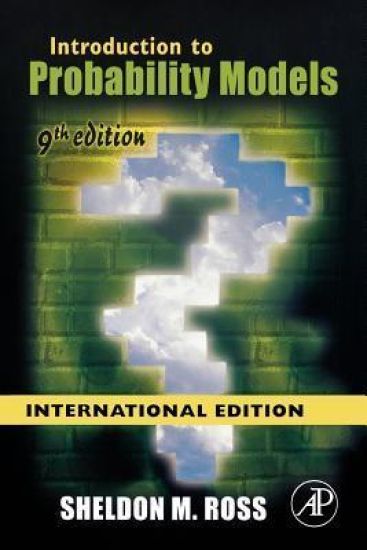
Introduction to Probability Models, ISE

Introduction to Probability Models, ISE

Sheldon M. Ross

Academic Press Inc
2006
nidottu
Ross's classic bestseller, Introduction to Probability Models, has been used extensively by professionals and as the primary text for a first undergraduate course in applied probability. It provides an introduction to elementary probability theory and stochastic processes, and shows how probability theory can be applied to the study of phenomena in fields such as engineering, computer science, management science, the physical and social sciences, and operations research. With the addition of several new sections relating to actuaries, this text is highly recommended by the Society of Actuaries. A new section (3.7) on COMPOUND RANDOM VARIABLES, that can be used to establish a recursive formula for computing probability mass functions for a variety of common compounding distributions. A new section (4.11) on HIDDDEN MARKOV CHAINS, including the forward and backward approaches for computing the joint probability mass function of the signals, as well as the Viterbi algorithm for determining the most likely sequence of states. Simplified Approach for Analyzing Nonhomogeneous Poisson processes Additional results on queues relating to the (a) conditional distribution of the number found by an M/M/1 arrival who spends a time t in the system; (b) inspection paradox for M/M/1 queues (c) M/G/1 queue with server breakdown Many new examples and exercises.
Simulation

Simulation

Sheldon M. Ross

Academic Press Inc
2012
sidottu
The 5th edition of Ross’s Simulation continues to introduce aspiring and practicing actuaries, engineers, computer scientists and others to the practical aspects of constructing computerized simulation studies to analyze and interpret real phenomena. Readers learn to apply results of these analyses to problems in a wide variety of fields to obtain effective, accurate solutions and make predictions about future outcomes. This latest edition features all-new material on variance reduction, including control variables and their use in estimating the expected return at blackjack and their relation to regression analysis. Additionally, the 5th edition expands on Markov chain monte carlo methods, and offers unique information on the alias method for generating discrete random variables. By explaining how a computer can be used to generate random numbers and how to use these random numbers to generate the behavior of a stochastic model over time, Ross’s Simulation, 5th edition presents the statistics needed to analyze simulated data as well as that needed for validating the simulation model.
Introductory Statistics

Introductory Statistics

Sheldon M. Ross

Academic Press Inc
2017
sidottu
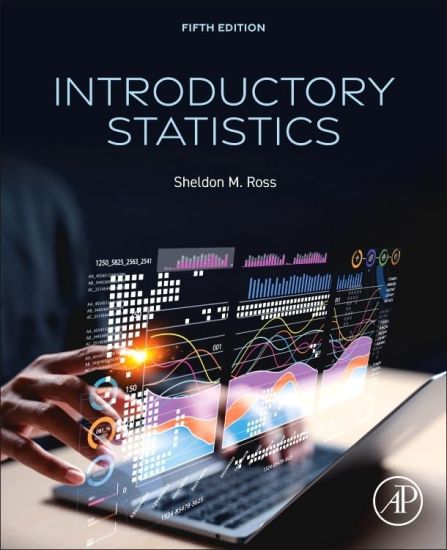
Introductory Statistics, Fourth Edition, reviews statistical concepts and techniques in a manner that will teach students not only how and when to utilize the statistical procedures developed, but also how to understand why these procedures should be used. The text's main merits are the clarity of presentation, contemporary examples and applications from diverse areas, an explanation of intuition, and the ideas behind the statistical methods. Concepts are motivated, illustrated, and explained in a way that attempts to increase one's intuition. To quote from the preface, it is only when a student develops a feel or intuition for statistics that she or he is really on the path toward making sense of data. Ross achieves this goal through a coherent mix of mathematical analysis, intuitive discussions, and examples. Applications and examples refer to real-world issues, such as gun control, stock price models, health issues, driving age limits, school admission ages, use of helmets, sports, scientific fraud, and many others. Examples relating to data mining techniques using the number of Google queries or Twitter tweets are also considered. For this fourth edition, new topical coverage includes sections on Pareto distribution and the 80-20 rule, Benford's law, added material on odds and joint distributions and correlation, logistic regression, A-B testing, and more modern (big data) examples and exercises.
Introduction to Probability and Statistics for Engineers and Scientists
Introduction to Probability and Statistics for Engineers and Scientists, Sixth Edition, uniquely emphasizes how probability informs statistical problems, thus helping readers develop an intuitive understanding of the statistical procedures commonly used by practicing engineers and scientists. Utilizing real data from actual studies across life science, engineering, computing and business, this useful introduction supports reader comprehension through a wide variety of exercises and examples. End-of-chapter reviews of materials highlight key ideas, also discussing the risks associated with the practical application of each material. In the new edition, coverage includes information on Big Data and the use of R. This book is intended for upper level undergraduate and graduate students taking a probability and statistics course in engineering programs as well as those across the biological, physical and computer science departments. It is also appropriate for scientists, engineers and other professionals seeking a reference of foundational content and application to these fields.
Simulation

Simulation

Sheldon M. Ross

ELSEVIER SCIENCE TECHNOLOGY
2022
sidottu
Simulation, Sixth Edition continues to introduce aspiring and practicing actuaries, engineers, computer scientists and others to the practical aspects of constructing computerized simulation studies to analyze and interpret real phenomena. Readers will learn to apply the results of these analyses to problems in a wide variety of fields to obtain effective, accurate solutions and make predictions. By explaining how a computer can be used to generate random numbers and how to use these random numbers to generate the behavior of a stochastic model over time, this book presents the statistics needed to analyze simulated data and validate simulation models.
Introduction to Probability Models

Introduction to Probability Models

Sheldon M. Ross

ELSEVIER SCIENCE PUBLISHING CO INC
2023
nidottu
*Textbook and Academic Authors Association (TAA) McGuffey Longevity Award Winner, 2024* A trusted market leader for four decades, Sheldon Ross’s Introduction to Probability Models offers a comprehensive foundation of this key subject with applications across engineering, computer science, management science, the physical and social sciences and operations research. Through its hallmark exercises and real examples, this valuable course text Introduction to Probability Models provides the reader with a comprehensive course in the subject, from foundations to advanced topics.
Stochastic Processes

Stochastic Processes

Sheldon M. Ross

John Wiley Sons Inc
1996
sidottu
A nonmeasure theoretic introduction to stochastic processes. Considers its diverse range of applications and provides readers with probabilistic intuition and insight in thinking about problems. This revised edition contains additional material on compound Poisson random variables including an identity which can be used to efficiently compute moments; a new chapter on Poisson approximations; and coverage of the mean time spent in transient states as well as examples relating to the Gibb's sampler, the Metropolis algorithm and mean cover time in star graphs. Numerous exercises and problems have been added throughout the text.
An Elementary Introduction to Mathematical Finance

An Elementary Introduction to Mathematical Finance

Sheldon M. Ross

Cambridge University Press
2011
sidottu
This textbook on the basics of option pricing is accessible to readers with limited mathematical training. It is for both professional traders and undergraduates studying the basics of finance. Assuming no prior knowledge of probability, Sheldon M. Ross offers clear, simple explanations of arbitrage, the Black-Scholes option pricing formula, and other topics such as utility functions, optimal portfolio selections, and the capital assets pricing model. Among the many new features of this third edition are new chapters on Brownian motion and geometric Brownian motion, stochastic order relations and stochastic dynamic programming, along with expanded sets of exercises and references for all the chapters.
Topics in Finite and Discrete Mathematics

Topics in Finite and Discrete Mathematics

Sheldon M. Ross

Cambridge University Press
2000
sidottu
Written for a broad audience of students in mathematics, computer science, operations research, statistics, and engineering, this textbook presents a short, lively survey of several fascinating non-calculus topics in modern applied mathematics. Coverage includes probability, mathematical finance, graphs, linear programming, statistics, computer science algorithms, and groups. A key feature is the abundance of interesting examples not normally found in standard finite mathematics courses, such as options pricing and arbitrage, tournaments, and counting formulas. The author assumes a level of mathematical sophistication at the beginning calculus level, that is, students should have had at least a course in pre-calculus, and the added sophistication attained from studying calculus would be useful.