Kirjojen hintavertailu. Mukana 11 627 362 kirjaa ja 12 kauppaa.

Kirjahaku

Etsi kirjoja tekijän nimen, kirjan nimen tai ISBN:n perusteella.

7 kirjaa tekijältä Sheldon S. Wolin

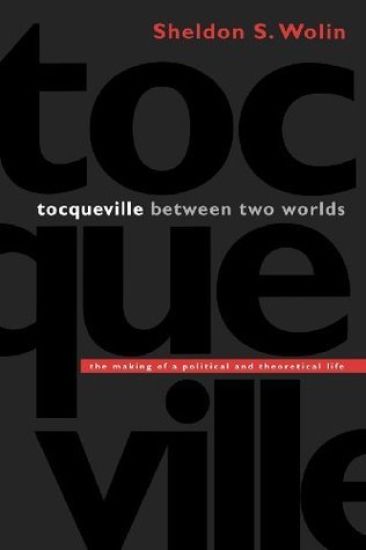
Tocqueville between Two Worlds

Tocqueville between Two Worlds

Sheldon S. Wolin

Princeton University Press
2003
pokkari
Alexis de Tocqueville may be the most influential political thinker in American history. He also led an unusually active and ambitious career in French politics. In this magisterial book, one of America's most important contemporary theorists draws on decades of research and thought to present the first work that fully connects Tocqueville's political and theoretical lives. In doing so, Sheldon Wolin presents sweeping new interpretations of Tocqueville's major works and of his place in intellectual history. As he traces the origins and impact of Tocqueville's ideas, Wolin also offers a profound commentary on the general trajectory of Western political life over the past two hundred years. Wolin proceeds by examining Tocqueville's key writings in light of his experiences in the troubled world of French politics. He portrays Democracy in America, for example, as a theory of discovery that emerged from Tocqueville's contrasting experiences of America and of France's constitutional monarchy. He shows us how Tocqueville used Recollections to reexamine his political commitments in light of the revolutions of 1848 and the threat of socialism. He portrays The Old Regime and the French Revolution as a work of theoretical history designed to throw light on the Bonapartist despotism he saw around him. Throughout, Wolin highlights the tensions between Tocqueville's ideas and his activities as a politician, arguing that--despite his limited political success--Tocqueville was "perhaps the last influential theorist who can be said to have truly cared about political life." In the course of the book, Wolin also shows that Tocqueville struggled with many of the forces that constrain politics today, including the relentless advance of capitalism, of science and technology, and of state bureaucracy. He concludes that Tocqueville's insights and anxieties about the impotence of politics in a "postaristocratic" era speak directly to the challenges of our own "postdemocratic" age. A monumental new study of Tocqueville, this is also a rich and provocative work about the past, the present, and the future of democratic life in America and abroad.
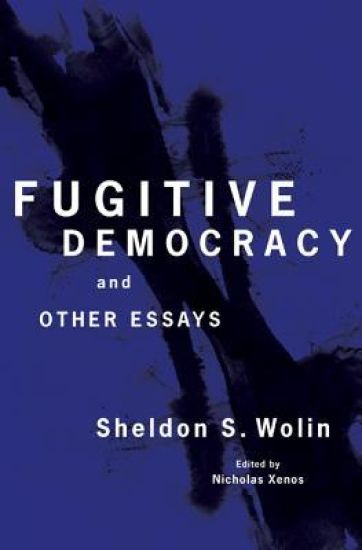
Fugitive Democracy

Fugitive Democracy

Sheldon S. Wolin

PRINCETON UNIVERSITY PRESS
2016
sidottu
Sheldon Wolin was one of the most influential and original political thinkers of the past fifty years. Fugitive Democracy brings together his most important writings, from classic essays such as "Political Theory as a Vocation," written amid the Cold War and the conflict in Vietnam, to his late radical essays on American democracy such as "Fugitive Democracy," in which he offers a controversial reinterpretation of democracy as an episodic phenomenon distinct from the routinized political management that passes for democracy today. The breathtaking range of Wolin's scholarship, political commitment, and critical acumen are on full display in this authoritative and accessible collection. He critically engages a diverse range of political theorists, including Thomas Hobbes, Karl Marx, Max Weber, Hannah Arendt, John Rawls, Michel Foucault, and Richard Rorty. These essays grapple with topics such as power, modernization, the sixties, revolutionary politics, and inequality, all the while showcasing Wolin's enduring commitment to writing civic-minded theoretical commentary on the most pressing political issues of the day. Here, Wolin laments the rise of conservatives who style themselves as revolutionary, criticizes Rawlsian liberals as abstract to the point of being apolitical, diagnoses postmodern theory as a form of acquiescence, and much more. Fugitive Democracy offers enduring insights into many of today's most pressing political predicaments, and introduces a whole new generation of readers to this provocative figure in contemporary political thought.
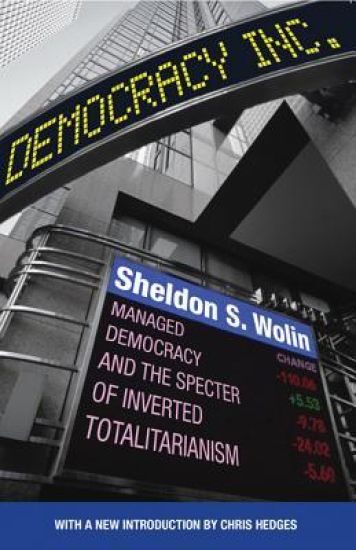
Democracy Incorporated

Democracy Incorporated

Sheldon S. Wolin

Princeton University Press
2017
pokkari
Democracy is struggling in America--by now this statement is almost cliche. But what if the country is no longer a democracy at all? In Democracy Incorporated, Sheldon Wolin considers the unthinkable: has America unwittingly morphed into a new and strange kind of political hybrid, one where economic and state powers are conjoined and virtually unbridled? Can the nation check its descent into what the author terms "inverted totalitarianism"? Wolin portrays a country where citizens are politically uninterested and submissive--and where elites are eager to keep them that way. At best the nation has become a "managed democracy" where the public is shepherded, not sovereign. At worst it is a place where corporate power no longer answers to state controls. Wolin makes clear that today's America is in no way morally or politically comparable to totalitarian states like Nazi Germany, yet he warns that unchecked economic power risks verging on total power and has its own unnerving pathologies. Wolin examines the myths and mythmaking that justify today's politics, the quest for an ever-expanding economy, and the perverse attractions of an endless war on terror. He argues passionately that democracy's best hope lies in citizens themselves learning anew to exercise power at the local level. Democracy Incorporated is one of the most worrying diagnoses of America's political ills to emerge in decades. It is sure to be a lightning rod for political debate for years to come. Now with a new introduction by Pulitzer Prize-winning journalist Chris Hedges, Democracy Incorporated remains an essential work for understanding the state of democracy in America.
Fugitive Democracy

Fugitive Democracy

Sheldon S. Wolin

Princeton University Press
2018
pokkari
An authoritative collection of the most important writings of an influential political thinkerSheldon Wolin was one of the most influential and original political thinkers of the past fifty years. In Fugitive Democracy, the breathtaking range of Wolin’s scholarship, political commitment, and critical acumen are on full display in this authoritative and accessible collection of essays. This book brings together his most important writings, from classic essays to his late radical essays on American democracy such as "Fugitive Democracy," in which he offers a controversial reinterpretation of democracy as an episodic phenomenon distinct from the routinized political management that passes for democracy today. Wolin critically engages a diverse range of political theorists, and grapples with topics such as power, modernization, the sixties, revolutionary politics, and inequality, all the while showcasing enduring commitment to writing civic-minded theoretical commentary on the most pressing political issues of the day. Fugitive Democracy offers enduring insights into many of today’s most pressing political predicaments, and introduces a whole new generation of readers to this provocative figure in contemporary political thought.
Politics and Vision: Continuity and Innovation in Western Political Thought
""Politics and Vision: Continuity and Innovation in Western Political Thought"" by Sheldon S. Wolin is a comprehensive exploration of the evolution of political thought in the Western world. The book examines the historical context and philosophical ideas that have shaped political theory over time, from ancient Greece to modern times. Wolin argues that political theory has always been a product of its time, shaped by the historical and social conditions of the era in which it was developed. At the same time, he also argues that there are certain enduring themes and ideas that have persisted throughout history, such as the tension between individual freedom and social order, and the struggle for power and control. Through a careful analysis of key thinkers and their works, Wolin traces the development of these themes and ideas over time, showing how they have been adapted and transformed in response to changing circumstances. ""Politics and Vision"" is a rich and insightful work that will appeal to anyone interested in the history of political thought and the evolution of political ideas in the Western world.This scarce antiquarian book is a facsimile reprint of the old original and may contain some imperfections such as library marks and notations. Because we believe this work is culturally important, we have made it available as part of our commitment for protecting, preserving, and promoting the world's literature in affordable, high quality, modern editions, that are true to their original work.
Politics and Vision: Continuity and Innovation in Western Political Thought
This is a significantly expanded edition of one of the greatest works of modern political theory. Sheldon Wolin's "Politics and Vision" inspired and instructed two generations of political theorists after its appearance in 1960. This new edition retains intact the original ten chapters about political thinkers from Plato to Mill, and adds seven chapters about theorists from Marx and Nietzsche to Rawls and the postmodernists. The new chapters, which show how thinkers have grappled with the immense possibilities and dangers of modern power, are themselves a major theoretical statement. They culminate in Wolin's remarkable argument that the United States has invented a new political form, "inverted totalitarianism," in which economic rather than political power is dangerously dominant. In this new edition, the book that helped to define political theory in the late twentieth century should energize, enlighten, and provoke generations of scholars to come. Wolin originally wrote "Politics and Vision" to challenge the idea that political analysis should consist simply of the neutral observation of objective reality. He argues that political thinkers must also rely on creative vision. Wolin shows that great theorists have been driven to shape politics to some vision of the Good that lies outside the existing political order. As he tells it, the history of theory is thus, in part, the story of changing assumptions about the Good. In the new chapters, Wolin displays all the energy and flair, the command of detail and of grand historical developments, that he brought to this story forty years ago. This is a work of immense talent and intense thought, an intellectual achievement that will endure.