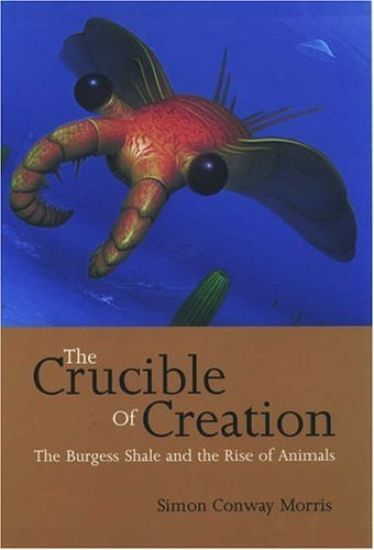
'tells a great story and manages to be informative at all levels. Conway Morris has a collector's eye for the sort of entertaining yet informative snippets that keep readers on their toes.' New Scientist Located in the west of Canada, the Burgess Shale contains a unique collection of fossil remains, and has become an icon for those studying the history of life. This remarkable book takes us on a fresh journey back in time through the Burgess Shale and its astonishing collection of pre-Cambrian creatures. In an entertaining and readable style, Simon Conway Morris paints a vivid picture of the critical period which saw the diversification of all the major animal groups, and takes a controversial stance on current evolutionary theories that is sure to provoke much interest and debate. 'It is less bleak in its assessment of life on earth and it is spiritually uplifting, rather than dry and mechanistic as some would have us believe' THES 'The centerpiece of The Crucible of Creation is a description, authoritative and readable, of the animals themselves. New York Times Book Review
The assassin’s bullet misses, the Archduke’s carriage moves forward, and a catastrophic war is avoided. So too with the history of life. Re-run the tape of life, as Stephen J. Gould claimed, and the outcome must be entirely different: an alien world, without humans and maybe not even intelligence. The history of life is littered with accidents: any twist or turn may lead to a completely different world. Now this view is being challenged. Simon Conway Morris explores the evidence demonstrating life’s almost eerie ability to navigate to a single solution, repeatedly. Eyes, brains, tools, even culture: all are very much on the cards. So if these are all evolutionary inevitabilities, where are our counterparts across the galaxy? The tape of life can only run on a suitable planet, and it seems that such Earth-like planets may be much rarer than hoped. Inevitable humans, yes, but in a lonely Universe.
How did human beings acquire imaginations that can conjure up untrue possibilities? How did the Universe become self-aware? In The Runes of Evolution, Simon Conway Morris revitalizes the study of evolution from the perspective of convergence, providing us with compelling new evidence to support the mounting scientific view that the history of life is far more predictable than once thought. A leading evolutionary biologist at the University of Cambridge, Conway Morris came into international prominence for his work on the Cambrian explosion (especially fossils of the Burgess Shale) and evolutionary convergence, which is the process whereby organisms not closely related (not monophyletic), independently evolve similar traits as a result of having to adapt to similar environments or ecological niches. In The Runes of Evolution, he illustrates how the ubiquity of convergence hints at an underlying framework whereby many outcomes, not least brains and intelligence, are virtually guaranteed on any Earth-like planet. Conway Morris also emphasizes how much of the complexity of advanced biological systems is inherent in microbial forms. By casting a wider net, The Runes of Evolution explores many neglected evolutionary questions. Some are remarkably general. Why, for example, are convergences such as parasitism, carnivory, and nitrogen fixation in plants concentrated in particular taxonomic hot spots? Why do certain groups have a particular propensity to evolve toward particular states? Some questions lead to unexpected evolutionary insights: If bees sleep (as they do), do they dream? Why is that insect copulating with an orchid? Why have sponges evolved a system of fiber optics? What do mantis shrimps and submarines have in common? If dinosaurs had not gone extinct what would have happened next? Will a saber-toothed cat ever re-evolve? Cona Morris observes: “Even amongst the mammals, let alone the entire tree of life, humans represent one minute twig of a vast (and largely fossilized) arborescence. Every living species is a linear descendant of an immense string of now-vanished ancestors, but evolution itself is the very reverse of linear. Rather it is endlessly exploratory, probing the vast spaces of biological hyperspace. Indeed this book is a celebration of how our world is (and was) populated by a riot of forms, a coruscating tapestry of life.” The Runes of Evolution is the most definitive synthesis of evolutionary convergence to be published to date.
How did human beings acquire imaginations that can conjure up untrue possibilities? How did the Universe become self-aware? In The Runes of Evolution, Simon Conway Morris revitalizes the study of evolution from the perspective of convergence, providing us with compelling new evidence to support the mounting scientific view that the history of life is far more predictable than once thought. A leading evolutionary biologist at the University of Cambridge, Conway Morris came into international prominence for his work on the Cambrian explosion (especially fossils of the Burgess Shale) and evolutionary convergence, which is the process whereby organisms not closely related (not monophyletic), independently evolve similar traits as a result of having to adapt to similar environments or ecological niches. In The Runes of Evolution, he illustrates how the ubiquity of convergence hints at an underlying framework whereby many outcomes, not least brains and intelligence, are virtually guaranteed on any Earth-like planet. Conway Morris also emphasizes how much of the complexity of advanced biological systems is inherent in microbial forms. By casting a wider net, The Runes of Evolution explores many neglected evolutionary questions. Some are remarkably general. Why, for example, are convergences such as parasitism, carnivory, and nitrogen fixation in plants concentrated in particular taxonomic hot spots? Why do certain groups have a particular propensity to evolve toward particular states? Some questions lead to unexpected evolutionary insights: If bees sleep (as they do), do they dream? Why is that insect copulating with an orchid? Why have sponges evolved a system of fiber optics? What do mantis shrimps and submarines have in common? If dinosaurs had not gone extinct what would have happened next? Will a saber-toothed cat ever re-evolve? Cona Morris observes: “Even amongst the mammals, let alone the entire tree of life, humans represent one minute twig of a vast (and largely fossilized) arborescence. Every living species is a linear descendant of an immense string of now-vanished ancestors, but evolution itself is the very reverse of linear. Rather it is endlessly exploratory, probing the vast spaces of biological hyperspace. Indeed this book is a celebration of how our world is (and was) populated by a riot of forms, a coruscating tapestry of life.” The Runes of Evolution is the most definitive synthesis of evolutionary convergence to be published to date.