Kirjojen hintavertailu. Mukana 11 424 356 kirjaa ja 12 kauppaa.

Kirjahaku

Etsi kirjoja tekijän nimen, kirjan nimen tai ISBN:n perusteella.

8 kirjaa tekijältä Simon Forty

Normandy 1944: The Battle of the Hedgerows

Normandy 1944: The Battle of the Hedgerows

Simon Forty

Pen Sword Military
2018
nidottu
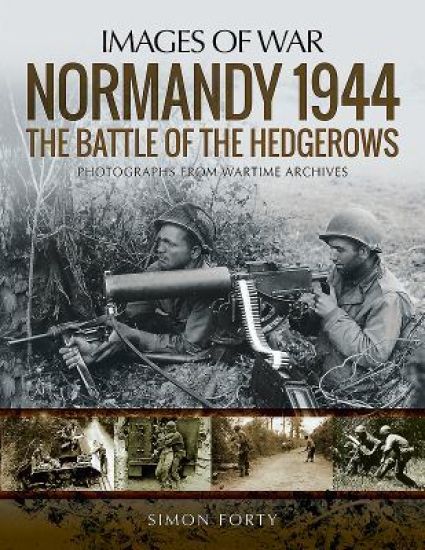
Just as the Anglo-Canadian forces in the east found it difficult to advance beyond Caen after D-Day, so the US First Army laboured to advance through the Norman bocage country in the west. The lethal struggle that developed there was a defining episode in the Normandy campaign, and this photographic history is a vivid introduction to it. Through a selection of over 150 carefully chosen and meticulously captioned�wartime photographs Simon Forty traces the course of the battle and gives the reader a graphic impression of the conditions, the terrain and the experience of the troops. The Germans mounted a tenacious defence. They fought from prepared positions in the high hedgerows. Each cramped field and narrow lane became a killing ground. But the Americans adapted their tactics and brought in special equipment including bulldozers and tanks with hedgerow cutters to force their way through. The losses were appalling as the Germans used snipers, mines, machineguns and artillery to great effect. Inexorably, however, and with enormous bravery, First Army solved their tactical problems, inflicted heavy casualties on the defenders and ground their way to Saint-L�.
Normandy 1944: The Battle for Caen

Normandy 1944: The Battle for Caen

Simon Forty

Pen Sword Military
2018
nidottu
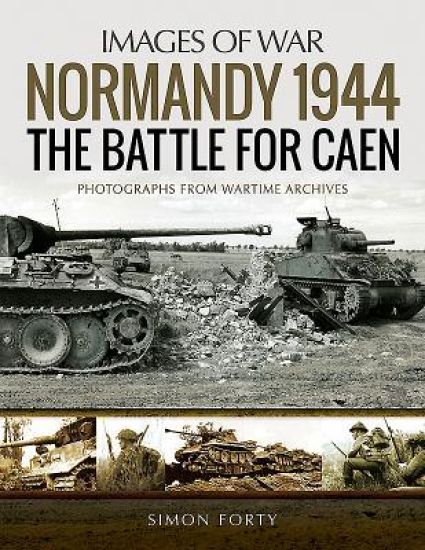
Caen, a D-Day objective on 6 June 1944, did not fall to the British and Canadian troops of Second Army until 6 August, by which time much of the city had been reduced to rubble. The two-month struggle was a crucial stage in the Normandy campaign and, as Simon Forty demonstrates in this photographic history, one of the most controversial. His detailed, graphic account gives the reader a fascinating insight into the opposing forces, the conditions, the terrain, the equipment and weaponry deployed-and it illustrates just how intense and protracted the fighting was on the ground. The reasons for the slow Allied advance have been hotly disputed. Deficiencies in British and Canadian equipment and tactics have been blamed, as has the tenacity of the German resistance. Ultimately a sequence of Allied operations sapped the defenders' strength, and it is these operations-Perch, Martlet, Epsom, Windsor, Charnwood, Jupiter, Atlantic, Goodwood-that feature strongly in the striking photographs that have been selected for this book. They record in the most dramatic fashion the character of the fighting and show how even the SS divisions and heavy tank battalions were eventually defeated.
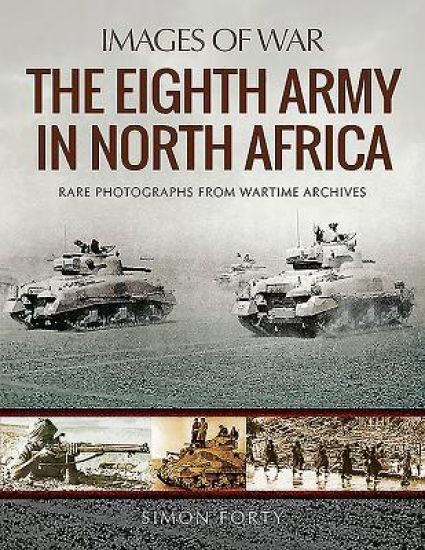
The Eighth Army in North Africa

The Eighth Army in North Africa

Simon Forty

Pen Sword Military
2019
nidottu
The British Eighth Army, which played a decisive role in defeating the Axis in North Africa, was one of the most celebrated Allied armies of the Second World War, and this photographic history is the ideal introduction to it. The carefully chosen photographs show the men, weapons and equipment of the army during campaigns in Egypt, Libya and Tunisia. The battles the army fought in the Western Desert in 1941 and 1942 are the stuff of legend, as is the second Battle of El Alamein when, under Montgomery, it defeated the German and Italian forces commanded by Rommel. The book gives a vivid insight into the fighting and the desert conditions, and it shows what a varied, multinational force the army was, for it brought together men from Britain, the British Empire and Commonwealth as well as Free French, Greeks and Poles.
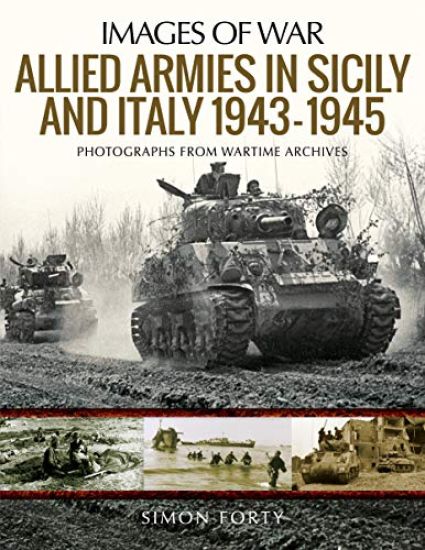
Allied Armies in Sicily and Italy, 1943-1945

Allied Armies in Sicily and Italy, 1943-1945

Simon Forty

Pen Sword Military
2020
nidottu
The Italian campaign was one of the most debated of the Second World War, splitting the American and British allies, and causing great disharmony. After the fall of Rome and the surrender of Italy, the invasion of Normandy led to the Italian campaign becoming a sideshow as the D-Day Dodgers' fought their way through Italy to the Alps against a grinding defence and extreme weather. In a sequence of 200 wartime photographs Simon Forty sums up the major events of the conflict - from the landings on Sicily to the crossing of the Po. Commanded first by Sir Harold Alexander and then Mark Clark, the Allied armies (US Fifth and British Eighth) drew men not only from Britain, the United States, France and Poland but from all over the Commonwealth - from Australia, Canada, India, New Zealand and South Africa - as well as such other countries as Brazil, Czechoslovakia, Greece and Palestine. The devastation caused by the war in the cities, towns and countryside is part of the story, but perhaps the most powerful impression is made by the faces of the soldiers themselves as they look out from the Italian front of so long ago.
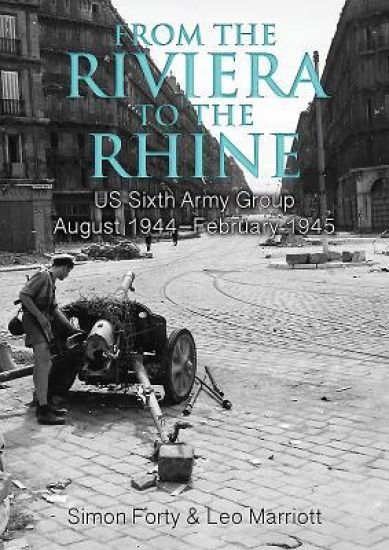
From the Riviera to the Rhine

From the Riviera to the Rhine

Simon Forty

Casemate Publishers
2018
sidottu
Two months after D-Day, just as the battle of Normandy was reaching its climax, with all eyes on the Falaise Pocket, the Allies unleashed the second invasion of France not in the Pas de Calais but the French Riviera. Immaculately planned, effectively undertaken, the Allies quickly broke out of their bridgehead, drove 400 miles into France in three weeks, and liberated 10,000 square miles of French territory while inflicting 143,250 German casualties. On September 10 they linked up with Patton’s Third Army and advanced into the Vosges Mountains, taking Strasbourg and holding the area against the Germans’ final big attack in the west: Operation Nordwind in January 1945. US Seventh Army and 6th Army Group undertook a successful campaign placing a third Allied army group with its own independent supply lines, in northeastern France at a time when the two northern Allied army groups were stretched to the limit. Without this force the Allies would have struggled to hold the frontage to Switzerland and Third Army would have been exposed to attack in its southern flank—something that could have had disastrous repercussions particularly during the Ardennes offensive of December 1944.The images of palm trees and azure seas obscure our view of this campaign. It was no cakewalk. The Germans knew the Allies were coming and had strong defences in the area. A shortage of landing craft, vehicles, and matériel meant that the US Seventh and French First armies were restricted in the assault. The heavy fog and anti-glider defences made for a difficult airborne assault, but it was carried out effectively, the amphibious assault was textbook in execution and the invasion of southern France ended up as a significant victory. But the story of 6th Army Group wasn’t finished. Taking up a position on the east flank of Third Army it fought its way through the Vosges and withstood the Germans’ last throw: Operation Nordwind—the vain attempt to relieve pressure on the Ardennes assault by attacking in the Vosges. Heavy fighting pressed hard towards Strasbourg but the Allies were ultimately victorious, inflicting severe losses on the Germans.
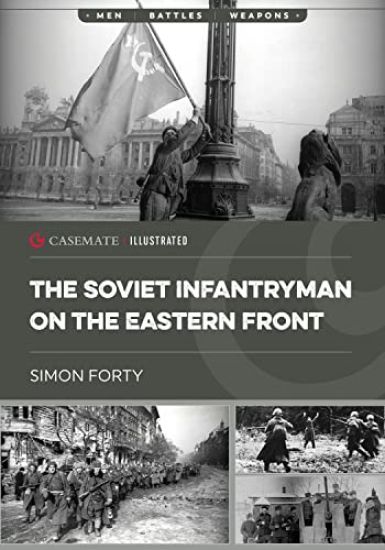
The Soviet Infantryman on the Eastern Front

The Soviet Infantryman on the Eastern Front

Simon Forty

Casemate Publishers
2023
nidottu
The Soviet Army was ill-prepared for its erstwhile ally's treacherous onslaught in 1941. Its officer corps decimated by Stalin's purges and its men less well-trained than the Germans, the Red Army was poorly led, hampered by the power of the political officers and only partly mobilised. But, in spite of the huge German victories and the speed of the Nazi attack, the Soviets proved fantastically capable of rolling with the punches. The vast territory of the Soviet Union and huge population were significant factors, as was substantial assistance from the West – the United States and Britain in particular – which was in evidence when the German columns got to within a few miles short of Moscow and were held and then forced back. The tide turned thanks to help from outside and the efforts of the Soviet soldiers, who proved hardy and durable. And just like its soldiers, Russian infantry equipment was rugged and effective. While Soviet infantrymen may not have had the flexibility or tactical nous of the Germans, they did not lack cunning: deception, camouflage skills and endurance made Russian snipers, as an example, more than the equal of the Germans. Most views of the Soviet soldier and campaign are influenced by self-serving German postwar accounts designed to excuse their loss by suggesting that Adolf Hitler's meddling and Soviet numbers were the main reasons for victory: this denigrates the Russian infantryman whose toughness and ingenuity helped destroy the Third Reich in spite of the faults of its own regime. Fully illustrated with over 200 contemporary photographs and illustrations, Soviet Infantryman on the Eastern Front in the Casemate Illustrated series provides an insight into the Soviets' main theater of operations in World War II.
British Infantryman

British Infantryman

Simon Forty

J H Haynes Co Ltd
2020
sidottu
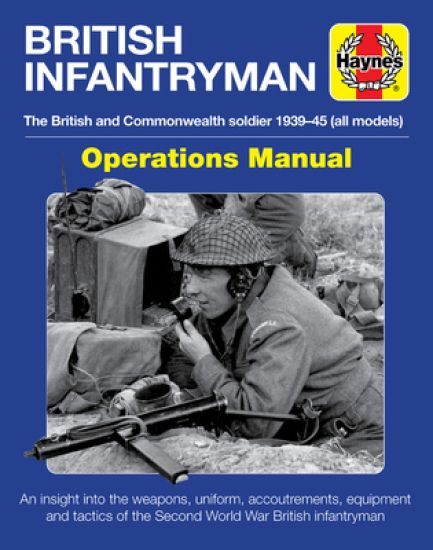
The British and Commonwealth Soldier 1939-45, British soldiers, with their old-fashioned helmets, spring-powered PIAT anti-tank guns and veneration of heroic defeats, may have lost the propaganda war, but their record speaks for itself: they may have started badly in France in 1940 and the Far East in 1941, but they were victorious in the North African desert, in Europe and in India and Burma where the 'Forgotten Army' first held the Japanese and then inflicted at Imphal and Kohima the greatest loss to the Japanese on land. They held back the might of the Panzers in Normandy in 1944, chased the Germans back into Holland and came within a whisker at Arnhem of circumventing the Siegfried Line, and won battle after battle against a fanatical defence on their way to final victory., This book doesn't cover the progress of the Second World War, but looks in detail at the weapons, uniform, accoutrements, equipment and tactics of the Second World War British infantryman, following the themes of the Haynes Great War British Tommy and German Infantryman Manuals., Author: Simon Forty was educated at Sedbergh School and London University's School of Slavonic and East European Studies. He has been involved in publishing for over three decades and specializes in military history having contributed to a large number of books. He was also general editor of World War I: A Visual Encyclopedia. Simon lives in Devon with his wife and two children.
D-Day UK

D-Day UK

Simon Forty

Historic England
2019
sidottu
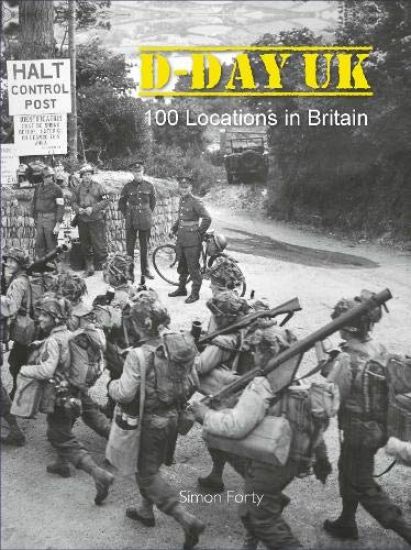
The D-Day landings of 6 June 1944 were the culmination of months of meticulous planning and organisation. A vast army had to be trained and equipped; huge amounts of material – from tin cans to tank transporters, petrol to parachutes – had to be stockpiled, distributed and readied for transport to the beaches of Normandy; bombing missions had to reduce the enemy; fighters, minesweepers and other naval missions had to clear the English Channel; and, finally, the men had to embark and the armada had to deliver its cargo to a strict timetable under enemy fire onto a hostile shore. For understandable reasons, the emphasis on remembrance of D-Day is focused on the beaches: that’s where the battles took place; that’s where most of the casualties occurred; that’s where the remarkable stories were written in blood, sand and shingle. We should never forget the sacrifice of those who fell, but equally we shouldn’t forget the sacrifices of those who prepared the way. The hundred locations chosen for this book are a small collection of those places in Britain that were involved in the preparations for D-Day. It would have been easy to choose a hundred others: few parts of Britain were not part of the war effort. It is perhaps best to see the chosen 100 as starting points from which the reader can discover the considerable depth of involvement required to launch the great invasion.