Kirjojen hintavertailu. Mukana 11 342 296 kirjaa ja 12 kauppaa.

Kirjahaku

Etsi kirjoja tekijän nimen, kirjan nimen tai ISBN:n perusteella.

16 kirjaa tekijältä Simon Hornblower

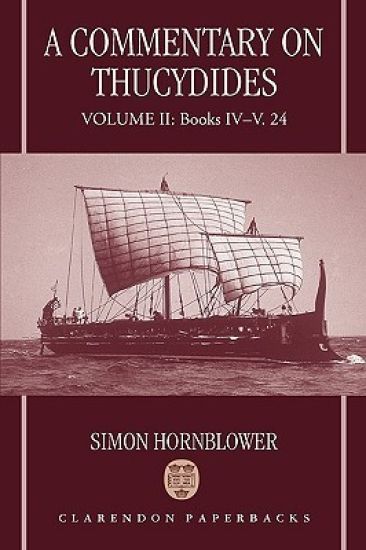
A Commentary on Thucydides: Volume II: Books iv-v.24
This is the second volume of a three-volume historical and literary commentary of the eight books of Thucydides, the great fifth-century BC historian of the Peloponnesian War between Athens and Sparta. Books iv-v.24 cover the years 425-421 BC and contain the Pylos-Spakteria narrative, the Delion Campaign, and Brasidas' operations in the north of Greece. This volume ends with the Peace of Nikias and the alliance between Athens and Sparta. A new feature of this volume is the full thematic introduction which discusses such topics as Thucydides and Herodotus, Thucydide's presentation of Brasidas, Thucydides and kinship, speech - direct and indirect - in iv-v.24, Thucydides and epigraphy (including personal names), iv-v.24 as a work of art: innovative or merely incomplete? Thucydides intended his work to be `an everlasting possession' and the continuing importance of his work is undisputed. Simon Hornblower's commentary, by translating every passage of Greek commented on for the first time, allows readers with little or no Greek to appreciate the detail of Thucydides' thought and subject-matter. A full index at the end of the volume.
A Commentary on Thucydides: Volume I: Books i-iii
This is the first volume of a three-volume historical and literary commentary on the eight books of Thucydides, the great fifth-century BC historian of the Peloponnesian War between Athens and Sparta. Of the three books covered in this volume, Book I presents Thucydides' aims in writing the work and the historical background to the war. Books II and III describe the main events of the first five years of the war (431-426) and include Pericles' funeral oration, the plague of Athens, the revolt of Mytilene, the destruction of Plataea, and civil war in Corcyra. Thucydides intended his work to be `an everlasting possession' and the continuing importance of his work is undisputed. Simon Hornblower's commentary, by translating every passage or phrase of Greek commented on, for the first time allows the reader with little or no Greek to appreciate the detail of Thucydides' thought and subject-matter. It is the first complete commentary written by a single author this century and explores both the historical and literary aspects of the work. A full index is provided at the end of the volume.

Lykophron's Alexandra, Rome, and the Hellenistic World

Lykophron's Alexandra, Rome, and the Hellenistic World

Simon Hornblower

Oxford University Press
2018
sidottu
This volume takes as its subject one of the most important Greek poems of the Hellenistic period: the Alexandra attributed to Lykophron, probably written in about 190 BC. At 1474 lines and with a riddling narrative and a preponderance of unusual vocabulary it is a notoriously challenging prospect for scholars, but it also sheds crucial light on Greek religion (in particular the role of women) and on foundation myths and myths of colonial identity. Most of the poem purports to be a prophecy by the Trojan princess, Kassandra, who foretells the conflicts between Europe and Asia from the Trojan Wars to the establishment of Roman ascendancy over the Greek world in the poet's own time. The central section narrates in the future tense the dispersal of returning Greek heroes throughout the Mediterranean zone, and their founding of new cities. This section culminates in the Italian wanderings and foundational activity of the Trojan refugee Aineias, Kassandra's own kinsman. Following Simon Hornblower's detailed full-length commentary on the Alexandra (OUP 2015; paperback 2017), this monograph asserts the poem's importance as not only a strongly political work, but also as a historical document of interest to cultural and religious historians and students of myths of identity. Divided into two Parts, the first explores Lykophron's geopolitical world, paying special attention to south Italy (perhaps the bilingual poet's own area of origin), Sicily, and Rhodes; it suggests that the recent hostile presence of Hannibal in south Italy surfaces as a frequent yet indirectly expressed concern of the poem. The thematic second Part investigates the Alexandra's relation to the Sibylline Oracles and to other apocalyptic literature of the period, and argues for its cultural and religious topicality. The Conclusion puts the case for the 190s BC as a turning-point in Roman history and contends that Lykophron demonstrates a veiled awareness of this, especially of certain peculiar features of Roman colonizing policy in that decade.
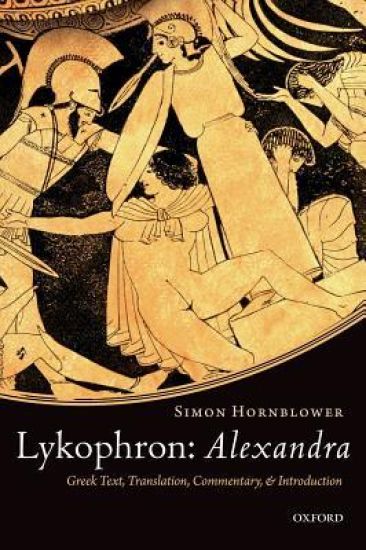
Lykophron: Alexandra

Lykophron: Alexandra

Simon Hornblower

Oxford University Press
2017
nidottu
The Alexandra attributed to Lykophron is a minor poetic masterpiece. At 1474 lines, it is one of the most important and notoriously difficult Greek poems dating from the Hellenistic period (most likely the early second century BC). Most of the poem purports to be a prophecy by the mythical Trojan princess, Kassandra, the most beautiful of the daughters of King Priam, and her prophecy ranges from the Trojan War to the Roman defeat of Macedon in 197 BC, which took place in the poet's own time. The poem's importance arises from the light which it sheds on Greek religion (in particular the role of women), on foundation myths and myths of colonial identity, and on local - especially Italian - cults and cult places. The difficulty of the poem stems from its unusual vocabulary - many words of ancient Greek are found only in this poem - and the riddling and indirect way in which most of the many mythological characters are introduced. As well as providing the Greek text in full and its English translation, this volume provides the first ever full-length commentary in English on the poem.
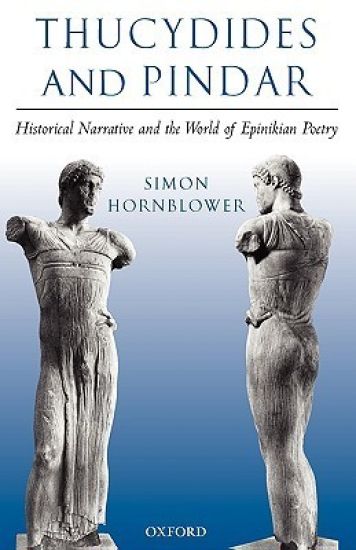
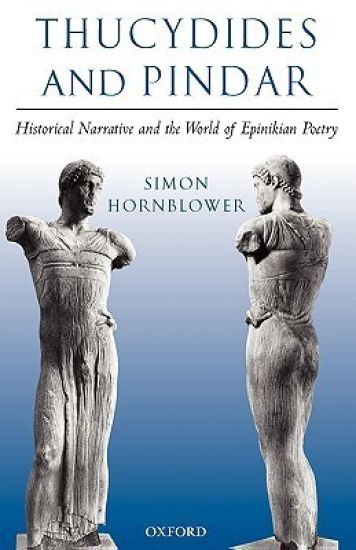
Thucydides and Pindar

Thucydides and Pindar

Simon Hornblower

Oxford University Press
2004
sidottu
Simon Hornblower argues for a relationship between Thucydides and Pindar not so far acknowledged in modern scholarship. He argues that ancient critics were right to detect stylistic similarities between these two great exponents of the `severe style' in prose and verse. In Part One he explores the background of epinikian poetry and athletics, the values shared by the two authors, and religion and colonization myths, and presents a geographically organized survey of Pindar's Mediterranean world, exploiting onomastic evidence. Part Two includes an analysis of Thucydides' account of the Olympic games of 420 BC; discussions of the four components of Thucydides' history in their relation to Pindar; statements of method, excursuses, speeches, and narrative, especially the Sicilian books; and a stylistic-literary comparison of Thucydides and Pindar.
A Commentary on Thucydides: Volume II: Books IV-V. 24

A Commentary on Thucydides: Volume II: Books IV-V. 24

Simon Hornblower

Oxford University Press
2005
nidottu
This is the second volume of a three-volume historical and literary commentary of the eight books of Thucydides, the great fifth-century BC historian of the Peloponnesian War between Athens and Sparta. Books IV-V. 24 cover the years 425-421 BC and contain the Pylos-Spakteria narrative, the Delion Campaign, and Brasidas' operations in the north of Greece. This volume ends with the Peace of Nikias and the alliance between Athens and Sparta. A valuable feature of this volume is the full thematic introduction which discusses such topics as Thucydides and Herodotus, Thucydides' presentation of Brasidas, Thucydides and kinship, speech - direct and indirect - in IV-V. 24, Thucydides and epigraphy (including personal names), IV-V. 24 as a work of art: innovative or merely incomplete? Thucydides intended his work to be `an everlasting possession' and the continuing importance of his work is undisputed. Simon Hornblower's commentary, by translating every passage of Greek commented on, for the first time allows readers with little or no Greek to appreciate the detail of Thucydides' thought and subject-matter. A full index is provided at the end of the volume.
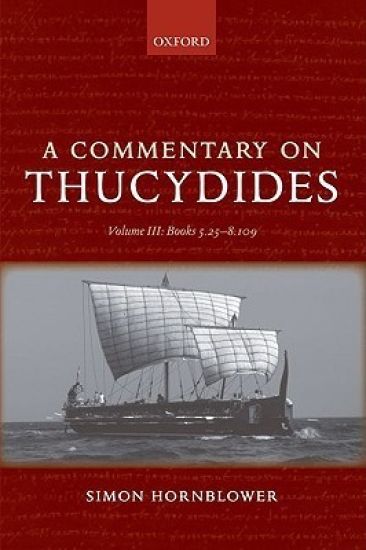
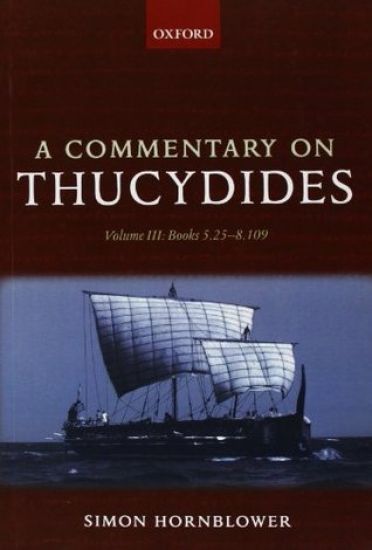
A Commentary on Thucydides: Volume III: Books 5.25-8.109

A Commentary on Thucydides: Volume III: Books 5.25-8.109

Simon Hornblower

Oxford University Press
2008
sidottu
This is the third and final volume (Vol. I 1991, Vol. II 1996) of a historical and literary commentary on the history of the first 20 years of the twenty-seven-year 'Peloponnesian War' (between the Athenians and Spartans and their respective allies) written by the great fifth-century BC historian Thucydides. The present volume of commentary covers the ten closely-narrated years 421-411 BC, and nearly half of the total of eight 'books' (subdivisions) of Thucydides' work. It includes one of the most famous sections of ancient Greek literary writing, the lengthy and supremely dramatic account of the disastrous Athenian expedition against Sicily (415-413) in Books 6 and 7; but also the Melian Dialogue (Book 5), a notorious document of Athenian imperialism; and the account of the oligarchic revolution at Athens in 411 (Book 8). All Greek is translated. There is a thematic General Introduction and two Appendixes.
Thucydides and Pindar

Thucydides and Pindar

Simon Hornblower

Oxford University Press
2006
nidottu
Simon Hornblower argues for a relationship between Thucydides and Pindar not so far acknowledged in modern scholarship. He argues that ancient critics were right to detect stylistic similarities between these two great exponents of the `severe style' in prose and verse. In Part One he explores the background of epinikian poetry and athletics, the values shared by the two authors, and religion and colonization myths, and presents a geographically organized survey of Pindar's Mediterranean world, exploiting onomastic evidence. Part Two includes an analysis of Thucydides' account of the Olympic games of 420 BC; discussions of the four components of Thucydides' history in their relation to Pindar; statements of method, excursuses, speeches, and narrative, especially the Sicilian books; and a stylistic-literary comparison of Thucydides and Pindar.
Thucydidean Themes

Thucydidean Themes

Simon Hornblower

Oxford University Press
2010
sidottu
Thucydidean Themes is a collection of seventeen essays by Simon Hornblower on the great fifth-century BC Greek historian Thucydides; but other ancient Greek historians, notably Herodotus, also feature. The chapters are arranged thematically, in three main parts (general; discussions of particular sections of the History; Thucydides' reception). Although most have previously appeared in print, many have been extensively rewritten for this volume. All are provided with prefatory material which reviews recent work on the topic. Thucydidean Themes is intended both as a companion volume to the author's recently completed three-volume Commentary on Thucydides, and as a freestanding contribution to the study of Thucydides. Like the Commentary, the present volume exploits every available approach - historical, literary, rhetorical, onomastic, epigraphic, religious, philosophical, textual, and archaeological - while the specially written Introduction seeks to identify what is distinctively admirable about Thucydides' History.
Lykophron: Alexandra

Lykophron: Alexandra

Simon Hornblower

Oxford University Press
2015
sidottu
The Alexandra attributed to Lykophron is a minor poetic masterpiece. At 1474 lines, it is one of the most important and notoriously difficult Greek poems dating from the Hellenistic period (most likely the early second century BC). Most of the poem purports to be a prophecy by the mythical Trojan princess, Kassandra, the most beautiful of the daughters of King Priam, and her prophecy ranges from the Trojan War to the historical Roman conquest of Greece, which took place in the poet's own time. The poem's importance arises from the light which it sheds on Greek religion (in particular the role of women), on foundation myths and myths of colonial identity, and on local - especially Italian - cults and cult places. The difficulty of the poem stems from its unusual vocabulary - many words of ancient Greek are found only in this poem - and the riddling and meandering way in which most of the many mythological characters are referenced. As well as providing the Greek text in full and its English translation, this volume provides the first ever full-length commentary in English on the poem.
A Commentary on Thucydides: Volume III: Books 5.25-8.109

A Commentary on Thucydides: Volume III: Books 5.25-8.109

Simon Hornblower

Oxford University Press
2010
nidottu
This is the third and final volume (Vol. I 1991, Vol. II 1996) of a historical and literary commentary on the history of the first 20 years of the twenty-seven-year 'Peloponnesian War' (between the Athenians and Spartans and their respective allies) written by the great fifth-century BC historian Thucydides. The present volume of commentary covers the ten closely-narrated years 421-411 BC, and nearly half of the total of eight 'books' (subdivisions) of Thucydides' work. It includes one of the most famous sections of ancient Greek literary writing, the lengthy and supremely dramatic account of the disastrous Athenian expedition against Sicily (415-413) in Books 6 and 7; but also the Melian Dialogue (Book 5), a notorious document of Athenian imperialism; and the account of the oligarchic revolution at Athens in 411 (Book 8). All Greek is translated. There is a thematic General Introduction and two Appendixes.
The Greek World 479-323 BC

The Greek World 479-323 BC

Simon Hornblower

Routledge
2011
sidottu
The Greek World 479-323 BC has been an indispensable guide to classical Greek history since its first publication nearly thirty years ago. Now Simon Hornblower has comprehensively revised and partly rewritten his original text, bringing it up-to-date for yet another generation of readers. In particular, this fourth edition takes full account of recent and detailed scholarship on Greek poleis across the Hellenic world, allowing for further development of the key theme of regional variety across the Mediterranean and beyond. Other extensive changes include a new sub-chapter on Islands, a completely updated bibliography, and revised citation of epigraphic material relating to the fourth-century BC. With valuable coverage of the broader Mediterranean world in which Greek culture flourished, as well as close examination of Athens, Sparta, and the other great city-states of Greece itself, this fourth edition of a classic work is a more essential read than ever before.
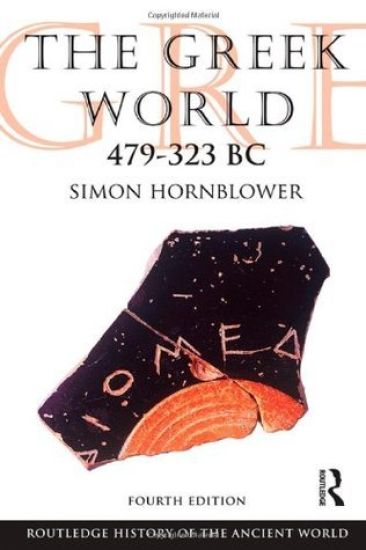
The Greek World 479-323 BC

The Greek World 479-323 BC

Simon Hornblower

Routledge
2011
nidottu
The Greek World 479-323 BC has been an indispensable guide to classical Greek history since its first publication nearly thirty years ago. Now Simon Hornblower has comprehensively revised and partly rewritten his original text, bringing it up-to-date for yet another generation of readers. In particular, this fourth edition takes full account of recent and detailed scholarship on Greek poleis across the Hellenic world, allowing for further development of the key theme of regional variety across the Mediterranean and beyond. Other extensive changes include a new sub-chapter on Islands, a completely updated bibliography, and revised citation of epigraphic material relating to the fourth-century BC. With valuable coverage of the broader Mediterranean world in which Greek culture flourished, as well as close examination of Athens, Sparta, and the other great city-states of Greece itself, this fourth edition of a classic work is a more essential read than ever before.
Hannibal and Scipio

Hannibal and Scipio

Simon Hornblower

Cambridge University Press
2024
sidottu
The Second Punic War between Carthage and Rome began in 218 BCE and ended in 202 with the dramatic defeat at the Battle of Zama of Carthage's commander Hannibal by his adversary, the Roman Scipio. The two men were born about a decade apart but died in the same year, 183, following brilliant but ultimately unhappy careers. In this absorbing joint biography, celebrated historian Simon Hornblower reveals how the trajectory of each general illuminates his counterpart. Their individual journeys help us comprehend the momentous historical period which they shared, and which in distinct but interconnected ways they helped to shape. Hornblower interweaves his central military and political narrative with lively treatments of high politics, religious motivations and manipulations, overseas commands, hellenisation, and his subjects' ancient and modern reception. This gripping portrait of a momentous rivalry will delight readers of biography and military history and scholars and students of antiquity alike.