Kirjojen hintavertailu. Mukana 12 083 983 kirjaa ja 12 kauppaa.

Kirjahaku

Etsi kirjoja tekijän nimen, kirjan nimen tai ISBN:n perusteella.

18 kirjaa tekijältä Simon J. Bronner

The Oxford Handbook of American Folklore and Folklife Studies

The Oxford Handbook of American Folklore and Folklife Studies

Simon J. Bronner

Oxford University Press Inc
2019
sidottu
The Oxford Handbook of American Folklore and Folklife Studies surveys the materials, approaches, concepts, and applications of the field to provide a sweeping guide to American folklore and folklife, culture, history, and society. Forty-three comprehensive and diverse chapters delve into significant themes and methods of folklore and folklife study; established expressions and activities; spheres and locations of folkloric action; and shared cultures and common identities. Beyond the longstanding arenas of academic focus developed throughout the 350-year legacy of folklore and folklife study, contributors at the forefront of the field also explore exciting new areas of attention that have emerged in the twenty-first century such as the Internet, bodylore, folklore of organizations and networks, sexual orientation, neurodiverse identities, and disability groups. Encompassing a wide range of cultural traditions in the United States, from bits of slang in private conversations to massive public demonstrations, ancient beliefs to contemporary viral memes, and a simple handshake greeting to group festivals, these chapters consider the meanings in oral, social, and material genres of dance, ritual, drama, play, speech, song, and story while drawing attention to tradition-centered communities such as the Amish and Hasidim, occupational groups and their workaday worlds, and children and other age groups. Weaving together such varied and manifest traditions, this handbook pays significant attention to the cultural diversity and changing national boundaries that have always been distinctive in the American experience, reflecting on the relative youth of the nation; global connections of customs brought by immigrants; mobility of residents and their relation to an indigenous, urbanized, and racialized population; and a varied landscape and settlement pattern. Edited by leading folklore scholar Simon J. Bronner, this handbook celebrates the extraordinary richness of the American social and cultural fabric, offering a valuable resource not only for scholars and students of American studies, but also for the global study of tradition, folk arts, and cultural practice.
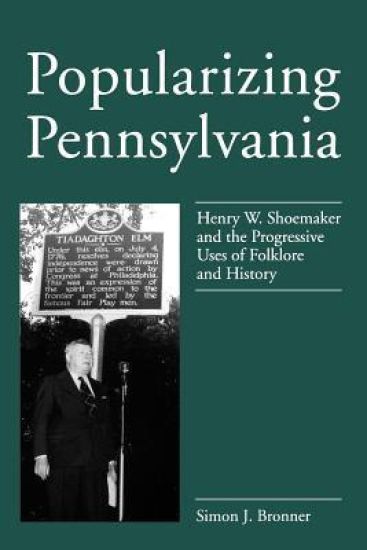
Popularizing Pennsylvania - Henry W. Shoemaker and the Progressive Uses of Folklore and History
A fascinating biography of America’s first state folklorist and a pioneer of national conservation. "Simon J. Bronner’s biography of Henry Wharton Shoemaker is an important examination of an individual’s contributions to the cultural preservation movement. Shoemaker was the first state-appointed folklorist in America, Pennsylvania being the first state to establish such a position. How he came to that honor and his influence on cultural conservation is an exciting narrative. . . . This book contains an excellent explanation of folklore scholarship for the lay audience. It also forced acknowledgment of the interdependence of the academy and the public sector."—The Public Historian Few regions have had as energetic and influential a promoter as Henry W. Shoemaker (1880-1958), who devoted his life’s work to preserving Pennsylvania's cultural and natural heritage. His memory lives on in the legends he helped promote, such as that of the Indian princess "Nita-Nee," for whom Central Pennsylvania’s Nittany Mountain is supposedly named. He was also instrumental in creating Pennsylvania’s noted system of parks and forests and the Pennsylvania Historical and Museum Commission. In his own day, Shoemaker was a controversial figure, talked about for his immense wealth, powerful connections, eccentric hobbies, and, above all, his consuming passion for conserving and promoting Pennsylvania’s wildlife, mountains, and common folk. During the Progressive Era, he fell in with national leaders such as Theodore Roosevelt and Gifford Pinchot, who encouraged Americans to commune with nature and to appreciate its history and legend. He espoused the Progressive belief that nature and folk cultures held vital, even spiritual, powers for a modern age, especially in America, where Shoemaker hoped to create a mythology supporting nationalism. Shoemaker hoped to "sell Pennsylvania to Pennsylvanians" and instill an appreciation for the state’s wilderness, threatened by industrialization. He authored hundreds of pamphlets and books on nature, history, and folklore. He was publisher of several influential newspapers in Pennsylvania, including the Altoona Tribune and the Reading Eagle. He became the first state folklorist in America, one of the first chairs of the Pennsylvania Historical Commission, and an influential member of the State Forest Commission and the State Geographic Board. He is responsible for the network of historical markers that dot the byways of the Commonwealth. For this book, the first full-length biography of Shoemaker, Simon Bronner has located never-before-available private papers and interviewed many people who knew Shoemaker. Included are rare photographs and a sampler of Shoemaker stories.
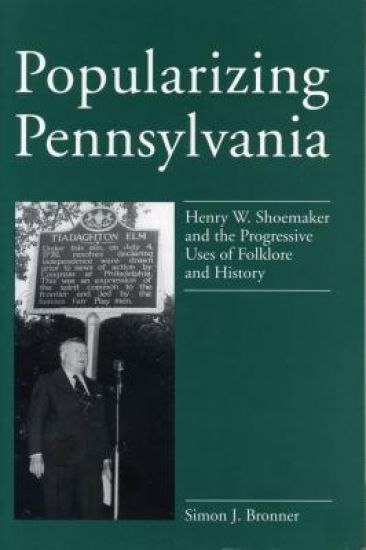
Popularizing Pennsylvania

Popularizing Pennsylvania

Simon J. Bronner

Pennsylvania State University Press
1996
pokkari
Few regions have had as energetic and influential a promoter as Henry W. Shoemaker (1880–1958), who devoted his life's work to preserving Pennsylvania's cultural and natural heritage. His memory lives on in the legends he helped promote, such as that of the Indian princess "Nita-Nee," for whom Central Pennsylvania's Nittany Mountain is supposedly named. He was also instrumental in creating Pennsylvania's noted system of parks and forests and the Pennsylvania Historical and Museum Commission. In his own day, Shoemaker was a controversial figure, talked about for his immense wealth, powerful connections, eccentric hobbies, and, above all, his consuming passion for conserving and promoting Pennsylvania's wildlife, mountains, and common folk. During the Progressive Era, he fell in with national leaders such as Theodore Roosevelt and Gifford Pinchot, who encouraged Americans to commune with nature and to appreciate its history and legend. He espoused the Progressive belief that nature and folk cultures held vital, even spiritual, powers for a modern age, especially in America, where Shoemaker hoped to create a mythology supporting nationalism. Shoemaker hoped to "sell Pennsylvania to Pennsylvanians" and instill an appreciation for the state's wilderness, threatened by industrialization. He authored hundreds of pamphlets and books on nature, history, and folklore. He was publisher of several influential newspapers in Pennsylvania, including the Altoona Tribune and the Reading Eagle. He became the first state folklorist in America, one of the first chairs of the Pennsylvania Historical Commission, and an influential member of the State Forest Commission and the State Geographic Board. He is responsible for the network of historical markers that dot the byways of the Commonwealth. For this book, the first full-length biography of Shoemaker, Simon Bronner has located never-before-available private papers and interviewed many people who knew Shoemaker. Included are rare photographs and a sampler of Shoemaker stories.
American Folklore Studies

American Folklore Studies

Simon J. Bronner

University Press of Kansas
1986
nidottu
Folklore. Washington Irving and Mark Twain used it in their fiction; Sigmund Freud and William James incorporated it into their work; Henry Ford and Franklin Roosevelt promoted it. Their efforts were set against the background of folklorists who brought collections of traditional tales, songs, and crafts to the attention of a modernizing society. The ideas of these folklorists influenced how Americans thought about the character of their society and the directions it was taking. Here for the first time is a history of American folkloristic ideas and the figures who shaped them. Simon Bronner puts these ideas in cultural context, showing the interconnection of folklore studies with historical events, social changes, and intellectual movements. He follows the beginnings of American folklore studies in the antiquarian literature of the 1830s through the rise of folklore societies in the 1880s to the emergence of an independent discipline in the 1950s. In this progression, Bronner identifies several major themes tying folklore studies to intellectual history: first, the unearthing of a hidden, usable past; second, the charting of time and space; and third, the structuring of communication. More than a chronological or biographical history, this book is an interpretation of folkloristic ideas and their relationship to American society.
Jewish Cultural Studies

Jewish Cultural Studies

Simon J. Bronner

Wayne State University Press
2021
nidottu
Jewish Cultural Studies charts the contours and boundaries of Jewish cultural studies and the issues of Jewish culture that make it so intriguing-and necessary-not only for Jews but also for students of identity, ethnicity, and diversity generally. In addition to framing the distinguishing features of Jewish culture and the ways it has been studied, and often misrepresented and maligned, Simon J. Bronner presents several case studies using ethnography, folkloristic interpretation, and rhetorical analysis. Bronner, building on many years of global cultural exploration, locates patterns, processes, frames, and themes of events and actions identified as Jewish to discern what makes them appear Jewish and why. Jewish Cultural Studies is divided into three parts. Part 1 deals with the conceptualization of how Jews in complex, heterogenous societies identify themselves as a cultural group to non-Jews and vice versa-such as how the Jewish home is socially and materially constructed. Part 2 delves into ritualization as a strategic Jewish practice for perpetuating peoplehood and the values that it suggests-for example, the rising popularity of naming ceremonies for newborn girls, simhat bat or zeved habat, in the twenty-first century. Part 3 explores narration, including the global transformation of Jewish joking in online settings and the role of Jews in American political culture. Bronner reflects that a reason to separate Jewish cultural studies from the fields of Jewish studies and cultural studies is the distinctiveness of Jewish culture among other ethnic experiences. As a diasporic group with religious ties and varying local customs, Jews present difficulties of categorization. He encourages a multiperspectival approach that considers the Jewish double consciousness as being aware of both insider and outsider perspectives, participation in ancient tradition and recent modernization, and the great variety and stigmatization of Jewish experience and cultural expression. Students and scholars in Jewish studies, cultural studies, ethnic-religious studies, folklore, sociology, psychology, and ethnology are the intended audience for this book.
Jewish Cultural Studies

Jewish Cultural Studies

Simon J. Bronner

Wayne State University Press
2021
sidottu
Jewish Cultural Studies charts the contours and boundaries of Jewish cultural studies and the issues of Jewish culture that make it so intriguing-and necessary-not only for Jews but also for students of identity, ethnicity, and diversity generally. In addition to framing the distinguishing features of Jewish culture and the ways it has been studied, and often misrepresented and maligned, Simon J. Bronner presents several case studies using ethnography, folkloristic interpretation, and rhetorical analysis. Bronner, building on many years of global cultural exploration, locates patterns, processes, frames, and themes of events and actions identified as Jewish to discern what makes them appear Jewish and why. Jewish Cultural Studies is divided into three parts. Part 1 deals with the conceptualization of how Jews in complex, heterogenous societies identify themselves as a cultural group to non-Jews and vice versa-such as how the Jewish home is socially and materially constructed. Part 2 delves into ritualization as a strategic Jewish practice for perpetuating peoplehood and the values that it suggests-for example, the rising popularity of naming ceremonies for newborn girls, simhat bat or zeved habat, in the twenty-first century. Part 3 explores narration, including the global transformation of Jewish joking in online settings and the role of Jews in American political culture. Bronner reflects that a reason to separate Jewish cultural studies from the fields of Jewish studies and cultural studies is the distinctiveness of Jewish culture among other ethnic experiences. As a diasporic group with religious ties and varying local customs, Jews present difficulties of categorization. He encourages a multiperspectival approach that considers the Jewish double consciousness as being aware of both insider and outsider perspectives, participation in ancient tradition and recent modernization, and the great variety and stigmatization of Jewish experience and cultural expression. Students and scholars in Jewish studies, cultural studies, ethnic-religious studies, folklore, sociology, psychology, and ethnology are the intended audience for this book.
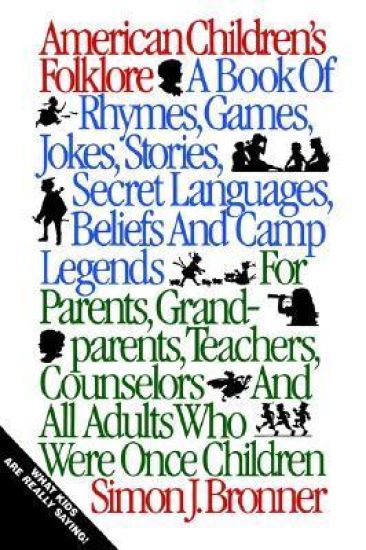
American Children's Folklore

American Children's Folklore

Simon J. Bronner

August House Publishers
2000
pokkari
Concentrating on lore gathered since World War II, Bronner has assembled an anthology of what children really say, not what adults wish they would say. It is through such shared lore--songs, expressions, games and beliefs--that children adapt to new situations. Bronner includes secret languages, jump rope rhymes, song parodies, games, taunts, tongue twisters, jokes, and more. These treasures make for nostalgic reading for adults who want to relive their own childhoods or gain a window to their own children's world.
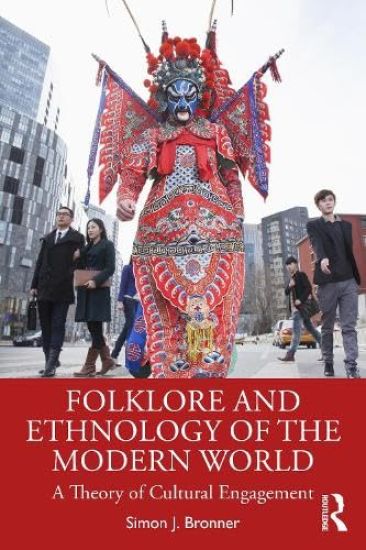
Folklore and Ethnology of the Modern World

Folklore and Ethnology of the Modern World

Simon J. Bronner

TAYLOR FRANCIS LTD
2025
sidottu
In Folklore and Ethnology of the Modern World, Simon Bronner identifies “cultural engagements” that people use to reconcile tradition and modernity and confront the anxieties of the present by bringing together the past, often represented by tradition, and the immediate digital, unreal future. These socially bounded, symbol-laden practices integrate ritual, play, narrative, and object with the instrumental purpose of confronting paradoxes and tensions of modern life. They provide the basis for a theory of how people cope culturally with change that appears to be outside of their control. Bronner explains the social and psychological complexities of cultural engagements with case studies from different parts of the world connected by their often politicized clash between tradition and modernity. The book explains the growth of strongman contests invoking mythology, the evolving meaning of Chinese puzzle balls, the responses to suppression of naval hazing traditions in Europe and America, the ubiquitous infusion of magical thinking into email practices, the “meme diplomacy” in the border wars between India and Pakistan and the projection of conflict onto cricket matches, and the global implications of the rise of “algorithmic folklore” in an AI future. This clear and accessible book is an essential read for anyone approaching the ethnological study of folklore and its interaction with modern society and culture.
Folklore and Ethnology of the Modern World

Folklore and Ethnology of the Modern World

Simon J. Bronner

TAYLOR FRANCIS LTD
2025
nidottu
In Folklore and Ethnology of the Modern World, Simon Bronner identifies “cultural engagements” that people use to reconcile tradition and modernity and confront the anxieties of the present by bringing together the past, often represented by tradition, and the immediate digital, unreal future. These socially bounded, symbol-laden practices integrate ritual, play, narrative, and object with the instrumental purpose of confronting paradoxes and tensions of modern life. They provide the basis for a theory of how people cope culturally with change that appears to be outside of their control. Bronner explains the social and psychological complexities of cultural engagements with case studies from different parts of the world connected by their often politicized clash between tradition and modernity. The book explains the growth of strongman contests invoking mythology, the evolving meaning of Chinese puzzle balls, the responses to suppression of naval hazing traditions in Europe and America, the ubiquitous infusion of magical thinking into email practices, the “meme diplomacy” in the border wars between India and Pakistan and the projection of conflict onto cricket matches, and the global implications of the rise of “algorithmic folklore” in an AI future. This clear and accessible book is an essential read for anyone approaching the ethnological study of folklore and its interaction with modern society and culture.
Americanness

Americanness

Simon J. Bronner

Routledge
2021
nidottu
Americanness: Inquiries into the Thought and Culture of the United States analyzes several core themes that connect Americans because of, and despite, their pronounced diversity.The book investigates shared ideas and ideals, such as individualism, mobility, materialism, and future-orientation, that drive an overarching American worldview. Simon J. Bronner begins with ideas of space and time as they formed and changed through the history of the United States, before moving to the emergence of modern American culture. He examines reasons America is characterized as having a "victory culture" that extends to the American legal, military, and business complexes. This victory culture is further analyzed by looking at the country’s relationship with the game of football—a sport that thrives in America but has not caught on in other countries. Finally, the volume probes American consumerism driven by a desire for individual prosperity in a supposedly egalitarian society. Using interdisciplinary approaches drawn from psychology, sociology, ethnology, and history, Bronner seeks explanations for people invoking, and evoking, ideas that they perceive as American.This book would be an invaluable addition to courses on American history, sociology, cultural studies, and American studies.
Americanness

Americanness

Simon J. Bronner

Routledge
2021
sidottu
Americanness: Inquiries into the Thought and Culture of the United States analyzes several core themes that connect Americans because of, and despite, their pronounced diversity.The book investigates shared ideas and ideals, such as individualism, mobility, materialism, and future-orientation, that drive an overarching American worldview. Simon J. Bronner begins with ideas of space and time as they formed and changed through the history of the United States, before moving to the emergence of modern American culture. He examines reasons America is characterized as having a "victory culture" that extends to the American legal, military, and business complexes. This victory culture is further analyzed by looking at the country’s relationship with the game of football—a sport that thrives in America but has not caught on in other countries. Finally, the volume probes American consumerism driven by a desire for individual prosperity in a supposedly egalitarian society. Using interdisciplinary approaches drawn from psychology, sociology, ethnology, and history, Bronner seeks explanations for people invoking, and evoking, ideas that they perceive as American.This book would be an invaluable addition to courses on American history, sociology, cultural studies, and American studies.
Folklore: The Basics

Folklore: The Basics

Simon J. Bronner

Routledge
2016
sidottu
Folklore: The Basics is an engaging guide to the practice and interpretation of folklore. Taking examples from around the world, it explores the role of folklore in expressing fundamental human needs, desires, and anxieties that often are often not revealed through other means. Providing a clear framework for approaching the study of folklore, it introduces the reader to methodologies for identifying, documenting, interpreting and applying key information about folklore and its relevance to modern life. From the Brothers Grimm to Internet Memes, it addresses such topics as:What is folklore?How do we study it?Why does folklore matter?How does folklore relate to elite culture?Is folklore changing in a digital age?With case studies, suggestions for reading and a glossary of key terminology, Folklore: The Basics supports readers in becoming familiar with folkloric traditions and interpret cultural expression. It is an essential read for anyone approaching the study of folklore for the first time.
Folklore: The Basics

Folklore: The Basics

Simon J. Bronner

Routledge
2016
nidottu
Folklore: The Basics is an engaging guide to the practice and interpretation of folklore. Taking examples from around the world, it explores the role of folklore in expressing fundamental human needs, desires, and anxieties that often are often not revealed through other means. Providing a clear framework for approaching the study of folklore, it introduces the reader to methodologies for identifying, documenting, interpreting and applying key information about folklore and its relevance to modern life. From the Brothers Grimm to Internet Memes, it addresses such topics as:What is folklore?How do we study it?Why does folklore matter?How does folklore relate to elite culture?Is folklore changing in a digital age?With case studies, suggestions for reading and a glossary of key terminology, Folklore: The Basics supports readers in becoming familiar with folkloric traditions and interpret cultural expression. It is an essential read for anyone approaching the study of folklore for the first time.
The Practice of Folklore

The Practice of Folklore

Simon J. Bronner

University Press of Mississippi
2019
sidottu
Despite predictions that commercial mass culture would displace customs of the past, traditions firmly abound, often characterized as folklore. In The Practice of Folklore: Essays toward a Theory of Tradition, author Simon J. Bronner works with theories of cultural practice to explain the social and psychological need for tradition in everyday life. Bronner proposes a distinctive “praxic” perspective that will answer the pressing philosophical as well as psychological question of why people enjoy repeating themselves. The significance of the keyword practice, he asserts, is the embodiment of a tension between repetition and variation in human behavior. Thinking with practice, particularly in a digital world, forces redefinitions of folklore and a reorientation toward interpreting everyday life. More than performance or enactment in social theory, practice connects localized culture with the vernacular idea that “this is the way we do things around here.” Practice refers to the way those things are analyzed as part of, rather than apart from, theory, thus inviting the study of studying. “The way we do things” invokes the social basis of “doing” in practice as cultural and instrumental. Building on previous studies of tradition in relation to creativity, Bronner presents an overview of practice theory and the ways it might be used in folklore and folklife studies. Demonstrating the application of this theory in folkloristic studies, Bronner offers four provocative case studies of psychocultural meanings that arise from traditional frames of action and address issues of our times: referring to the boogieman; connecting “wild child” beliefs to school shootings; deciphering the offensive chants of sports fans; and explicating male bravado in bawdy singing. Turning his analysis to the analysts of tradition, Bronner uses practice theory to evaluate the agenda of folklorists in shaping perceptions of tradition-centered “folk societies” such as the Amish. He further unpacks the culturally based rationale of public folklore programming. He interprets the evolving idea of folk museums in a digital world and assesses how the folklorists' terms and actions affect how people think about tradition.
The Practice of Folklore

The Practice of Folklore

Simon J. Bronner

University Press of Mississippi
2019
nidottu
Despite predictions that commercial mass culture would displace customs of the past, traditions firmly abound, often characterized as folklore. In The Practice of Folklore: Essays toward a Theory of Tradition, author Simon J. Bronner works with theories of cultural practice to explain the social and psychological need for tradition in everyday life. Bronner proposes a distinctive “praxic” perspective that will answer the pressing philosophical as well as psychological question of why people enjoy repeating themselves. The significance of the keyword practice, he asserts, is the embodiment of a tension between repetition and variation in human behavior. Thinking with practice, particularly in a digital world, forces redefinitions of folklore and a reorientation toward interpreting everyday life. More than performance or enactment in social theory, practice connects localized culture with the vernacular idea that “this is the way we do things around here.” Practice refers to the way those things are analyzed as part of, rather than apart from, theory, thus inviting the study of studying. “The way we do things” invokes the social basis of “doing” in practice as cultural and instrumental. Building on previous studies of tradition in relation to creativity, Bronner presents an overview of practice theory and the ways it might be used in folklore and folklife studies. Demonstrating the application of this theory in folkloristic studies, Bronner offers four provocative case studies of psychocultural meanings that arise from traditional frames of action and address issues of our times: referring to the boogieman; connecting “wild child” beliefs to school shootings; deciphering the offensive chants of sports fans; and explicating male bravado in bawdy singing. Turning his analysis to the analysts of tradition, Bronner uses practice theory to evaluate the agenda of folklorists in shaping perceptions of tradition-centered “folk societies” such as the Amish. He further unpacks the culturally based rationale of public folklore programming. He interprets the evolving idea of folk museums in a digital world and assesses how the folklorists' terms and actions affect how people think about tradition.
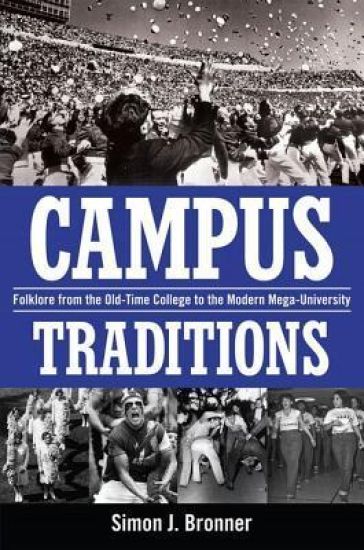
Campus Traditions

Campus Traditions

Simon J. Bronner

University Press of Mississippi
2012
nidottu
From their beginnings, campuses emerged as hotbeds of traditions and folklore. American college students inhabit a culture with its own slang, stories, humor, beliefs, rituals, and pranks. Simon J. Bronner takes a long, engaging look at American campus life and how it is shaped by students and at the same time shapes the values of all who pass through it. The archetypes of absent-minded profs, fumbling jocks, and curve-setting dweebs are the stuff of legend and humor, along with the all-nighters, tailgating parties, and initiations that mark campus tradition--and student identities. Undergraduates in their hallowed halls embrace distinctive traditions because the experience of higher education precariously spans childhood and adulthood, parental and societal authority, home and corporation, play and work.Bronner traces historical changes in these traditions. The predominant context has shifted from what he calls the ""old-time college,"" small in size and strong in its sense of community, to mass society's ""mega-university,"" a behemoth that extends beyond any campus to multiple branches and offshoots throughout a state, region, and sometimes the globe. One might assume that the mega-university has dissolved collegiate traditions and displaced the old-time college, but Bronner finds the opposite. Student needs for social belonging in large universities and a fear of losing personal control have given rise to distinctive forms of lore and a striving for retaining the pastoral ""campus feel"" of the old-time college. The folkloric material students spout, and sprout, in response to these needs is varied but it is tied together by its invocation of tradition and social purpose. Beneath the veil of play, students work through tough issues of their age and environment. They use their lore to suggest ramifications, if not resolution, of these issues for themselves and for their institutions. In the process, campus traditions are keys to the development of American culture.
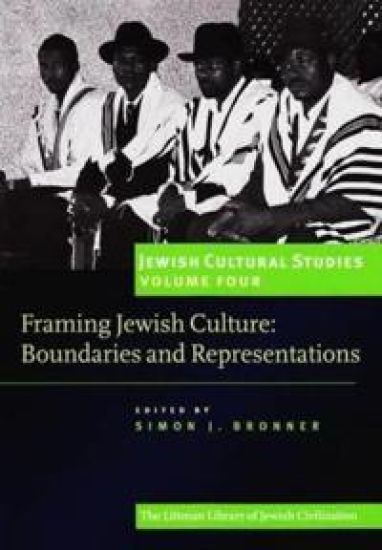
Framing Jewish Culture

Framing Jewish Culture

Simon J. Bronner

The Littman Library of Jewish Civilization
2014
nidottu
Modernity offers people choices about who they want to be and how they want to appear to others. The way in which Jews choose to frame their identity establishes the dynamic of their social relations with other Jews and non-Jews - a dynamic complicated by how non-Jews position the boundaries around what and who they define as Jewish. This book uncovers these processes, historically, as well as in contemporary behavior, and finds explanations for the various manifestations, in feeling and action, of 'being Jewish.' Boundaries and borders raise fundamental questions about the difference between Jews and non-Jews. At root, the question is how 'Jewish' is understood in social situations where people recognize or construct boundaries between their own identity and those of others. The question is important because this is by definition the point at which the lines of demarcation between Jews and non-Jews, and between different groupings of Jews, are negotiated. Collectively, the contributors to the book expand our understanding of the social dynamics of framing Jewish identity. The book opens with an introduction that locates the issues raised by the contributors in terms of the scholarly traditions from which they have evolved. Part I presents four essays dealing with the construction and maintenance of boundaries - two by scholars showing how boundaries come to be etched on an ethnic landscape and two by activists who question and adjust distinctions among neighbors. Part II focuses on expressive means of conveying identity and memory, while, in Part III, the discussion turns to museum exhibitions and festive performances as locations for the negotiation of identity in the public sphere. A lively discussion forum concludes the book with a consideration of the paradoxes of Jewish heritage revival in Poland, and the perception of that revival by Jews and non-Jews.