Kirjojen hintavertailu. Mukana 12 016 292 kirjaa ja 12 kauppaa.

Kirjahaku

Etsi kirjoja tekijän nimen, kirjan nimen tai ISBN:n perusteella.

8 kirjaa tekijältä Simon MacDowall

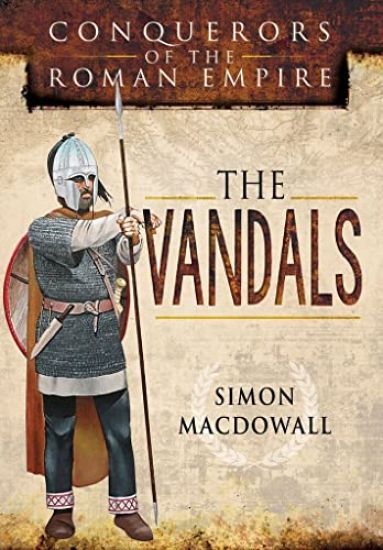
Conquerors of the Roman Empire: The Vandals

Conquerors of the Roman Empire: The Vandals

Simon MacDowall

PEN SWORD BOOKS LTD
2022
nidottu
On 31 December AD 406, a group of German tribes crossed the Rhine, pierced the Roman defensive limes and began a rampage across Roman Gaul, sacking cities such as Metz, Arras and Strasbourg. Foremost amongst them were the Vandals and their search for a new homeland took them on the most remarkable odyssey. The Romans were unable to stop them and their closest allies, the Alans, marching the breadth of Gaul, crossing the Pyrenees and making themselves masters of Spain. However, this Kingdom of the Vandals and Alans soon came under intense pressure from Romes Visigothic allies. In 429, under their new king, Gaiseric, they crossed the straits of Gibraltar to North Africa. They quickly overran this rich Roman province and established a stable kingdom. Taking to the seas they soon dominated the Western Mediterranean and raided Italy, famously sacking Rome itself in 455. Eventually, however, they were utterly conquered by Belisarius in 533 and vanished from history. Simon MacDowall narrates and analyses these events, with particular focus on the evolution of Vandal armies and warfare.
Catalaunian Fields AD 451

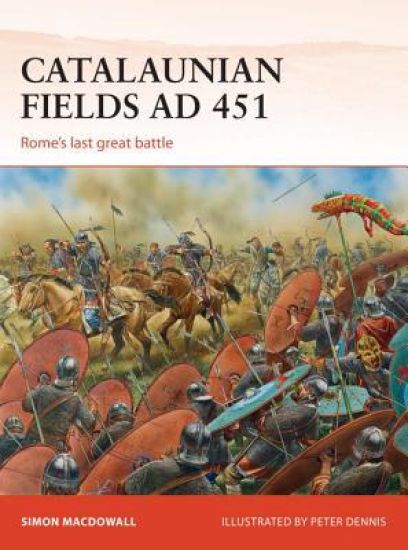
Catalaunian Fields AD 451

Simon MacDowall

Osprey Publishing
2015
nidottu
A description of Attila the Hun’s invasion of Gaul in AD 451, the Roman response and the eventual battle of Chalons.The battle of the Catalaunian Fields saw two massive, powerful empires square up in a conflict that was to shape the course of Eurasian history forever. For despite the Roman victory, the Roman Empire would not survive for more than 15 years following the battle, whilst the Huns, shattered and demoralized, would meet their downfall against a coalition of German tribes soon after.This book, using revealing bird’s-eye-views of the plains of Champagne and detailed illustrations of the opposing warriors in the midst of desperate combat, describes the fighting at the Catalaunian Fields and reveals the broader campaign of Hunnic incursion that led up to it.Drawing on the latest research, Simon MacDowall reveals the shocking intensity and appalling casualties of the battle, whilst assessing the wider significance and consequences of the campaign.
Malplaquet 1709

Malplaquet 1709

Simon MacDowall

Osprey Publishing
2020
nidottu
A highly illustrated study of the battle of Malplaquet, the last and bloodiest of Marlborough's victories in the 18th century War of the Spanish Succession.In 1709, after eight years of war, France was on her knees. There was not enough money left in the treasury to pay, equip or feed the army and a bad harvest led to starvation throughout the kingdom. Circumstances had worsened to the point that King Louis XIV was forced to offer to end the War of Spanish Succession on humiliating terms for his country. However, the allied powers – Britain, the Dutch Republic and the Holy Roman Empire – refused Louis’ offer, believing that one more successful campaign would utterly destroy French power. This book examines the campaign of 1709, culminating in the battle of Malplaquet, which would prove Louis’ enemies disastrously wrong. Led by the Duke of Marlborough and Prince Eugene of Savoy, the allied armies achieved a tactical victory – but it was a hollow one. The allies suffered 23,000 casualties to the French 11,000 in what was the bloodiest battle of the 18th century. The scale of casualties shocked Europe and led to a reversal of fortunes, with the dismissal of Marlborough and a newly confident King Louis resolving to fight on. When the war finally ended, it did so on terms favourable to France.In this illustrated title, Simon MacDowall examines the campaign in full and shows how, though it is generally accepted that Marlborough was never defeated, the Battle of Malplaquet was ultimately a French strategic victory.
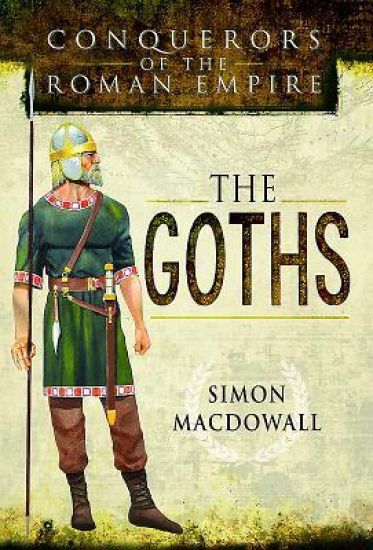
Conquerors of the Roman Empire: The Goths

Conquerors of the Roman Empire: The Goths

Simon MacDowall

Pen Sword Military
2017
sidottu
In the late 4th century, pressure from the Huns forced the Goths to cross the Danube into the Roman Empire. The resultant Battle of Adrianople in 378 was one of Rome s greatest defeats. Both western (Visigoth) and eastern (Ostrogoth) branches of the Goths had a complex relationship with the Romans, sometimes fighting as their allies against other barbarian interlopers but carving out their own kingdoms in the process. Under Alaric the Visigoths sacked Rome itself in 410 and went on to establish a kingdom in Gaul (France). They helped the Romans defeat the Hunnic invasion of Gaul at Chalons in 451 but continued to expand at Roman expense. Defeated by the Franks they then took Spain from the Vandals. The Ostrogoths had a similar relationship with the Eastern Roman Empire before eventually conquering Italy. Adrianople, the events of 410 and the Ostrogoths long war with Belisarius, including the Siege of Rome, are among the campaigns and battles Simon MacDowall narrates in detail. He analyses the arms and contrasting fighting styles of the Ostro- and Visi- Goths and evaluates their effectiveness against the Romans.
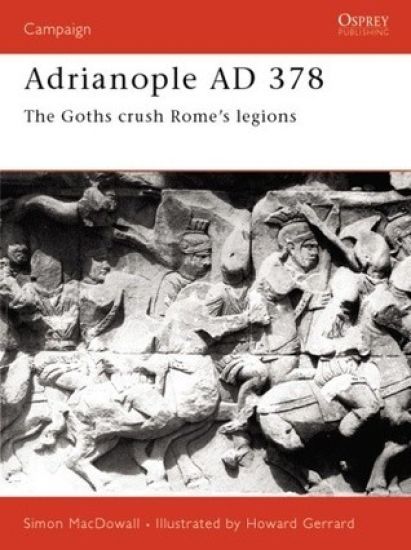
Adrianople AD 378

Adrianople AD 378

Simon MacDowall

Osprey Publishing
2001
nidottu
'Never, except in the battle of Cannae, had there been so destructive a slaughter recorded in our annals.' Thus the Roman historian Ammianus Marcellinus recorded the battle of Adrianople, which spelied the beginning of the end of the Roman Empire. Such a crushing Roman defeat by Gothic cavalry proved to the Empire, as well as to the Goths themselves, that the migratory barbarians were a force to be reckoned with. Simon Macdowall tells the story of the misguided Roman plans and the surprise attack of Gothic cavalry, and puts forward the most recent theories as to the true location of the battlefield.
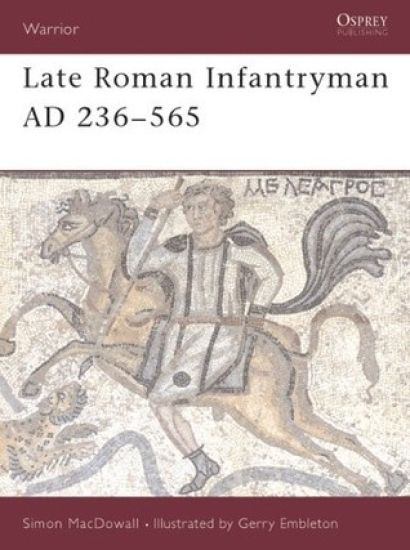
Late Roman Infantryman AD 236–565

Late Roman Infantryman AD 236–565

Simon MacDowall

Osprey Publishing
1994
nidottu
This is a description of the uniforms, weaponry, military practices and daily life of the Roman soldier during the twilight years of the Empire, a time which saw the army increasingly influenced by German troops and the rise of private armies. The book is illustrated with contemporary images, diagrams and colour plates.
Late Roman Cavalryman AD 236–565

Late Roman Cavalryman AD 236–565

Simon MacDowall

Osprey Publishing
1995
nidottu
The twilight of the Roman Empire saw a revolution in the way war was waged. The drilled infantryman, who had been the mainstay of Mediterranean armies since the days of the Greek hoplite, was gradually replaced by the mounted warrior. This change did not take place overnight, and in the 3rd and 4th centuries the role of the cavalryman was primarily to support the infantry. However, by the time of the 6th century, the situation had been completely reversed. Late Roman Cavalryman gives a full account of the changing experience of the mounted soldiers who defended Rome's withering western empire.
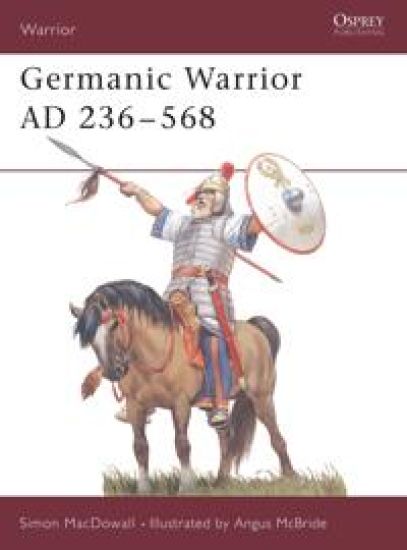
Germanic Warrior AD 236–568

Germanic Warrior AD 236–568

Simon MacDowall

Osprey Publishing
1996
nidottu
The 3rd to the 6th centuries saw the collapse of the classical Mediterranean civilization and the emergence of new states in western Europe based on the Germanic warrior society. This book focuses particularly on the men who made up the retinues of the Germanic warlords who carved kingdoms out of the carcass of the West Roman Empire. Although sources are scarce, Simon MacDowall constructs a convincing picture, using evidence from Roman historians, German archaeology and Anglo-Saxon poetry. The warriors' society, hierarchy, training, equipment, appearance, tactics and style of fighting are all examined, building a comprehensive portrait of the Germanic warrior in this period.