Kirjojen hintavertailu. Mukana 11 244 527 kirjaa ja 12 kauppaa.

Kirjahaku

Etsi kirjoja tekijän nimen, kirjan nimen tai ISBN:n perusteella.

3 kirjaa tekijältä Simone Chambers

Reasonable Democracy

Reasonable Democracy

Simone Chambers

Cornell University Press
1996
pokkari
In Reasonable Democracy, Simone Chambers describes, explains, and defends a discursive politics inspired by the work of Jürgen Habermas. In addition to comparing Habermas's ideas with other non-Kantian liberal theories in clear and accessible prose, Chambers develops her own views regarding the role of discourse and its importance within liberal democracies. Beginning with a deceptively simple question—"Why is talking better than fighting?"—Chambers explains how the idea of talking provides a rich and compelling view of morality, rationality, and political stability. She considers talking as a way for people to respect each other as moral agents, as a way to reach reasonable and legitimate solutions to disputes, and as a way to reproduce and strengthen shared understandings. In the course of this argument, she defends modern universalist ethics, communicative rationality, and what she calls a "discursive political culture," a concept that locates the political power of discourse and deliberation not so much in institutions of democratic decision-making as in the type of conversations that go on around these institutions. While discourse and deliberation cannot replace voting, bargaining, or compromise, Chambers argues, it is important to maintain a background moral conversation in which to anchor other activities. As an extended case study, Chambers examines the conversation about language rights that has been taking place for more than twenty years in Quebec. A culture of dialogue, she shows, has proved a positive and powerful force in resolving some of the disagreements between the two linguistic communities there.
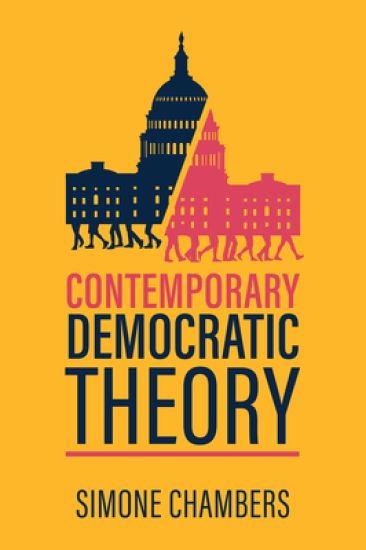
Contemporary Democratic Theory

Contemporary Democratic Theory

Simone Chambers

JOHN WILEY AND SONS LTD
2023
sidottu
Is democracy worth saving? Responding to the erosion of democracy, philosophical debates have pivoted from analyzing the best forms of democracy to questioning what is so valuable about democracy to begin with, how we can save it, and whether it is indeed worth saving. Contemporary Democratic Theory charts this pivot and surveys the most important new developments in the philosophical, theoretical, and normative examination of the concept of democracy. Comparisons that dominated 20th century democratic theory - between direct democracy, participatory democracy, deliberative democracy, and agonistic democracy - are in the 21st century giving way to comparisons between democracy and its challengers: epistocracy, technocracy, meritocracy, oligarchy, and autocracy. Philosophical interest in the canonical figures of democratic theory like Aristotle, Rousseau and Mill is being eclipsed by damage control in the face populism, sinking trust in democratic institutions, failing political parties, and the spread of misinformation.Overarching epochal forces of crisis and threat are pushing democratic theory in new directions and towards new ideas. This refreshing and authoritative text identifies, explains, and evaluates the new directions taken by contemporary democratic theory in challenging times.
Contemporary Democratic Theory

Contemporary Democratic Theory

Simone Chambers

JOHN WILEY AND SONS LTD
2023
nidottu
Is democracy worth saving? Responding to the erosion of democracy, philosophical debates have pivoted from analyzing the best forms of democracy to questioning what is so valuable about democracy to begin with, how we can save it, and whether it is indeed worth saving. Contemporary Democratic Theory charts this pivot and surveys the most important new developments in the philosophical, theoretical, and normative examination of the concept of democracy. Comparisons that dominated 20th century democratic theory - between direct democracy, participatory democracy, deliberative democracy, and agonistic democracy - are in the 21st century giving way to comparisons between democracy and its challengers: epistocracy, technocracy, meritocracy, oligarchy, and autocracy. Philosophical interest in the canonical figures of democratic theory like Aristotle, Rousseau and Mill is being eclipsed by damage control in the face populism, sinking trust in democratic institutions, failing political parties, and the spread of misinformation.Overarching epochal forces of crisis and threat are pushing democratic theory in new directions and towards new ideas. This refreshing and authoritative text identifies, explains, and evaluates the new directions taken by contemporary democratic theory in challenging times.