Kirjojen hintavertailu. Mukana 12 205 901 kirjaa ja 12 kauppaa.

Kirjahaku

Etsi kirjoja tekijän nimen, kirjan nimen tai ISBN:n perusteella.

3 kirjaa tekijältä Stanley F. Bonner

Education in Ancient Rome: From the Elder Cato to the Younger Pliny

Education in Ancient Rome: From the Elder Cato to the Younger Pliny

Stanley F. Bonner

University of California Press
2022
nidottu
Education in Ancient Rome explores the Roman approach to education, highlighting its lasting relevance beyond antiquity. Roman education focused not just on academic knowledge but also on character and behavior, as the Latin term educatio referred to raising a child physically and morally rather than intellectually. The Romans, although heavily influenced by Greek educational methods, crafted a cohesive curriculum that blended Greek and Latin literature, with figures like Virgil and Cicero studied alongside Homer and Demosthenes. Over time, the curriculum became more focused on grammar, literature, and rhetoric, which later formed the core of the medieval Trivium and influenced education for centuries, including during the Elizabethan era. Based primarily on Quintilian and other Roman sources, this work offers both a synthesis of known material and new contributions to the understanding of Roman education, contributing to the scholarly exploration of ancient educational practices. This title is part of UC Press's Voices Revived program, which commemorates University of California Press's mission to seek out and cultivate the brightest minds and give them voice, reach, and impact. Drawing on a backlist dating to 1893, Voices Revived makes high-quality, peer-reviewed scholarship accessible once again using print-on-demand technology. This title was originally published in 1977.

Education in Ancient Rome: From the Elder Cato to the Younger Pliny

Education in Ancient Rome: From the Elder Cato to the Younger Pliny

Stanley F. Bonner

University of California Press
2022
sidottu
Education in Ancient Rome explores the Roman approach to education, highlighting its lasting relevance beyond antiquity. Roman education focused not just on academic knowledge but also on character and behavior, as the Latin term educatio referred to raising a child physically and morally rather than intellectually. The Romans, although heavily influenced by Greek educational methods, crafted a cohesive curriculum that blended Greek and Latin literature, with figures like Virgil and Cicero studied alongside Homer and Demosthenes. Over time, the curriculum became more focused on grammar, literature, and rhetoric, which later formed the core of the medieval Trivium and influenced education for centuries, including during the Elizabethan era. Based primarily on Quintilian and other Roman sources, this work offers both a synthesis of known material and new contributions to the understanding of Roman education, contributing to the scholarly exploration of ancient educational practices. This title is part of UC Press's Voices Revived program, which commemorates University of California Press's mission to seek out and cultivate the brightest minds and give them voice, reach, and impact. Drawing on a backlist dating to 1893, Voices Revived makes high-quality, peer-reviewed scholarship accessible once again using print-on-demand technology. This title was originally published in 1977.
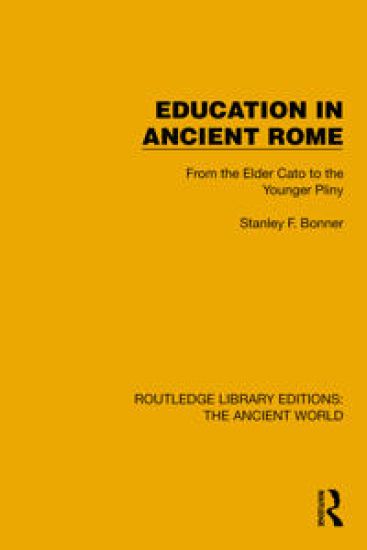
Education in Ancient Rome

Education in Ancient Rome

Stanley F. Bonner

TAYLOR FRANCIS LTD
2024
sidottu
Education in Ancient Rome (1977) examines the development, structure and role of education from the third century B.C. to the time of Trajan, a period which saw great changes in Roman society. It provides a historical background, showing the effects upon the educational system of Rome’s transition from an agricultural community to a great metropolis, tracing the development of primary, grammar and rhetoric schools, and discussing the standards of upbringing and education. The book then looks at the physical conditions of teaching – accommodation, equipment, discipline, the economic position of teachers, the fee-paying system, and the part played by the Roman State. Finally, it gives a full appraisal of the standard Roman teaching programme.