Kirjojen hintavertailu. Mukana 12 390 323 kirjaa ja 12 kauppaa.

Kirjahaku

Etsi kirjoja tekijän nimen, kirjan nimen tai ISBN:n perusteella.

23 kirjaa tekijältä Stanley Vestal

Joe Meek

Joe Meek

Stanley Vestal

University of Nebraska Press
1963
pokkari
Looks at the career and accomplishments of the Western pioneer as fur trapper, Indian fighter, scout, politician, and U.S. Marshal during the early nineteenth century
Jim Bridger

Jim Bridger

Stanley Vestal

Bison Books
1970
pokkari
Even among the mighty mountain men, Jim Bridger was a towering figure. He was one of the greatest explorers and pathfinders in American history. He couldn't write his name, but at eighteen he had braved the fury of the Missouri, ascending it in a keelboat flotilla commanded by that stalwart Mike Fink. By 1824, when he was only twenty, he had discovered the Great Salt Lake. Later he was to open the Overland Route, which was the path of the Overland Stage, the Pony Express, and the Union Pacific. One of the foremost trappers in the Rocky Mountain Fur Company, he was a legend in his own time as well as ours. He remains one of the most important scouts and guides in the history of the West.The Christian Science Monitor has called this biography "probably the fairest portrait of Jim Bridger in existence." The New York Times has praise for a "painstaking job of research among the usual Bridger sources and among some others which have been neglected. . . . [The author] has adequately set the scene for his hero's adventures and has honestly appraised the great guide's historical stature."Other Bison Books by Stanley Vestal: Dodge City: Queen of Cowtowns, Joe Meek: The Merry MOuntain Man; The Missouri, The Old Santa Fe Trail, and Warpath: The True Story of the Fighting Sioux Told in a Biography of Chief White Bull
Happy Hunting Grounds

Happy Hunting Grounds

Stanley Vestal

University of Oklahoma Press
2012
nidottu
Here is a story, in thinly disguised fictional form, of Plains Indians, especially a Cheyenne chief, Whirlwind - his manner of life, his beliefs, and particularly, his love of his son. The villain is a Mandan who is given refuge in the Cheyenne camp and then wreaks havoc with the lives of his hosts. He causes a battle with the Sioux, steals the chief's favorite wife, and slays the chief's young son. Whirlwind's revenge for the death of his beloved son provides a dramatic climax.Happy Hunting Grounds recaptures Cheyenne life on the plains. The battles, celebrations, and lifeways of the Indians - Sioux, Cheyennes, and Mandans - are accurately and graphically portrayed. This volume is illustrated with drawings and paintings by Frederick Weygold, reflecting his own long association with the Plains tribes.
New Sources of Indian History, 1850-1891

New Sources of Indian History, 1850-1891

Stanley Vestal

University of Oklahoma Press
2015
nidottu
More than a century has passed since that winter morning in 1890 when the Indian police killed Sitting Bull and destroyed the power of his great Sioux Nation. Yet only recently were the facts about Sitting Bull and the Sioux being sifted from the fables that have grown up in the interim. In New Sources of Indian History, Stanley Vestal traced scores of historical threads, obtained firsthand, which helped reveal the fabric of Sioux life, warfare, and relations with the whites from 1850 to 1891. This miscellany brings together the many phases of existence the Sioux knew when buffalo still roamed the shores of the Missouri, cultural aspects they lost when Indian agencies and military posts replaced the council fire. More than a series of episodes hung on the thread of time, this book portrays a many-colored pattern of American Indian personalities - from Sitting Bull, the leader of a mighty warrior society, to Black Bull, the Indian trickster, who would have sold Sioux lands to whites by the pound. For readers of Vestal's Sitting Bull (1932) this volume presents proof of the facts set forth in that remarkable biography.
Sitting Bull, Champion of the Sioux: A Biography

Sitting Bull, Champion of the Sioux: A Biography

Stanley Vestal

Literary Licensing, LLC
2013
sidottu
Sitting Bull, Champion of the Sioux: A Biography by Stanley Vestal is a comprehensive account of the life of Sitting Bull, the famous Native American chief and warrior of the Sioux tribe. The book traces Sitting Bull's life from his early years as a young warrior to his rise as a respected leader of the Sioux nation. The author vividly describes the battles and conflicts that Sitting Bull participated in, including the Battle of Little Bighorn, where he played a key role in defeating General Custer's army.The book also delves into Sitting Bull's personal life, including his relationships with his wives and children, and his deep spiritual beliefs. The author explores the complex relationship between Sitting Bull and the U.S. government, which ultimately led to his exile to Canada and his eventual return to the United States.Throughout the book, Vestal paints a vivid portrait of Sitting Bull as a complex and multifaceted individual, who was both a fierce warrior and a respected spiritual leader. The author draws on a wide range of sources, including Sitting Bull's own words, to provide a nuanced and insightful account of this iconic figure in American history.Overall, Sitting Bull, Champion of the Sioux: A Biography is a compelling and illuminating read for anyone interested in the history of the American West, Native American culture, or the life of one of the most famous and influential figures in Native American history.This is a new release of the original 1932 edition.This scarce antiquarian book is a facsimile reprint of the old original and may contain some imperfections such as library marks and notations. Because we believe this work is culturally important, we have made it available as part of our commitment for protecting, preserving, and promoting the world's literature in affordable, high quality, modern editions, that are true to their original work.
New Sources Of Indian History 1850-1891
This volume contains a fascinating and detailed history of the Sioux Plains Indians. The author spent five years among the Sioux Indians, as part of his intense research for a biography of Sitting Bull. The resultant text constitutes a comprehensive chronology of key events during their conflict with the American authorities, compiled from statements of Indian eye-witnesses. This book will appeal to those with an interest in the Sioux Indians, and would make for a worthy addition to collections of related literature. The chapters include: "Indian Warfare," "An Officer's Tribute to the Plains Indians," "Comparative Casualties as Between U.S. Troops and Indians During the Sioux Campaigns," "Note on the Ways of Warriors," "Problems of Peace," "Notes on Individuals," etcetera. Many vintage texts such as this are increasingly scarce and expensive, and it is with this in mind that we are republishing this book now, in an affordable, high-quality, modern edition. It comes complete with a specially commissioned biography of the author.
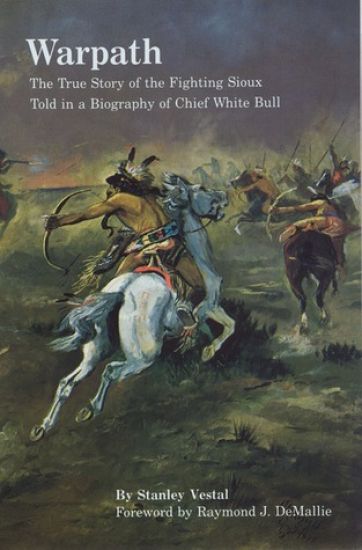
Warpath

Warpath

Stanley Vestal; Raymond J. DeMallie

University of Nebraska Press
1984
pokkari
Nephew to Sitting Bull, chief of the Sioux, Pte San Hunka (White Bull) was a famous warrior in his own right. He had been on the warpath against whites and other Indians for more than a decade when he fought the greatest battle of his life. On the afternoon of June 25, 1876, five troops of the U. S. Seventh Cavalry under the command of George Armstrong Custer rode into the valley of the Little Big Horn River, confidently expecting to rout the Indian encampments there. Instead, the cavalry met the gathered strength of Sioux and Cheyenne warriors, who did not run as expected but turned the battle toward the soldiers. White Bull charged again and again, fighting until the last soldier was dead. The battle was Custer's Last Stand, and White Bull was later referred to as the warrior who killed Custer. In 1932 White Bull related his life story to Stanley Vestal, who corroborated the details, from other sources and prepared this biography. "All that I told him is straight and true," said White Bull. His story is a matchless account of the life of an Indian warrior.
Wagons Southwest: Story of the Old Trail to Santa Fe

Wagons Southwest: Story of the Old Trail to Santa Fe

Stanley Vestal; Irvin Shope; Howard R. Driggs

Literary Licensing, LLC
2011
sidottu
""Wagons Southwest: Story Of The Old Trail To Santa Fe"" is a historical account of the famous trail that connected Missouri to Santa Fe in the mid-1800s. Written by Stanley Vestal, this book delves into the history of the trail and the people who traveled it. The book covers the early explorers who discovered the trail, the traders who used it to transport goods, and the Native Americans who inhabited the area. The author also describes the challenges faced by the travelers, including harsh weather conditions, disease, and attacks by bandits and hostile tribes. The book also explores the cultural and economic impact of the trail, as well as its role in shaping the American West. With vivid descriptions and detailed research, ""Wagons Southwest"" offers a fascinating look at an important chapter in American history.This scarce antiquarian book is a facsimile reprint of the old original and may contain some imperfections such as library marks and notations. Because we believe this work is culturally important, we have made it available as part of our commitment for protecting, preserving, and promoting the world's literature in affordable, high quality, modern editions, that are true to their original work.
Rivers of America: The Missouri

Rivers of America: The Missouri

Stanley Vestal; Jonathan Waterman

The Lyons Press
2019
pokkari
The Missouri was the river of Lewis and Clark, of Manuel Lisa, General Ashley, and other organizers of the fur trade; of such noted travelers as George Catlin, Henry R. Schoolcraft, and Prince Maximilian; of a host of adventurous steamboat captains; of explorers like Jedediah Smith, Kit Carson, and Frémont; of doughty hunters and trappers like Hugh Glass, Jim Bridger, and John Colter. Stanley Vestal's rollicking story of one of America's most fabled waterways presents western history on a grand scale, one that. according to the New York Times, "anyone remotely interested in the American West will read." "Vestal takes the Big Muddy as the central character in an intriguing story. . . . It is always readable, always informative."—Los Angeles Times