Kirjojen hintavertailu. Mukana 11 342 296 kirjaa ja 12 kauppaa.

Kirjahaku

Etsi kirjoja tekijän nimen, kirjan nimen tai ISBN:n perusteella.

4 kirjaa tekijältä Stephan Feuchtwang

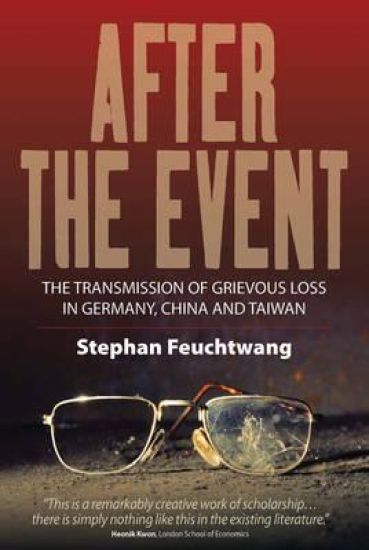
After the Event

After the Event

Stephan Feuchtwang

Berghahn Books
2011
sidottu
Two of the most destructive moments of state violence in the twentieth century occurred in Europe between 1933 and 1945 and in China between 1959 and 1961 (the Great Leap famine). This is the first book to bring the two histories together in order to examine their differences and to understand if there are any similar processes of transmission at work. The author expertly ties in the Taiwanese civil war between Nationalists and Communists, which included the White Terror from 1947 to 1987, a less well-known but equally revealing part of twentieth-century history. Personal and family stories are told, often in the individual’s own words, and then compared with the public accounts of the same events as found in official histories, commemorations, school textbooks and other forms of public memory. The author presents innovative and constructive criticisms of social memory theories in order to make sense both of what happened and how what happened is transmitted.
Popular Religion in China

Popular Religion in China

Stephan Feuchtwang

TAYLOR FRANCIS LTD
2023
nidottu
First published in 2001, Popular Religion in China: The Imperial Metaphor was written to bring together both the previously unpublished and published results of fieldwork in the People’s Republic of China and Taiwan and to put them into an historical, political, and theoretical context. The book presents Chinese popular religion as a distinctive institution and describes its content as an ‘imperial metaphor’. In doing so, it explores a wide range of topics, including both official and local cults, local festivals, Daoism, Ang Gong, the politics of religion, and political ritual.
Popular Religion in China

Popular Religion in China

Stephan Feuchtwang

Taylor Francis Ltd
2021
sidottu
First published in 2001, Popular Religion in China: The Imperial Metaphor was written to bring together both the previously unpublished and published results of fieldwork in the People’s Republic of China and Taiwan and to put them into an historical, political, and theoretical context. The book presents Chinese popular religion as a distinctive institution and describes its content as an ‘imperial metaphor’. In doing so, it explores a wide range of topics, including both official and local cults, local festivals, Daoism, Ang Gong, the politics of religion, and political ritual.
Emancipatory Politics: A Critique

Emancipatory Politics: A Critique

Stephan Feuchtwang

Createspace Independent Publishing Platform
2017
nidottu
This volume shows that organised emancipatory politics, in part or mainly reinforced by arms, is still very much alive in a range of postcolonial states. By 'emancipatory politics' we mean political activities that aim to end exploitation and enhance participatory democracy through which leadership can be held to account on a daily as well as periodic basis, in the workplace and beyond. Whether it be India, Nepal, the Philippines, Peru or Columbia, long-standing armed movements aiming to seize and transform state power are still burning and working for a different future. In Euro-American debate it is easy to forget those movements - some of which have a more than forty-year history - of the Maoists in India or Nepal, FARC in Columbia, or the Communist Party of the Philippines. We focus here on movements that are still very much active as well as on movements of Marxist emancipatory change that achieved state power - the Mozambican case of Frelimo and the Sandinistas of Nicaragua - whose experiences shed an important critical light on those that are still in active struggle. These cases have been chosen to illustrate a range of reasons for embarking on and sustaining armed struggle. We show that questions of ideological, political and economic organization strongly influence the specifically military aspects of these movements. Most are adaptations of Mao's Chinese revolutionary movement and its tenets, but some refer to other revolutionary traditions. The selection is not meant to be comprehensive, but to focus on the reasons for and history of movements of this kind, highlighting the limitations that this mobilisation and its ties to Maoist teachings have placed on their emancipatory politics.