Kirjojen hintavertailu. Mukana 11 717 486 kirjaa ja 12 kauppaa.

Kirjahaku

Etsi kirjoja tekijän nimen, kirjan nimen tai ISBN:n perusteella.

7 kirjaa tekijältä Stephan Palmié

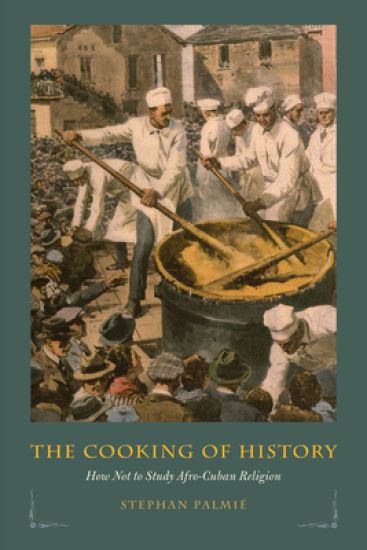
The Cooking of History

The Cooking of History

Stephan Palmié

University of Chicago Press
2013
sidottu
Over a lifetime of studying Cuban Santeria and other religions related to Orisha worship - a practice also found among the Yoruba in West Africa - Stephan Palmie has grown progressively uneasy with the assumptions inherent in the very term Afro-Cuban religion. In "The Cooking of History" he provides a comprehensive analysis of these assumptions, in the process offering an incisive critique both of the anthropology of religion and of scholarship on the cultural history of the Afro-Atlantic World. Understood largely through its rituals and ceremonies, Santeria and related religions have been a challenge for anthropologists to link to a hypothetical African past. But, Palmie argues, precisely by relying on the notion of an aboriginal African past, and by claiming to authenticate these religions via their findings, anthropologists - some of whom have converted to these religions - have exerted considerable influence upon contemporary practices. Critiquing widespread and damaging simplifications that posit religious practices as stable and self-contained, Palmie calls for a drastic new approach that properly situates cultural origins within the complex social environments and scholarly fields in which they are investigated.
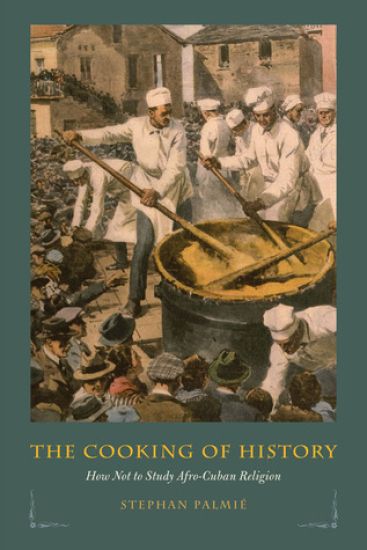
The Cooking of History

The Cooking of History

Stephan Palmié

University of Chicago Press
2013
nidottu
Over a lifetime of studying Cuban Santeria and other religions related to Orisha worship - a practice also found among the Yoruba in West Africa - Stephan Palmie has grown progressively uneasy with the assumptions inherent in the very term Afro-Cuban religion. In "The Cooking of History" he provides a comprehensive analysis of these assumptions, in the process offering an incisive critique both of the anthropology of religion and of scholarship on the cultural history of the Afro-Atlantic World. Understood largely through its rituals and ceremonies, Santeria and related religions have been a challenge for anthropologists to link to a hypothetical African past. But, Palmie argues, precisely by relying on the notion of an aboriginal African past, and by claiming to authenticate these religions via their findings, anthropologists - some of whom have converted to these religions - have exerted considerable influence upon contemporary practices. Critiquing widespread and damaging simplifications that posit religious practices as stable and self-contained, Palmie calls for a drastic new approach that properly situates cultural origins within the complex social environments and scholarly fields in which they are investigated.

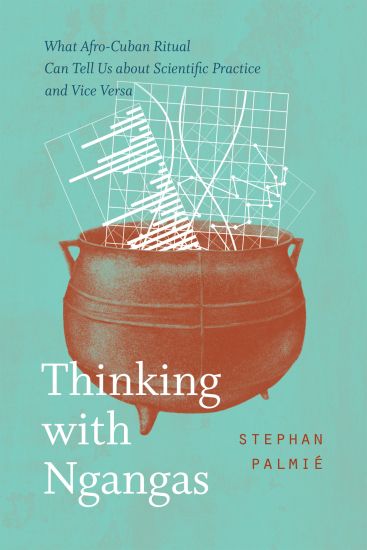
Thinking with Ngangas

Thinking with Ngangas

Stephan Palmié

THE UNIVERSITY OF CHICAGO PRESS
2023
sidottu
A comparative investigation of Afro-Cuban ritual and Western science that aims to challenge the rationality of Western expert practices. Inspired by the exercises of Father Lafitau, an eighteenth-century Jesuit priest and protoethnographer who compared the lives of the Iroquois to those of the ancient Greeks, Stephan Palmié embarks on a series of unusual comparative investigations of Afro-Cuban ritual and Western science. What do organ transplants have to do with ngangas, a complex assemblage of mineral, animal, and vegetal materials, including human remains, that serve as the embodiment of the spirits of the dead? How do genomics and “ancestry projects” converge with divination and oracular systems? What does it mean that Black Cubans in the United States took advantage of Edisonian technology to project the disembodied voice of a mystical entity named ecué onto the streets of Philadelphia? Can we consider Afro-Cuban spirit possession as a form of historical knowledge production? By writing about Afro-Cuban ritual in relation to Western scientific practice, and vice versa, Palmié hopes to challenge the rationality of Western expert practices, revealing the logic that brings together enchantment and experiment.
Thinking with Ngangas

Thinking with Ngangas

Stephan Palmié

THE UNIVERSITY OF CHICAGO PRESS
2023
nidottu
A comparative investigation of Afro-Cuban ritual and Western science that aims to challenge the rationality of Western expert practices. Inspired by the exercises of Father Lafitau, an eighteenth-century Jesuit priest and protoethnographer who compared the lives of the Iroquois to those of the ancient Greeks, Stephan Palmié embarks on a series of unusual comparative investigations of Afro-Cuban ritual and Western science. What do organ transplants have to do with ngangas, a complex assemblage of mineral, animal, and vegetal materials, including human remains, that serve as the embodiment of the spirits of the dead? How do genomics and “ancestry projects” converge with divination and oracular systems? What does it mean that Black Cubans in the United States took advantage of Edisonian technology to project the disembodied voice of a mystical entity named ecué onto the streets of Philadelphia? Can we consider Afro-Cuban spirit possession as a form of historical knowledge production? By writing about Afro-Cuban ritual in relation to Western scientific practice, and vice versa, Palmié hopes to challenge the rationality of Western expert practices, revealing the logic that brings together enchantment and experiment.
Wizards and Scientists

Wizards and Scientists

Stephan Palmié

Duke University Press
2002
sidottu
In Wizards and Scientists Stephan Palmié offers a corrective to the existing historiography on the Caribbean. Focusing on developments in Afro-Cuban religious culture, he demonstrates that traditional Caribbean cultural practices are part and parcel of the same history that produced modernity and that both represent complexly interrelated hybrid formations. Palmié argues that the standard narrative trajectory from tradition to modernity, and from passion to reason, is a violation of the synergistic processes through which historically specific, moral communities develop the cultural forms that integrate them.Highlighting the ways that Afro-Cuban discourses serve as a means of moral analysis of social action, Palmié suggests that the supposedly irrational premises of Afro-Cuban religious traditions not only rival Western rationality in analytical acumen but are integrally linked to rationality itself. Afro-Cuban religion is as “modern” as nuclear thermodynamics, he claims, just as the Caribbean might be regarded as one of the world’s first truly “modern” locales: based on the appropriation and destruction of human bodies for profit, its plantation export economy anticipated the industrial revolution in the metropolis by more than a century. Working to prove that modernity is not just an aspect of the West, Palmié focuses on those whose physical abuse and intellectual denigration were the price paid for modernity’s achievement. All cultures influenced by the transcontinental Atlantic economy share a legacy of slave commerce. Nevertheless, local forms of moral imagination have developed distinctive yet interrelated responses to this violent past and the contradiction-ridden postcolonial present that can be analyzed as forms of historical and social analysis in their own right.
Wizards and Scientists

Wizards and Scientists

Stephan Palmié

Duke University Press
2002
pokkari
This volume focuses on developments in Afro-Cuban religious culture, demonstrating that traditional Caribbean cultural practices are steeped in the same history that produced modernity and represent complex hybrid formations.
Fernando Ortiz – Caribbean and Mediterranean Counterpoints

Fernando Ortiz – Caribbean and Mediterranean Counterpoints

Stephan Palmié

HAU Society Of Ethnographic Theory
2023
nidottu
Cross-regional scholarly dialogue inspired by the work of the pioneering Cuban scholar. Fernando Ortiz (1881–1969) coined the term “transculturation” in 1940. This was an early case of theory from the South: concepts developed from an explicitly peripheral epistemological vantage point and launched as a corrective to European and North American theoretical formulations. What Ortiz proposed was a contrapuntal vision of complexly entangled processes that we, today, would conceptualize as cultural emergence. Inspired by Ortiz, this volume engineers an unprecedented conversation between Mediterraneanists and Caribbeanists. It harnesses Ortiz’s mid-twentieth-century theoretical formulations to early twenty-first-century issues pertinent to both regions, including migration, territorial sovereignty, and cultural diversity. The contributors explore this perspective (arguably formed during Ortiz’s youth in late nineteenth-century Menorca) in a dialogue between scholars of the contemporary Caribbean and Mediterranean to enable novel analytics for both regions and to more broadly to probe the promises and limits of Ortiz’s contribution for contemporary anthropological research and theorizing.