Kirjojen hintavertailu. Mukana 12 137 071 kirjaa ja 12 kauppaa.

Kirjahaku

Etsi kirjoja tekijän nimen, kirjan nimen tai ISBN:n perusteella.

3 kirjaa tekijältä Stephan Scheel

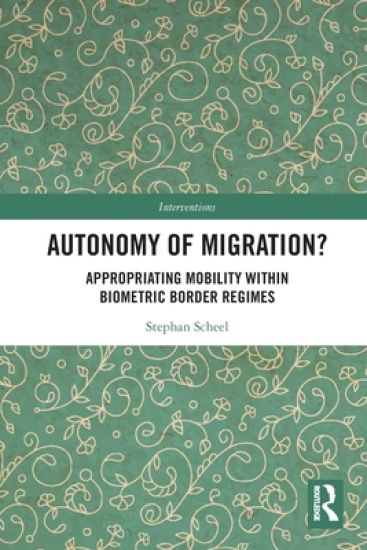
Autonomy of Migration?

Autonomy of Migration?

Stephan Scheel

Routledge
2021
nidottu
Examining how migrants appropriate mobility in the context of biometric border controls, this volume mobilises new analytics and empirics in the debates about the politics of migration and provides an analytically effective and politically significant tool for the study of contemporary migration.Drawing from the tension between the EU’s attempt to achieve watertight border controls by means of biometric technologies, and migrants’ persistence to move to and live in the EU, the volume pursues two interrelated objectives: first, it studies the encounters between migrants and the Visa Information System (VIS), one of the largest biometric databases in the world, from the perspective of mobility in order to investigate how migrants appropriate mobility via Schengen visa within and against this biometric border regime. Second, it addresses criticisms of autonomy of migration in order to develop it as a viable approach for border, migration and critical security studies. Hence, the book is driven by two interrelated research questions: what does the assertion of moments of autonomy of migration refer to in the context of border regimes that use biometrics to turn migrants’ bodies into a means of mobility control? And how do migrants appropriate mobility via Schengen visa within and against biometric border regimes? This book will be of great interest to scholars in border, migration and critical security studies, as well as researchers engaged in citizenship studies, surveillance studies, political theory, critical IR theory and international political sociology.
Autonomy of Migration?

Autonomy of Migration?

Stephan Scheel

Routledge
2019
sidottu
Examining how migrants appropriate mobility in the context of biometric border controls, this volume mobilises new analytics and empirics in the debates about the politics of migration and provides an analytically effective and politically significant tool for the study of contemporary migration.Drawing from the tension between the EU’s attempt to achieve watertight border controls by means of biometric technologies, and migrants’ persistence to move to and live in the EU, the volume pursues two interrelated objectives: first, it studies the encounters between migrants and the Visa Information System (VIS), one of the largest biometric databases in the world, from the perspective of mobility in order to investigate how migrants appropriate mobility via Schengen visa within and against this biometric border regime. Second, it addresses criticisms of autonomy of migration in order to develop it as a viable approach for border, migration and critical security studies. Hence, the book is driven by two interrelated research questions: what does the assertion of moments of autonomy of migration refer to in the context of border regimes that use biometrics to turn migrants’ bodies into a means of mobility control? And how do migrants appropriate mobility via Schengen visa within and against biometric border regimes? This book will be of great interest to scholars in border, migration and critical security studies, as well as researchers engaged in citizenship studies, surveillance studies, political theory, critical IR theory and international political sociology.

Data Practices

Data Practices

Evelyn Ruppert; Stephan Scheel

GOLDSMITHS, UNIVERSITY OF LONDON
2021
sidottu
How EU data practices establish and assign people to categories, and how this matters in enacting--making up--Europe as a population and people. What is Europe and who are Europeans? Data Practices approaches this contemporary political and theoretical question by treating it as a practical problem of counting. Only through the myriad data practices that make up methods such as censuses can EU member states know their national populations, and this in turn is utilized by the EU to understand the population of Europe. But this volume approaches data practices not simply as reflecting populations but as performative in two senses: they simultaneously enact--that is, make up--a European population and, by so doing--intentionally or otherwise--also contribute to making up a European people. The book develops a conception of data practices to analyze and interpret findings from collaborative ethnographic multisite fieldwork conducted by an interdisciplinary team of social science researchers as part of a five-year project, Peopling Europe: How Data Make a People. The book focuses on data practices that involve establishing and assigning people to categories and how this matters in enacting Europe as a population and people. Five core chapters explore key categories of people--usual residents, refugees, homeless people, migrants, and ethnic minorities--and how they come into being through specific data practices such as defining, estimating, recalibrating and inferring. Two additional chapters address two key subject positions that data practices produce and require: the data subject and the statistician subject.