Kirjojen hintavertailu. Mukana 12 390 323 kirjaa ja 12 kauppaa.

Kirjahaku

Etsi kirjoja tekijän nimen, kirjan nimen tai ISBN:n perusteella.

9 kirjaa tekijältä Stephen C. Levinson

Presumptive Meanings

Presumptive Meanings

Stephen C. Levinson

Bradford Books
2000
pokkari
This is the first extended discussion of preferred interpretation in language understanding, integrating much of the best research in linguistic pragmatics from the last two decades.When we speak, we mean more than we say. In this book Stephen C. Levinson explains some general processes that underlie presumptions in communication. This is the first extended discussion of preferred interpretation in language understanding, integrating much of the best research in linguistic pragmatics from the last two decades. Levinson outlines a theory of presumptive meanings, or preferred interpretations, governing the use of language, building on the idea of implicature developed by the philosopher H.P. Grice. Some of the indirect information carried by speech is presumed by default because it is carried by general principles, rather than inferred from specific assumptions about intention and context. Levinson examines this class of general pragmatic inferences in detail, showing how they apply to a wide range of linguistic constructions. This approach has radical consequences for how we think about language and communication.
Pragmatics

Pragmatics

Stephen C. Levinson

Cambridge University Press
1983
pokkari
Dr Levinson provides a lucid and integrative analysis of the central topics in pragmatics - deixis, implicature, presupposition, speech acts, and conversational structure. A central concern of the book is the relation between pragmatics and semantics.
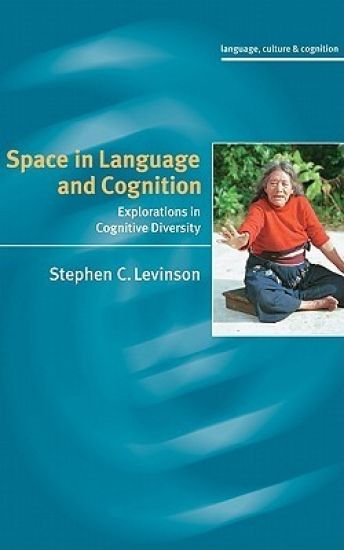
Space in Language and Cognition

Space in Language and Cognition

Stephen C. Levinson

Cambridge University Press
2003
sidottu
Languages differ in how they describe space, and such differences between languages can be used to explore the relation between language and thought. This 2003 book shows that even in a core cognitive domain like spatial thinking, language influences how people think, memorize and reason about spatial relations and directions. After outlining a typology of spatial coordinate systems in language and cognition, it is shown that not all languages use all types, and that non-linguistic cognition mirrors the systems available in the local language. The book reports on collaborative, interdisciplinary research, involving anthropologists, linguists and psychologists, conducted in many languages and cultures around the world, which establishes this robust correlation. The overall results suggest that thinking in the cognitive sciences underestimates the transformative power of language on thinking. The book will be of interest to linguists, psychologists, anthropologists and philosophers, and especially to students of spatial cognition.
The Dark Matter of Pragmatics

The Dark Matter of Pragmatics

Stephen C. Levinson

Cambridge University Press
2024
sidottu
This Element tries to discern the known unknowns in the field of pragmatics, the 'Dark Matter' of the title. We can identify a key bottleneck in human communication, the sheer limitation on the speed of speech encoding: pragmatics occupies the niche nestled between slow speech encoding and fast comprehension. Pragmatic strategies are tricks for evading this tight encoding bottleneck by meaning more than you say. Five such tricks are reviewed, which are all domains where we have made considerable progress. We can then ask for each of these areas, where have we neglected to push the frontier forward? These are the known unknowns of pragmatics, key areas, and topics for future research. The Element thus offers a brief review of some central areas of pragmatics, and a survey of targets for future research. This title is also available as Open Access on Cambridge Core.
The Dark Matter of Pragmatics

The Dark Matter of Pragmatics

Stephen C. Levinson

Cambridge University Press
2024
pokkari
This Element tries to discern the known unknowns in the field of pragmatics, the 'Dark Matter' of the title. We can identify a key bottleneck in human communication, the sheer limitation on the speed of speech encoding: pragmatics occupies the niche nestled between slow speech encoding and fast comprehension. Pragmatic strategies are tricks for evading this tight encoding bottleneck by meaning more than you say. Five such tricks are reviewed, which are all domains where we have made considerable progress. We can then ask for each of these areas, where have we neglected to push the frontier forward? These are the known unknowns of pragmatics, key areas, and topics for future research. The Element thus offers a brief review of some central areas of pragmatics, and a survey of targets for future research. This title is also available as Open Access on Cambridge Core.
The Interaction Engine

The Interaction Engine

Stephen C. Levinson

Cambridge University Press
2025
sidottu
Communicative interaction forms the core of human experience. In this fascinating book Levinson, one of the world's leading scholars in the field, explores how human communicative interaction is structured, the demands it puts on our cognitive processing, and how its system evolved out of continuities with other primate systems. It celebrates the role of the 'interaction engine' which drives our social interaction, not only in human life, but also in the evolution of our species – showing how exchanges such as words, glances, laughter and face-to-face encounters bring us our greatest and most difficult experiences, and have come to define what it means to be human. It draws extensively on the author's fieldwork with speakers across multiple cultures and communities, and was inspired by his own experiences during the Covid lockdown, when humans were starved of the very social interaction that shapes our lives. This title is also available as open access on Cambridge Core.
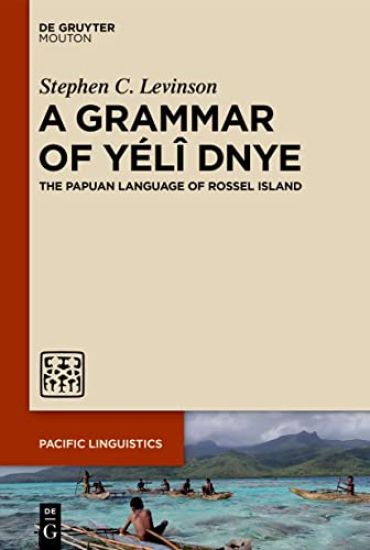
A Grammar of Yélî Dnye

A Grammar of Yélî Dnye

Stephen C. Levinson

De Gruyter
2022
sidottu
This is a comprehensive description of a language spoken some 450 km offshore from the mainland of Papua New Guinea. The language is remarkable for its phonological, morphological and syntactic complexity. As the sole surviving member of its language family, and with little historical contact with surrounding languages, the language provides evidence of the kind of languages spoken in this part of the world before the Austronesian expansion. The grammar provides detailed information on the phoneme inventory, morphology, syntax and select semantic fields. Remarkable features include a 90 phoneme inventory including unique sounds, a morphology with thousands of non-compositional portmanteau elements, complex rules for negation, and extensive ergative syntax. Unusual patterns are also found in the organization of semantic fields, for example in partonymies of the body, taxonomies of the natural world, verbal semantics and kinship terms. The combination of linguistic ‘rara’ suggest that linguistic evolution under low contact can yield baroque and unusual patterns. The volume should be of special interest to linguists, typologists, sociolinguists, anthropologists and researchers in Oceania and Melanesia. Endorsement: "This long-awaited grammar is a major contribution to Papuan and general linguistics, providing as it does by far the most comprehensive and accurate grammatical description of a language that has already assumed a position as one of the world's most complicated. Hitherto, the most extensive grammatical description of the language has been the survey-like Henderson (1995), and while Levinson explicitly acknowledges his debt to this earlier grammar and to unpublished work by Henderson, his own detailed grammar clearly takes the level of description and analysis of the language to a completely new level. In particular, Levinson's grammar makes clear precisely to what extent and in what ways the language's morphology is complex beyond even what most studies on morphologically complex languages envisage. In addition, it provides a much more detailed account of the language's syntax, based on a judicious combination of corpus attestation and careful elicitation (incl. using the kits developed by Levinson's group at the MPI for Psycholinguistics). The grammar thus not only fills a major lacuna in our knowledge of the non-Austronesian languages of the New Guinea area, but also provides grist for future studies on the implications of the language's complexities."Bernard Comrie, University of California, Santa Barbara
A Grammar of Yélî Dnye

A Grammar of Yélî Dnye

Stephen C. Levinson

De Gruyter
2023
isokokoinen pokkari
This is a comprehensive description of a language spoken some 450 km offshore from the mainland of Papua New Guinea. The language is remarkable for its phonological, morphological and syntactic complexity. As the sole surviving member of its language family, and with little historical contact with surrounding languages, the language provides evidence of the kind of languages spoken in this part of the world before the Austronesian expansion. The grammar provides detailed information on the phoneme inventory, morphology, syntax and select semantic fields. Remarkable features include a 90 phoneme inventory including unique sounds, a morphology with thousands of non-compositional portmanteau elements, complex rules for negation, and extensive ergative syntax. Unusual patterns are also found in the organization of semantic fields, for example in partonymies of the body, taxonomies of the natural world, verbal semantics and kinship terms. The combination of linguistic ‘rara’ suggest that linguistic evolution under low contact can yield baroque and unusual patterns. The volume should be of special interest to linguists, typologists, sociolinguists, anthropologists and researchers in Oceania and Melanesia. Endorsement: "This long-awaited grammar is a major contribution to Papuan and general linguistics, providing as it does by far the most comprehensive and accurate grammatical description of a language that has already assumed a position as one of the world's most complicated. Hitherto, the most extensive grammatical description of the language has been the survey-like Henderson (1995), and while Levinson explicitly acknowledges his debt to this earlier grammar and to unpublished work by Henderson, his own detailed grammar clearly takes the level of description and analysis of the language to a completely new level. In particular, Levinson's grammar makes clear precisely to what extent and in what ways the language's morphology is complex beyond even what most studies on morphologically complex languages envisage. In addition, it provides a much more detailed account of the language's syntax, based on a judicious combination of corpus attestation and careful elicitation (incl. using the kits developed by Levinson's group at the MPI for Psycholinguistics). The grammar thus not only fills a major lacuna in our knowledge of the non-Austronesian languages of the New Guinea area, but also provides grist for future studies on the implications of the language's complexities."Bernard Comrie, University of California, Santa Barbara
Language, Thought, and Reality

Language, Thought, and Reality

Benjamin Lee Whorf; Stephen C. Levinson

MIT Press
2012
pokkari
Writings by a pioneering linguist, including his famous work on the Hopi language, general reflections on language and meaning, and the "Yale Report." The pioneering linguist Benjamin Whorf (1897-1941) grasped the relationship between human language and human thinking: how language can shape our innermost thoughts. His basic thesis is that our perception of the world and our ways of thinking about it are deeply influenced by the structure of the languages we speak. The writings collected in this volume include important papers on the Maya, Hopi, and Shawnee languages, as well as more general reflections on language and meaning. Whorf's ideas about the relation of language and thought have always appealed to a wide audience, but their reception in expert circles has alternated between dismissal and applause. Recently the language sciences have headed in directions that give Whorf's thinking a renewed relevance. Hence this new edition of Whorf's classic work is especially timely. The second edition includes all the writings from the first edition as well as John Carroll's original introduction, a new foreword by Stephen Levinson of the Max Planck Institute for Psycholinguistics that puts Whorf's work in historical and contemporary context, and new indexes. In addition, this edition offers Whorf's "Yale Report," an important work from Whorf's mature oeuvre.