Kirjojen hintavertailu. Mukana 11 503 850 kirjaa ja 12 kauppaa.

Kirjahaku

Etsi kirjoja tekijän nimen, kirjan nimen tai ISBN:n perusteella.

7 kirjaa tekijältä Stephen Clarkson

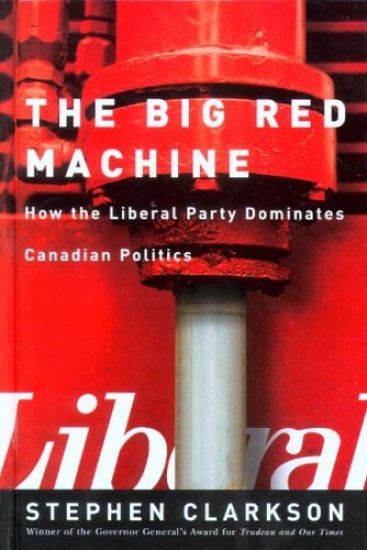
The Big Red Machine

The Big Red Machine

Stephen Clarkson

University of British Columbia Press
2005
sidottu
The Liberal Party of Canada has governed for 78 of the last 110 years, making it the most successful political party in the world. How has one party been able to dominate the polls during such a tumultuous sweep of history? Will it continue to win?In The Big Red Machine, astute Liberal observer Stephen Clarkson tells the story of the Liberal Party's performance in the last nine elections, providing essential historical context for each and offering incisive, behind-the-scenes detail about how the party has planned, changed, and executed its successful electoral strategies. Arguing that the Liberal Party has opportunistically straddled the political centre since Sir John A. Macdonald – leaning left or moving right and as circumstances required – Clarkson also shows that the party's grip on power is becoming increasingly uncertain, having lost its appeal not just in the West, but now in Québec. Its campaigns now reflect the splintering of the party system and the integration of Canada into the global economy.An ideal political primer, deftly written and filled with a wealth of fact and analysis, The Big Red Machine is a fascinating history of Liberal pragmatism, communication tactics, and dramatic changes in leadership style. "Even if the last century did not belong to Canada, Canada turns out to have belonged to the Liberal Party," Clarkson concludes. Although he foresees considerably less rosy prospects for Grits in the years ahead, the "big red machine" remains a formidable political force.
The Big Red Machine

The Big Red Machine

Stephen Clarkson

University of British Columbia Press
2005
pokkari
The Liberal Party of Canada has governed for 78 of the last 110 years, making it the most successful political party in the world. How has one party been able to dominate the polls during such a tumultuous sweep of history? Will it continue to win?In The Big Red Machine, astute Liberal observer Stephen Clarkson tells the story of the Liberal Party's performance in the last nine elections, providing essential historical context for each and offering incisive, behind-the-scenes detail about how the party has planned, changed, and executed its successful electoral strategies. Arguing that the Liberal Party has opportunistically straddled the political centre since Sir John A. Macdonald – leaning left or moving right and as circumstances required – Clarkson also shows that the party's grip on power is becoming increasingly uncertain, having lost its appeal not just in the West, but now in Québec. Its campaigns now reflect the splintering of the party system and the integration of Canada into the global economy.An ideal political primer, deftly written and filled with a wealth of fact and analysis, The Big Red Machine is a fascinating history of Liberal pragmatism, communication tactics, and dramatic changes in leadership style. "Even if the last century did not belong to Canada, Canada turns out to have belonged to the Liberal Party," Clarkson concludes. Although he foresees considerably less rosy prospects for Grits in the years ahead, the "big red machine" remains a formidable political force.
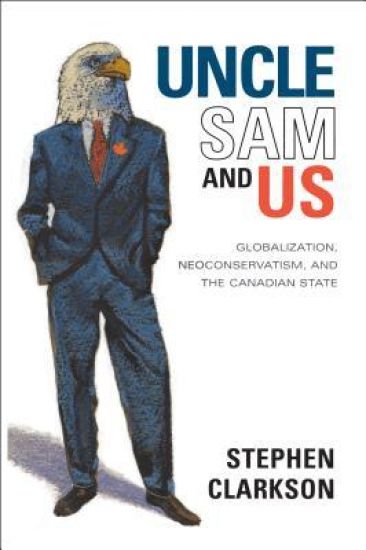
Uncle Sam and Us

Uncle Sam and Us

Stephen Clarkson

University of Toronto Press
2002
sidottu
Between them, Brian Mulroney and Jean Chrétien radically altered the structure and functions of the federal government, first by signing and implementing major trade liberalization projects, and then by cutting back the size of their governments' budgets and the scope of their policies. Uncle Sam and Us analyzes the Mulroney-Chrétien era's impact on Canadian governance through two related factors, globalization from without and neoconservatism from within. Stephen Clarkson begins his study by conceptualizing the present Canadian state as a five-tiered, nested system stretching from the municipal and provincial levels, through the federal government, and on to the new continental and global spheres of governance: in effect, he argues, the North American Free Trade Agreement and the World Trade Organization have added a 'supraconstitution' to Canada's existing institutions. His analysis concerns the changes that have occurred not just in the federal government, but in provincial and municipal governance as well. The impact of globalization and neoconservatism is examined extensively in the second part of Clarkson's study, which examines how the functions of the Canadian state have altered. Clarkson addresses the changes in a number of policy areas such as macro and monetary policy, regulatory, industrial, and trade policy, as well as social, labour, environmental, cultural, and foreign policy. In linking external forces and internal factors in his analysis, Clarkson brings together separate aspects of the Canadian state into a comprehensive understanding of the current Canadian political climate. He combines a global knowledge of the international political economy with a micro concern for detailed analyses of policy issues, and concludes that the responsibility for Canada's predicament lies less with external forces, than with Canadians and the governments they elected. He ends with a hopeful look into the future, pointing towards a realization of the shortcomings of neoconservative globalization, and the expectation of a new governing paradigm. Co-published with Woodrow Wilson Center Press
Uncle Sam and Us

Uncle Sam and Us

Stephen Clarkson

University of Toronto Press
2002
pokkari
Between them, Brian Mulroney and Jean Chrétien radically altered the structure and functions of the federal government, first by signing and implementing major trade liberalization projects, and then by cutting back the size of their governments' budgets and the scope of their policies. Uncle Sam and Us analyzes the Mulroney-Chrétien era's impact on Canadian governance through two related factors, globalization from without and neoconservatism from within. Stephen Clarkson begins his study by conceptualizing the present Canadian state as a five-tiered, nested system stretching from the municipal and provincial levels, through the federal government, and on to the new continental and global spheres of governance: in effect, he argues, the North American Free Trade Agreement and the World Trade Organization have added a 'supraconstitution' to Canada's existing institutions. His analysis concerns the changes that have occurred not just in the federal government, but in provincial and municipal governance as well. The impact of globalization and neoconservatism is examined extensively in the second part of Clarkson's study, which examines how the functions of the Canadian state have altered. Clarkson addresses the changes in a number of policy areas such as macro and monetary policy, regulatory, industrial, and trade policy, as well as social, labour, environmental, cultural, and foreign policy. In linking external forces and internal factors in his analysis, Clarkson brings together separate aspects of the Canadian state into a comprehensive understanding of the current Canadian political climate. He combines a global knowledge of the international political economy with a micro concern for detailed analyses of policy issues, and concludes that the responsibility for Canada's predicament lies less with external forces, than with Canadians and the governments they elected. He ends with a hopeful look into the future, pointing towards a realization of the shortcomings of neoconservative globalization, and the expectation of a new governing paradigm. Co-published with Woodrow Wilson Center Press
Does North America Exist?

Does North America Exist?

Stephen Clarkson

University of Toronto Press
2008
pokkari
In the wake of the North American Free Trade Agreement and the terrorist attacks of September 11, 2001, renowned public intellectual and scholar Stephen Clarkson asks whether North America "exists" in the sense that the European Union has made Europe exist. Clarkson's rigorous study of the many political and economic relationships that link Canada, the United States, and Mexico answers this unusual question by looking at the institutions created by NAFTA, a broad selection of economic sectors, and the security policies put in place by the three neighbouring countries following 9/11. This detailed, meticulously researched, and up-to-date treatment of North America's transborder governance allows the reader to see to what extent the United States' dominance in the continent has been enhanced or mitigated by trilateral connections with its two continental partners. An illuminating product of seven years' political-economy, international-relations, and policy research, Does North America Exist? is an ambitious and path-breaking study that will be essential reading for those wanting to understand whether the continent containing the world's most powerful nation is holding its own as a global region.
Does North America Exist?

Does North America Exist?

Stephen Clarkson

University of Toronto Press
2008
sidottu
In the wake of the North American Free Trade Agreement and the terrorist attacks of September 11, 2001, renowned public intellectual and scholar Stephen Clarkson asks whether North America "exists" in the sense that the European Union has made Europe exist. Clarkson's rigorous study of the many political and economic relationships that link Canada, the United States, and Mexico answers this unusual question by looking at the institutions created by NAFTA, a broad selection of economic sectors, and the security policies put in place by the three neighbouring countries following 9/11. This detailed, meticulously researched, and up-to-date treatment of North America's transborder governance allows the reader to see to what extent the United States' dominance in the continent has been enhanced or mitigated by trilateral connections with its two continental partners. An illuminating product of seven years' political-economy, international-relations, and policy research, Does North America Exist? is an ambitious and path-breaking study that will be essential reading for those wanting to understand whether the continent containing the world's most powerful nation is holding its own as a global region.
The Soviet Theory of Development

The Soviet Theory of Development

Stephen Clarkson

University of Toronto Press
1978
pokkari
Until now the innumerable and widely distributed Soviet writings on the third world haven been scrutinized for the clues they contain on the Kremlin's aid, trade, and foreign policies, on Soviet strategies for local communist parties, and even on shifts in the Sino-Soviet Relationship. But they have rarely been analysed in their own terms and for what they are – the application of marxist-leninist theory by Soviet scholars to the problems of Asia, Africa, and Latin America. Based on research in Paris, New York, the Soviet Union, and India, this book provides a long needed insight into how Soviet thinkers understand such crucial problems in development as planning in mixed economies, foreign aid from socialist and capitalist donors, agrarian reform, and the class struggle. A concerned observer of Soviet development theory for some fifteen years, Stephen Clarkson is neither hostile nor uncritical. He argues that western students and third world policy-makers alike have a good deal to learn from marxist-leninist political economy because it presents an integrated approach to understanding the dilemmas of underdevelopment. Although Soviet scholarship benefits from some important theoretical advantages, it also suffers, in Clarkson's view, from severe intellectual handicaps. The book examines the Soviet analysis of third world development as a whole, drawing particularly on the most extensive and sophisticated school of interpretation, the Russian writings on India. This book makes an important contribution to Soviet and third world studies by offering the reader a guide to the publications on development, a complex and evolving aspect of the Soviet view of the world.