Kirjojen hintavertailu. Mukana 11 342 296 kirjaa ja 12 kauppaa.

Kirjahaku

Etsi kirjoja tekijän nimen, kirjan nimen tai ISBN:n perusteella.

2 kirjaa tekijältä Stephen D. Bowd

Renaissance Mass Murder

Renaissance Mass Murder

Stephen D. Bowd

Oxford University Press
2018
sidottu
Renaissance Mass Murder explores the devastating impact of war on the men and women of the Renaissance. In contrast to the picture of balance and harmony usually associated with the Renaissance, it uncovers in forensic detail a world in which sacks of Italian cities and massacres of civilians at the hands of French, German, Spanish, Swiss, and Italian troops were regular occurrences. The arguments presented are based on a wealth of evidence - histories and chronicles, poetry and paintings, sculpture and other objects - which together provide a new and startling history of sixteenth-century Italy and a social history of the Italian Wars. It outlines how massacres happened, how princes, soldiers, lawyers, and writers justified and explained such events, and how they were represented in contemporary culture. On this basis, Renaissance Mass Murder reconstructs the terrifying individual experiences of civilians in the face of war and in doing so offers a story of human tragedy which redresses the balance of the history of the Italian Wars, and of Renaissance warfare, in favour of the civilian and away from the din of battle. This volume also places mass murder in a broader historical context and challenges claims that such violence was unusual or in decline in early modern Europe. Finally, it shows that women often suffered disproportionately from this violence and that immunity for them, as for their children, was often partially developed or poorly respected.
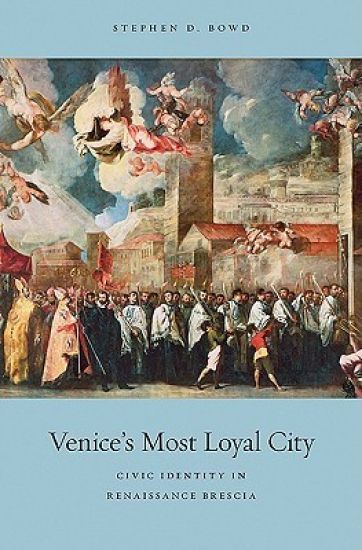
Venice's Most Loyal City

Venice's Most Loyal City

Stephen D. Bowd

Harvard University Press
2010
sidottu
By the second decade of the fifteenth century Venice had established an empire in Italy extending from its lagoon base to the lakes, mountains, and valleys of the northwestern part of the peninsula. The wealthiest and most populous part of this empire was the city of Brescia which, together with its surrounding territory, lay in a key frontier zone between the politically powerful Milanese and the economically important Germans. Venetian governance there involved political compromise and some sensitivity to local concerns, and Brescians forged their distinctive civic identity alongside a strong Venetian cultural presence.Based on archival, artistic, and architectural evidence, Stephen Bowd presents an innovative microhistory of a fascinating, yet historically neglected city. He shows how Brescian loyalty to Venice was repeatedly tested by a succession of disasters: assault by Milanese forces, economic downturn, demographic collapse, and occupation by French and Spanish armies intent on dismembering the Venetian empire. In spite of all these troubles the city experienced a cultural revival and a dramatic political transformation under Venetian rule, which Bowd describes and uses to illuminate the process of state formation in one of the most powerful regions of Renaissance Italy.