Kirjojen hintavertailu. Mukana 12 083 983 kirjaa ja 12 kauppaa.

Kirjahaku

Etsi kirjoja tekijän nimen, kirjan nimen tai ISBN:n perusteella.

14 kirjaa tekijältä Stephen Darwall

The Heart and its Attitudes

The Heart and its Attitudes

Stephen Darwall

Oxford University Press
2024
sidottu
Philosophers don't often write about the heart. At least, analytical philosophers don't. Why is this? Philosophers are said to live life “in their heads” rather than “from their hearts.” But even if that is so, why don't they think and write about the heart? Moreover, it can hardly have escaped philosophers' attention that matters of the heart are central to what we human beings value most about our lives, including our lives with animals. Philosophers write a lot about friendship and love, but they tend to do so in terms that leave out heartfelt connection. They speak rather of commitment to one another and each other's well-being, or taking each other as ends, or sharing deliberative standpoints or living life together, or a whole host of other topics, and much less about mutual emotional vulnerability and sharing and being in one another's hearts. Surely one explanation of philosophers' reticence is that talk of “the heart” seems unavoidably metaphorical. It turns out to be easy enough, however, to cash the metaphor in if we simply take “heart” refers to a cluster of emotional susceptibilities that have an essentially reciprocating structure. The heart aims at heartfelt connection-at shared experience of joys and sorrows, hopes and fears, and other personal emotions. We seek naturally to share these feelings with others and must suppress our natural tendencies if we wish to avoid doing so. Our heart's wish is to be open to other hearts in the hope that they will be open to ours, and thereby us, in return. This book is a systematic treatment-perhaps the first-of “attitudes of the heart”-remorse (versus guilt), love, trust, gratitude, personal anger (versus righteous anger), jealousy, and others-and their role in mediating personal relationship, attachment, and connection. This is obviously interesting in its own right, but it also shows how heartfelt attitudes mirror more extensively studied “reactive attitudes” of guilt, resentment, and blame (“attitudes of the will”). Whereas the latter mediate moral relations of mutual respect and accountability, attitudes of the heart are the currency of heartfelt connection and personal relationship.

Morality, Authority, and Law

Morality, Authority, and Law

Stephen Darwall

Oxford University Press
2013
sidottu
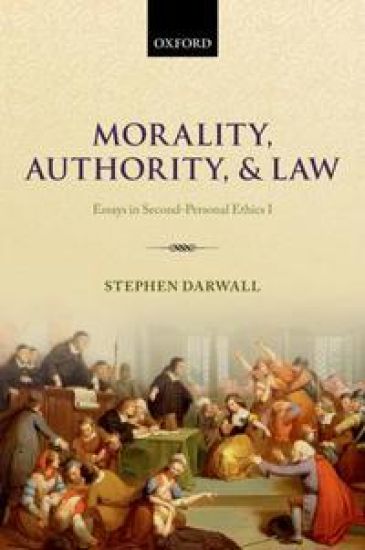
Stephen Darwall presents a series of essays that explore and extend the Second-Person Standpoints argument that central moral concepts are irreducibly second personal, entailing mutual accountability and the authority to address demands to one another (and ourselves). He illustrates the second-personal frameworks power to illuminate a wide variety of issues in moral, political, and legal philosophy. Section I concerns morality: its distinctiveness among normative concepts, the metaethics of bipolar obligations (owed to someone); the relation between moral obligations form and the substance of our obligations; whether the fact that an action is wrong is itself a reason against action (as opposed to simply entailing that sufficient moral reasons independently exist); and whether morality requires general principles or might be irreducibly particularistic. Section II consists of two essays on autonomy: one discussing the relation between Kants autonomy of the will and the right to autonomy, and another arguing that what makes an agents desires and will reason-giving is not the basis of internal practical reasons in desire, but the dignity of persons and shared second-personal authority. Section III focuses on the nature of authority and the law. Two essays take up Joseph Razs influential normal justification thesis and argue that it fails to capture authoritys second-personal nature, without which authority cannot create exclusionaryand preemptivereasons.The final two essays concern law.The first sketches the insights that a second-personal approach can provide into the nature of law and the grounds of distinctions between different parts of law.The second shows how a second-personal framework can be used to develop the civil recourse theory in the law of torts.
Morality, Authority, and Law

Morality, Authority, and Law

Stephen Darwall

Oxford University Press
2013
nidottu
Stephen Darwall presents a series of essays that explore the view that central moral concepts are irreducibly second-personal, in that they entail mutual accountability and the authority to address demands. He illustrates the power of the second-personal framework to illuminate a wide variety of issues in moral, political, and legal philosophy. Section I concerns morality: its distinctiveness among normative concepts; the metaethics of 'bipolar obligations' (owed to someone); the relation between moral obligation's form and the substance of our obligations; whether the fact that an action is wrong is itself a reason against action (as opposed to simply entailing that sufficient moral reasons independently exist); and whether morality requires general principles or might be irreducibly particularistic. Section II consists of two essays on autonomy: one discussing the relation between Kant's 'autonomy of the will' and the right to autonomy, and another arguing that what makes an agent's desires and will reason giving is not the basis of 'internal' practical reasons in desire, but the dignity of persons and shared second-personal authority. Section III focuses on the nature of authority and the law. Two essays take up Joseph Raz's influential 'normal justification thesis' and argue that it fails to capture authority's second-personal nature, without which authority cannot create 'exclusionary' and 'preemptive' reasons. The final two essays concern law. The first sketches the insights that a second-personal approach can provide into the nature of law and the grounds of distinctions between different parts of law. The second shows how a second-personal framework can be used to develop the 'civil recourse theory' in the law of torts.
Honor, History, and Relationship

Honor, History, and Relationship

Stephen Darwall

Oxford University Press
2013
sidottu
In Honor, History, and Relationship Stephen Darwall explores the idea of a second-personal framework for morality and its foundations, in which we are committed to morality by presuppositions that are inescapable when we relate to others (person to person). He expands on the argument set forth in The Second-Person Standpoint to explore the second-personal framework in three further settings. The first concerns a fundamental difference between the form that respect and the concept of person take in honor cultures, on the one hand, and the shape these assume in morality conceived as equal accountability, on the other. One essay explores this difference directly while others investigate related themes of justice versus retaliation and vengeance for insult and injury to honor, including in the writings of Adam Smith and Nietzsche on ressentiment. A second setting concerns the role of second-personal ideas in the development of a distinctively "modern" moral philosophy, beginning in seventeenth-century Europe. Two essays here discuss the centrality of second-personal notions in two formative modern natural law theorists: Grotius and Pufendorf. And two others concentrate on the role of reciprocal recognition in Kant and Fichte, respectively. A third group of essays treat the second-personal structure of interpersonal relations. There are three essays in this group: one on promising as a second-personal transaction between promiser and promisee, a second on what it is to be with another person, and a third on the role of second-personal standing in personal relationships.
Honor, History, and Relationship

Honor, History, and Relationship

Stephen Darwall

Oxford University Press
2013
nidottu
In Honor, History, and Relationship Stephen Darwall explores the idea of a second-personal framework for morality and its foundations, in which we are committed to morality by presuppositions that are inescapable when we relate to others (person to person). He expands on the argument set forth in The Second-Person Standpoint to explore the second-personal framework in three further settings. The first concerns a fundamental difference between the form that respect and the concept of person take in honor cultures, on the one hand, and the shape these assume in morality conceived as equal accountability, on the other. One essay explores this difference directly while others investigate related themes of justice versus retaliation and vengeance for insult and injury to honor, including in the writings of Adam Smith and Nietzsche on ressentiment. A second setting concerns the role of second-personal ideas in the development of a distinctively "modern" moral philosophy, beginning in seventeenth-century Europe. Two essays here discuss the centrality of second-personal notions in two formative modern natural law theorists: Grotius and Pufendorf. And two others concentrate on the role of reciprocal recognition in Kant and Fichte, respectively. A third group of essays treat the second-personal structure of interpersonal relations. There are three essays in this group: one on promising as a second-personal transaction between promiser and promisee, a second on what it is to be with another person, and a third on the role of second-personal standing in personal relationships.
Philosophical Ethics

Philosophical Ethics

Stephen Darwall

Routledge
2019
sidottu
Why is ethics part of philosophy? Stephen Darwall's Philosophical Ethics introduces students to ethics from a distinctively philosophical perspective, one that weaves together central ethical questions such as ?What has value?? and ?What are our moral obligations?? with fundamental philosophical issues such as ?What is value?? and ?What can a moral
The British Moralists and the Internal 'Ought'

The British Moralists and the Internal 'Ought'

Stephen Darwall

Cambridge University Press
1995
sidottu
This book is a major work in the history of ethics, and provides the first study of early modern British philosophy in several decades. Professor Darwall discerns two distinct traditions feeding into the moral philosophy of the seventeenth and eighteenth centuries. On the one hand, there is the empirical, naturalist tradition, comprising Hobbes, Locke, Cumberland, Hutcheson, and Hume, which argues that obligation is the practical force that empirical discoveries acquire in the process of deliberation. On the other hand, there is a group including Cudworth, Shaftesbury, Butler, and in some moments Locke, which views obligation as inconceivable without autonomy and which seeks to develop a theory of the will as self-determining.
The British Moralists and the Internal 'Ought'

The British Moralists and the Internal 'Ought'

Stephen Darwall

Cambridge University Press
1995
pokkari
This book is a major work in the history of ethics, and provides the first study of early modern British philosophy in several decades. Professor Darwall discerns two distinct traditions feeding into the moral philosophy of the seventeenth and eighteenth centuries. On the one hand, there is the empirical, naturalist tradition, comprising Hobbes, Locke, Cumberland, Hutcheson, and Hume, which argues that obligation is the practical force that empirical discoveries acquire in the process of deliberation. On the other hand, there is a group including Cudworth, Shaftesbury, Butler, and in some moments Locke, which views obligation as inconceivable without autonomy and which seeks to develop a theory of the will as self-determining.
Modern Moral Philosophy

Modern Moral Philosophy

Stephen Darwall

Cambridge University Press
2025
pokkari
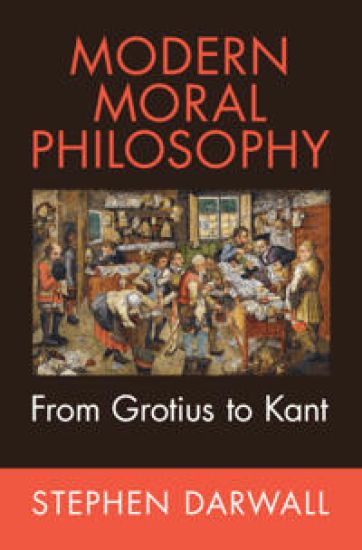
In this magisterial study, one of our leading moral philosophers refutes the charge (originally made by Elizabeth Anscombe) that modern ethics is incoherent because it essentially depends on theological and religious assumptions that it cannot acknowledge. Stephen Darwall's panoramic picture starts with the seventeenth-century thinker Grotius and tells the story continuously down to the time of Kant, exploring what was in fact a completely new way of doing ethics based on secular ideas of human psychology and universal accountability. He shows that thinkers from Grotius to Kant are profoundly united by this modern approach, and that it helped them to create a theory of natural human rights that remains of great political relevance today. He further shows that this new way of thinking provides conceptual resources that are far from exhausted, and that moral philosophy in this idiom still has a vibrant future.
Modern Moral Philosophy

Modern Moral Philosophy

Stephen Darwall

Cambridge University Press
2023
sidottu
In this magisterial study, one of our leading moral philosophers refutes the charge (originally made by Elizabeth Anscombe) that modern ethics is incoherent because it essentially depends on theological and religious assumptions that it cannot acknowledge. Stephen Darwall's panoramic picture starts with the seventeenth-century thinker Grotius and tells the story continuously down to the time of Kant, exploring what was in fact a completely new way of doing ethics based on secular ideas of human psychology and universal accountability. He shows that thinkers from Grotius to Kant are profoundly united by this modern approach, and that it helped them to create a theory of natural human rights that remains of great political relevance today. He further shows that this new way of thinking provides conceptual resources that are far from exhausted, and that moral philosophy in this idiom still has a vibrant future.
The Second-Person Standpoint

The Second-Person Standpoint

Stephen Darwall

Harvard University Press
2009
nidottu
Why should we avoid doing moral wrong? The inability of philosophy to answer this question in a compelling manner—along with the moral skepticism and ethical confusion that ensue—result, Stephen Darwall argues, from our failure to appreciate the essentially interpersonal character of moral obligation. After showing how attempts to vindicate morality have tended to change the subject—falling back on nonmoral values or practical, first-person considerations—Darwall elaborates the interpersonal nature of moral obligations: their inherent link to our responsibilities to one another as members of the moral community.As Darwall defines it, the concept of moral obligation has an irreducibly second-person aspect; it presupposes our authority to make claims and demands on one another. And so too do many other central notions, including those of rights, the dignity of and respect for persons, and the very concept of person itself. The result is nothing less than a fundamental reorientation of moral theory that enables it at last to account for morality's supreme authority—an account that Darwall carries from the realm of theory to the practical world of second-person attitudes, emotions, and actions.
Welfare and Rational Care

Welfare and Rational Care

Stephen Darwall

Princeton University Press
2004
pokkari
What kind of life best ensures human welfare? Since the ancient Greeks, this question has been as central to ethical philosophy as to ordinary reflection. But what exactly is welfare? This question has suffered from relative neglect. And, as Stephen Darwall shows, it has done so at a price. Presenting a provocative new "rational care theory of welfare," Darwall proves that a proper understanding of welfare fundamentally changes how we think about what is best for people. Most philosophers have assumed that a person's welfare is what is good from her point of view, namely, what she has a distinctive reason to pursue. In the now standard terminology, welfare is assumed to have an "agent-relative normativity." Darwall by contrast argues that someone's good is what one should want for that person insofar as one cares for her. Welfare, in other words, is normative, but not peculiarly for the person whose welfare is at stake. In addition, Darwall makes the radical proposal that something's contributing to someone's welfare is the same thing as its being something one ought to want for her own sake, insofar as one cares. Darwall defends this theory with clarity, precision, and elegance, and with a subtle understanding of the place of sympathetic concern in the rich psychology of sympathy and empathy. His forceful arguments will change how we understand a concept central to ethics and our understanding of human bonds and human choices.
Philosophical Ethics

Philosophical Ethics

Stephen Darwall

Westview Press Inc
1997
nidottu
This book shows how Hobbes, Mill, Kant, Aristotle, and Nietzsche all did ethical philosophy? It introduces students to ethics from a distinctively philosophical perspective, one that weaves together central ethical questions.
Modern Moral Philosophy in the Nineteenth Century

Modern Moral Philosophy in the Nineteenth Century

Stephen Darwall

Cambridge University Press
2025
sidottu
Stephen Darwall is a moral philosopher who has played a central role in contemporary debates around the foundation of ethics. This book is a sequel to his earlier volume Modern Moral Philosophy: From Grotius to Kant, and like its predecessor it explores the history of the period through its key ethical thinkers. Fichte, Hegel, Marx, Kierkegaard and Nietzsche – the founding members of the 'continental' tradition – are masterfully examined as they are brought into vivid conversation with both analytic philosophy and the mainstream Anglophone philosophical tradition. The author addresses topics which include the utilitarianism of Bentham and Mill; the anti-naturalism of Sidgwick and the British idealists; and Nietzsche's late-century critique of morality. He reveals that all these canonical thinkers – just like their precursors and successors – were wrestling with fundamental and enduring ethical problems, even when they claimed otherwise or were presenting their views in new and challenging terms.