Language does not consist solely of isolated words or sentences. Many sentences are connected together into longer stretches of discourse. Anyone engaging in the study of a language needs to consider the factors involved in associating sentences together so that the result is a coherent whole. Narrative* in particular employs both creative and economic features of the language to maximum effect.The approach presented in this volume has been used to analyse narratives in more than 500 languages. Topics includepreparation and charting of texts for analysis factors involved in the ordering of constituents within sentences backgrounding and highlighting devicesconnectivesreporting conversation in narrative participant referenceThis self-instruction course will help those who have completed an initial language learning and analysis phase in a language project, are planning to be involved in a Scripture translation project, or are engaged in the study of a language spoken anywhere in the world. Recommended prerequisites are the completion of a Language Study Skills track of an assignment-related training course, with associated field experience or its equivalent. Students will need an appropriate selection of narrative texts in the language they are studying.*Self-Instruction Materials on Narrative Discourse Analysis is a companion volume to Self-Instruction Materials on Non-Narrative Discourse Analysis, published by SIL International(R) 2023.
Many problems in translation arise because of mismatches between the source and receptor languages. A particularly relevant factor is whether or not the language normally places the verb at the end of the sentence, and whether or not the subject commonly follows the verb. Such potential mismatches are a major discussion in the eight chapters of this course. Topics includedifferences between instruction and persuasionconnectivesvariations in the order of constituents and propositionsprominence-giving, backgrounding and highlighting devicesrelative potency of different forms of exhortationboundary featuresThe course is designed particularly for those who expect to be involved in the translation of non-narrative texts from one language to another, whether as a mother tongue speaker, other tongue speaker or expatriate translator, consultant or advisor. It will also help anyone engaged in the study of non-narrative texts in any language in the world. Recommended prerequisites are the completion of a Narrative Discourse Analysis* course, with associated field experience or its equivalent. Students will need a selection of non-narrative texts in the language they are studying.*Self-Instruction Materials on Narrative Discourse Analysis is a companion volume to Self-Instruction Materials on Non-Narrative Discourse Analysis, published by SIL International(R) 2023.
Language does not consist solely of isolated words or sentences. Many sentences are connected together into longer stretches of discourse. Anyone engaging in the study of a language needs to consider the factors involved in associating sentences together so that the result is a coherent whole. Narrative* in particular employs both creative and economic features of the language to maximum effect.The approach presented in this volume has been used to analyse narratives in more than 500 languages. Topics includepreparation and charting of texts for analysis factors involved in the ordering of constituents within sentences backgrounding and highlighting devicesconnectivesreporting conversation in narrative participant referenceThis self-instruction course will help those who have completed an initial language learning and analysis phase in a language project, are planning to be involved in a Scripture translation project, or are engaged in the study of a language spoken anywhere in the world. Recommended prerequisites are the completion of a Language Study Skills track of an assignment-related training course, with associated field experience or its equivalent. Students will need an appropriate selection of narrative texts in the language they are studying.*Self-Instruction Materials on Narrative Discourse Analysis is a companion volume to Self-Instruction Materials on Non-Narrative Discourse Analysis, published by SIL International(R) 2023.
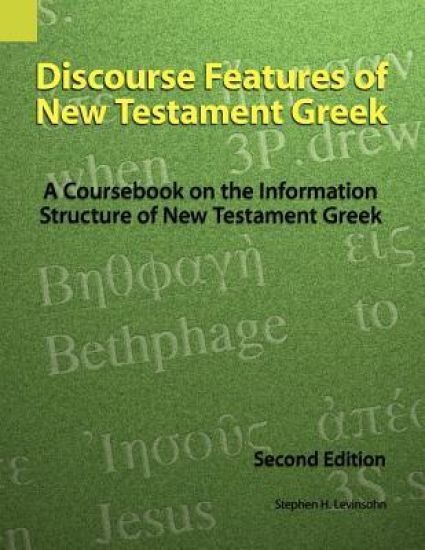
This coursebook is designed to be used in connection with lectures and discussion groups or in a self-instruction environment. The book takes a functional approach and builds on the principle that choice implies meaning. Each chapter presents one or more discourse features of Koine Greek that have been shown to make a significant contribution to the exegesis of the Greek New Testament. Part I discusses default orders of constituents in clauses, sentences and phrases, together with the significance of marked orders.Part II identifies the constraint that each common conjunction imposes on how readers are to relate the sentence concerned to its context.Part III considers patterns of reference including why, once participants have been introduced, they are sometimes referred to only in the verb and sometimes by means of a pronoun or noun phrase, as well. It also addresses the significance of omitting the article when referring to activated participants or concepts.Part IV describes some features that have the effect of backgrounding or highlighting information, such as the encoding of information in a participial or relative clause and the use of the historical present.Part V considers how different ways of introducing reported speeches reflect their status in stories. It also discusses the motivations for reporting conversation directly versus indirectly and the significance of introducing direct speech with ὅτι recitativum.The final part reviews criteria that may be cited to support or reject the segmenting of passages into sub-units. Readers need a basic knowledge of introductory Greek and discourse analysis. All examples in the text are provided with a word-by-word translation. Review questions and suggested answers are provided to assist in applying the principles. In this edition, the content has been extensively reviewed and polished, including errata corrections from the prior edition.
Many problems in translation arise because of mismatches between the source and receptor languages. A particularly relevant factor is whether or not the language normally places the verb at the end of the sentence, and whether or not the subject commonly follows the verb. Such potential mismatches are a major discussion in the eight chapters of this course. Topics includedifferences between instruction and persuasionconnectivesvariations in the order of constituents and propositionsprominence-giving, backgrounding and highlighting devicesrelative potency of different forms of exhortationboundary featuresThe course is designed particularly for those who expect to be involved in the translation of non-narrative texts from one language to another, whether as a mother tongue speaker, other tongue speaker or expatriate translator, consultant or advisor. It will also help anyone engaged in the study of non-narrative texts in any language in the world. Recommended prerequisites are the completion of a Narrative Discourse Analysis* course, with associated field experience or its equivalent. Students will need a selection of non-narrative texts in the language they are studying.*Self-Instruction Materials on Narrative Discourse Analysis is a companion volume to Self-Instruction Materials on Non-Narrative Discourse Analysis, published by SIL International(R) 2023.