Kirjojen hintavertailu. Mukana 11 590 110 kirjaa ja 12 kauppaa.

Kirjahaku

Etsi kirjoja tekijän nimen, kirjan nimen tai ISBN:n perusteella.

12 kirjaa tekijältä Stephen Kalberg

Max Weber's Sociology of Civilizations: A Reconstruction
This volume examines civilizations through the broad lens articulated by the works of Max Weber. In focusing upon his comparative-historical mode of analysis and his causal explanations for the sources, contours, and trajectories of civilizations, this study reconstructs Weber’s sociology in a manner that provides clear guidelines to researchers seeking to investigate civilizations systematically. Through detailed interpretations of the West’s unique development from Antiquity to the Modern era, precise comparisons to the long-range and singular pathways taken by China and India, and careful demarcations of the "particular rationalisms" of several civilizations, the author addresses Weber’s powerful model-building on the one hand and his opposition to organic holism and structural presuppositions on the other hand. Both a broad-ranging conceptual framework and case-based empirical investigations are pivotal to Weber. His research strategy emphasizes further the "subjective meanings" of actors East and West and the deep cultural origins of groups. Finally, this volume masterfully conveys Weber’s contextual and multi-causal methodology rooted in a tight interweaving of the present with the past. Max Weber’s Sociology of Civilizations: A Reconstruction will appeal to comparative sociologists and historians, as well as to theorists of all persuasions. The social scientist pursuing a cross-civilizational agenda will here discover the distinct contribution of Weber’s "interpretive understanding" procedures to the now-essential field of civilizational analysis.
Max Weber's Sociology of Civilizations: A Reconstruction
This volume examines civilizations through the broad lens articulated by the works of Max Weber. In focusing upon his comparative-historical mode of analysis and his causal explanations for the sources, contours, and trajectories of civilizations, this study reconstructs Weber’s sociology in a manner that provides clear guidelines to researchers seeking to investigate civilizations systematically. Through detailed interpretations of the West’s unique development from Antiquity to the Modern era, precise comparisons to the long-range and singular pathways taken by China and India, and careful demarcations of the "particular rationalisms" of several civilizations, the author addresses Weber’s powerful model-building on the one hand and his opposition to organic holism and structural presuppositions on the other hand. Both a broad-ranging conceptual framework and case-based empirical investigations are pivotal to Weber. His research strategy emphasizes further the "subjective meanings" of actors East and West and the deep cultural origins of groups. Finally, this volume masterfully conveys Weber’s contextual and multi-causal methodology rooted in a tight interweaving of the present with the past. Max Weber’s Sociology of Civilizations: A Reconstruction will appeal to comparative sociologists and historians, as well as to theorists of all persuasions. The social scientist pursuing a cross-civilizational agenda will here discover the distinct contribution of Weber’s "interpretive understanding" procedures to the now-essential field of civilizational analysis.
Max Weber's Comparative Historical Sociology
In this accessible and engaging work, Kalberg shows how Weber's work casts a direct light upon issues of pressing importance for comparative-historical research today addressing in a forceful way the whole range of problems and dilemmas confronted by the comparative-historical enterprise.
Max Weber’s Sociology

Max Weber’s Sociology

Stephen Kalberg

TAYLOR FRANCIS LTD
2024
sidottu
This volume outlines Max Weber’s comparative-historical sociology of "interpretive understanding" (verstehen) in a manner that clarifies his complex mode of analysis and multi-causal focus. Presenting the central features of his methodology, it demonstrates the strengths of his research strategies through discussions of his major works and overarching concerns. Among other themes, this study addresses the origins of the American political culture, the longevity of its civic sphere, and the multiple causes behind the unique historical pathways followed by several civilizations. Indeed, through summaries of Weber’s procedures and their application in his own empirical studies, Max Weber’s Sociology sustains a simultaneous orientation to his "big picture" themes and his rigorous manner of analysis. It demonstrates in so doing the capacity of Weber’s sociology to ground firmly both “ideal-type” theorizing and empirically oriented investigations. This volume will appeal to scholars throughout the social sciences with interests in the American civic sphere, the West’s uniqueness, ”the Protestant ethic thesis,” the multiple ways that civilizations develop, and the diverse twists and turns of Weber’s comparative-historical sociology.
Max Weber’s Sociology

Max Weber’s Sociology

Stephen Kalberg

TAYLOR FRANCIS LTD
2024
nidottu
This volume outlines Max Weber’s comparative-historical sociology of "interpretive understanding" (verstehen) in a manner that clarifies his complex mode of analysis and multi-causal focus. Presenting the central features of his methodology, it demonstrates the strengths of his research strategies through discussions of his major works and overarching concerns. Among other themes, this study addresses the origins of the American political culture, the longevity of its civic sphere, and the multiple causes behind the unique historical pathways followed by several civilizations. Indeed, through summaries of Weber’s procedures and their application in his own empirical studies, Max Weber’s Sociology sustains a simultaneous orientation to his "big picture" themes and his rigorous manner of analysis. It demonstrates in so doing the capacity of Weber’s sociology to ground firmly both “ideal-type” theorizing and empirically oriented investigations. This volume will appeal to scholars throughout the social sciences with interests in the American civic sphere, the West’s uniqueness, ”the Protestant ethic thesis,” the multiple ways that civilizations develop, and the diverse twists and turns of Weber’s comparative-historical sociology.
Max Weber's Comparative-Historical Sociology Today
Bringing together the author's major scholarly work on Weber over the last thirty years, Max Weber's Comparative-Historical Sociology Today addresses major themes in Weber's thought, whilst also examining the mode of analysis practised in his comparative-historical writings. By exploring Weber's concepts and procedures, the individual chapters seek to convey the rigor of his research strategies, demonstrating their uniqueness. In this light, this study proceeds to identify as incomplete and then reconstruct the analyses undertaken by Weber of the rise of Confucianism in China, the caste system in India, and monotheism in ancient Israel. The analysis then advances to the modern era, utilising Weber's research procedures to explain the origins of four independent phenomena: the singularity of the American political culture, the cultural foundations of modern citizenship, cultural pessimism (Kulturpessimismus) in nineteenth century Germany, and the 'location' of work in contemporary German society. A dialogue with a variety of recent major schools is pursued throughout this volume. Offering a rich examination of the major themes in Weber's sociology, alongside a reconstruction of his mode of analysis and application of his approach, this book will appeal to scholars around the world with interests in social theory, German and American societies, cultural sociology, political sociology, the sociology of knowledge, comparative-historical sociology, and the sociology of civilizations.
Max Weber's Comparative-Historical Sociology Today

Max Weber's Comparative-Historical Sociology Today

Stephen Kalberg

Ashgate Publishing Limited
2012
nidottu
Bringing together the author's major scholarly work on Weber over the last thirty years, Max Weber's Comparative-Historical Sociology Today addresses major themes in Weber's thought, whilst also examining the mode of analysis practised in his comparative-historical writings. By exploring Weber's concepts and procedures, the individual chapters seek to convey the rigor of his research strategies, demonstrating their uniqueness. In this light, this study proceeds to identify as incomplete and then reconstruct the analyses undertaken by Weber of the rise of Confucianism in China, the caste system in India, and monotheism in ancient Israel. The analysis then advances to the modern era, utilising Weber's research procedures to explain the origins of four independent phenomena: the singularity of the American political culture, the cultural foundations of modern citizenship, cultural pessimism (Kulturpessimismus) in nineteenth century Germany, and the 'location' of work in contemporary German society. A dialogue with a variety of recent major schools is pursued throughout this volume. Offering a rich examination of the major themes in Weber's sociology, alongside a reconstruction of his mode of analysis and application of his approach, this book will appeal to scholars around the world with interests in social theory, German and American societies, cultural sociology, political sociology, the sociology of knowledge, comparative-historical sociology, and the sociology of civilizations.
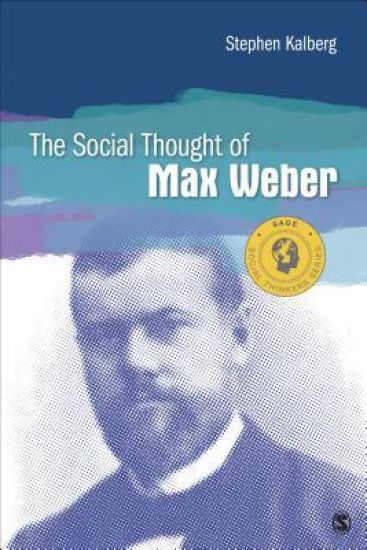
The Social Thought of Max Weber

The Social Thought of Max Weber

Stephen Kalberg

SAGE Publications Inc
2016
nidottu
Stephen Kalberg's The Social Thought of Max Weber, the newest volume of the SAGE Social Thinkers series, provides a concise introduction to the work, life, and influence of Max Weber, considered to be one of three most important founders (along with Marx and Durkheim) of sociology. The book serves as an excellent introduction to the full range of Weber’s major themes, and explores in detail the extent to which they are relevant today. It is ideal for use as a self-contained volume or in conjunction with other sociological theory textbooks.
Searching for the Spirit of American Democracy
The 'crisis of American democracy' debate is advanced in this engaging new contribution. By referring to Max Weber's long-term perspective, Stephen Karlberg provides rich new insights into the particular contours of today's American political culture - and some reasons for optimism. Kalberg draws upon Weber to reconstruct political culture in ways that define America's unique spirit of democracy. Developing several Weber-inspired models, the author reveals patterns of oscillation in American history. Can these pendulum movements sustain today the symbiotic dualism that earlier invigorated American democracy? Can they do so to such an extent that the American spirit of democracy is rejuvenated? Whilst exploring whether Weber's explanations and insights can be generalised beyond the American case, 'Searching for the Spirit of American Democracy' forcefully argues that facilitating political cultures is indispensable if democracies are to endure.
Searching for the Spirit of American Democracy
The 'crisis of American democracy' debate is advanced in this engaging new contribution. By referring to Max Weber's long-term perspective, Stephen Karlberg provides rich new insights into the particular contours of today's American political culture - and some reasons for optimism. Kalberg draws upon Weber to reconstruct political culture in ways that define America's unique spirit of democracy. Developing several Weber-inspired models, the author reveals patterns of oscillation in American history. Can these pendulum movements sustain today the symbiotic dualism that earlier invigorated American democracy? Can they do so to such an extent that the American spirit of democracy is rejuvenated? Whilst exploring whether Weber's explanations and insights can be generalised beyond the American case, 'Searching for the Spirit of American Democracy' forcefully argues that facilitating political cultures is indispensable if democracies are to endure.
Einführung in die historisch-vergleichende Soziologie Max Webers

Einführung in die historisch-vergleichende Soziologie Max Webers

Stephen Kalberg

Vs Verlag Fur Sozialwissenschaften
2001
nidottu
Die Wiederbelebung der historisch-vergleichenden Soziologie in den vergan­ genen Jahrzehnten wurde nur indirekt von Max Weber beeinflußt, obwohl er eine empirisch fundierte, vergleichende und historische Soziologie von uni­ versaler Breite und Tiefe geschaffen hat. Seit seinem Tod im Jahr 1920 ist sein Ansehen als der fruchtbarste und anregendste Soziologe unserer Zeit stetig gewachsen. In den vergangenen Jahren hat eine weltweite Renaissance des Interesses an seinen Schriften eine wahre Flut von Literatur über alle Aspekte seiner Soziologie hervorgebracht. Dennoch steht selbst Reinhard Bendix als Autor einer Reihe ausgezeichneter empirischer Studien, die wich­ tige Aspekte aus Webers Soziologie nutzen (vgl. 1960; I 977a; 1980), im Schatten von historisch-vergleichenden Soziologen, die sich eher auf die marxistische Theorie berufen, wie Barrington Moore und Theda Skocpol, und auf die Sozialgeschichte Braudels, wie Charles Tilly. Immanuel Wal­ lerstein, der eine ungemein einflußreiche Schule begründet hat, ist sowohl von der marxistischen als auch von der Braudelschen Tradition beeinflußt worden. Zum Teil kann Webers bescheidener Einfluß auf die heutige historisch­ vergleichende Soziologie einfach erklärt werden. Die vielen Würdigungen, die seinem Werk zuteil wurden, waren unablässig begleitet von Vorbehalten und Kritik. Während seine historisch-vergleichenden Arbeiten einerseits gefeiert wurden wegen ihrer unerreichten Breite und Fülle, die die Arbeiten anderer Begründer der Soziologie weit überragen, scheinen sie andererseits oft wahllos über das gesamte Gebiet der Soziologie verstreut zu sein.
Deutschland und Amerika aus der Sicht Max Webers
Sieht man genau hin, lassen sich große Unterschiede zwischen der deutschen und der amerikanischen Gesellschaft ausmachen. Viele davon sind unter der Oberfläche verborgen. Max Webers historisch-vergleichende Soziologie ist für eine kausale Erklärung dieser Unterschiede bestens gerüstet. Max Weber interessierte sich sein Leben lang für verschiedenste Aspekte der Gesellschaften in Deutschland und Amerika. Seine elfwöchige Amerikareise im Jahr 1904 hinterließ bei ihm einen unauslöschlichen Eindruck und regte ihn bis zu seinem Tod zu einem weitgestreuten Spektrum von Themen an. In diesem Band wird keine Mühe gescheut, die zentralen Merkmale seines historisch-vergleichenden Ansatzes vorzustellen und ihren Wert für die empirische Forschung in verständlicher Weise darzulegen. Webers aussagekräftiger theoretischer Rahmen ermöglicht es uns, die bestimmenden Charakteristika beider Gesellschaften anhand vielfältiger Ursachen zu erklären. Darüber hinaus erlauben seine Begriffe und Verfahren, die Grenzen der jeweiligen politischen Kultur scharf abzustecken. Ferner werden, bezogen auf die Vereinigten Staaten, ihre religiösen Wurzeln eingehend zur Sprache kommen.?