Kirjojen hintavertailu. Mukana 11 699 587 kirjaa ja 12 kauppaa.

Kirjahaku

Etsi kirjoja tekijän nimen, kirjan nimen tai ISBN:n perusteella.

6 kirjaa tekijältä Stephen Rookes

France's War in Indochina

France's War in Indochina

Stephen Rookes

HELION COMPANY
2023
pokkari
If America's attempt to push back communism in Vietnam is undoubtedly the most well-known of Asian wars, it was preceded by a conflict fought by French and Vietnamese forces that resulted in the death of over 75,000 members of France's armed forces from December 1946 to July 1954. The First Indochina War being a particularly savage conflict, it was fought by the French for similar reasons as the United States some years later. Armed forces led by Ho Chi Minh sought to impose communist doctrines in Vietnam, a move seen as unacceptable by France, and one that warranted a large-scale military encounter. Indeed, Vietnam was considered by the French as an integral part of Indochina, and France itself. The spread of communism in Indochina was not to be permitted, and neither were Ho Chi Minh's attempts to gain independence for Vietnam through this means.The first in a three-part series, this volume looks at what is generally seen as the first phase of the First Indochina War, a period that lasted from 1946 to 1949. Drawing on a variety of historical documents, this volume enables the reader to gain an historical perspective of the French presence in Vietnam, US support for France, the ideology and methodology of insurgents in Vietnam, as well as providing a detailed account of the battles, tactics, strategies, machines, and men that were used by both sides to further their objectives during the conflict.
France's War in Indochina, Volume 2

France's War in Indochina, Volume 2

Stephen Rookes

HELION COMPANY
2025
pokkari
If America's attempt to push back communism in Vietnam is undoubtedly the most well-known of Asian wars, it was preceded by a conflict fought by French and Vietnamese forces that resulted in the death of over 75,000 members of France's armed forces from December 1946 to July 1954. The First Indochina War being a particularly savage conflict, it was fought by the French for similar reasons as the United States some years later. Armed forces led by Ho Chi Minh sought to impose communist doctrines in Vietnam, a move seen as unacceptable by France, and one that warranted a large-scale military encounter. Indeed, Vietnam was considered by the French as an integral part of Indochina, and France itself. The spread of communism in Indochina was not to be permitted, and neither were Ho Chi Minh's attempts to gain independence for Vietnam through this means. The first in a three-part series, this volume looks at what is generally seen as the first phase of the First Indochina War, a period that lasted from 1946 to 1949. Drawing on a variety of historical documents, this volume enables the reader to gain an historical perspective of the French presence in Vietnam, US support for France, the ideology and methodology of the insurgents in Vietnam, as well as providing a detailed account of the battles, tactics, strategies, machines, and men that were used by both sides to further their objectives during the conflict.
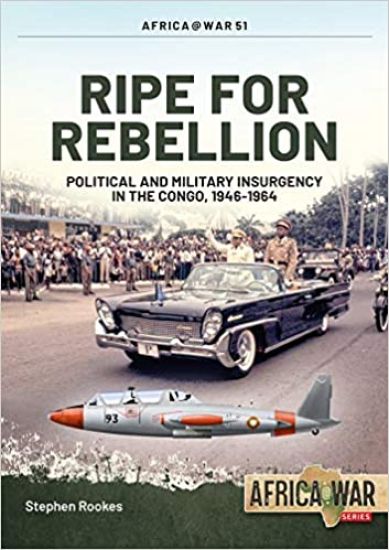
Ripe for Rebellion

Ripe for Rebellion

Stephen Rookes

Helion Company
2020
nidottu
After many years of political struggle, the Belgian Congo was finally granted its independence in June 1960. Becoming the Republic of the Congo and later the Democratic Republic of the Congo, what was supposed to be a momentous occasion in the country's history was rapidly transformed into a bitter internecine political battle which would tear the Congo apart. Within weeks, two Congolese provinces had declared their own independence putting the Congo's economic future in jeopardy. Recruiting hundreds of white mercenaries to sustain its secession, mineral-rich Katanga then attempted to fight off all attempts to bring it back into the fold. By early 1963 the mercenaries had been forced to leave by the UN, but other major outbreaks of armed protest against the Congolese government were taking place. The most significant of these were the Stanleyville, Kindu and Kivu Rebellions led by supporters of Patrice Lumumba, the former Prime Minister assassinated in January 1961. With the Soviet Union, the Republic of China and radical African governments all aiding rebel movements, what was a series of localised conflicts became a proxy war between the East and the West. Not wishing to see the Congo fall under what it perceived as ‘communist domination’, the United States then began to provide its own form of military assistance to government forces. Ripe for Rebellion is the first of two volumes examining the so-called ‘Congo Crisis’. Based on extensive research in multiple official archives, it throws entirely new light upon developments in a country which many US citizens of the time believed would become the next major battlefield. Richly illustrated, it provides a detailed account of the global political dynamics which led to civil war and encouraged so many to take up arms, and an intricate reconstruction of the military role played by the United States from 1964. The story told in Ripe for Rebellion will be continued in For God and the CIA, though each volume stands alone.
For God and the CIA

For God and the CIA

Stephen Rookes

Helion Company
2020
nidottu
As United Nations armed forces found themselves struggling to quell a series of armed rebellions, towards the end of 1962 the United States increased its military role in the Congo Crisis by providing the Congolese government with a small air force. Unarmed, and used firstly as a show of strength, this air force grew rapidly in size and power and provided air cover to government forces in operations against anti-government forces up to 1967. Recognising that a threat existed in the east of the Congo with weapons and supplies being transported across Lake Tanganyika, the Central Intelligence Agency then put in place a naval force to patrol Congolese waters and to prepare areas for attacks made by mercenaries. The presence of this navy proved to be crucial in limiting supplies and persuaded Ernesto 'Che' Guevara that his attempt to provoke widespread communist revolution in Central Africa was forlorn. The mission in the Congo was not the first operation against Communist forces for those who made up the air and naval forces. Some had taken part in operations in Guatemala, many had participated at the Bay of Pigs, and many had continued their fight against Fidel Castro's Cuba in operations launched from Nicaragua. Should it not be understood who these men were, they were not US citizens and neither was their battle with the Congolese: these men were Cuban exiles fighting for an ideology and for the CIA. The story which will unfold in this volume is of the men whose hatred of Communism and Fidel Castro inspired them to volunteer for covert missions in Cuba and in the Congo. It relies on their personal testimonies, on government archives, on declassified documents, and on piecing together a series of events to form them into a plausible and well-documented whole. Detailing how over 150 Cuban exiles known as the Makasi were recruited for missions in the Congo this volume will shed light on CIA covert operations which are widely unknown to the general public and to military historians alike. Starting with an examination of the CIA's covert warfare apparatus and its early operations, this volume takes us on a journey across two continents. All the while, it attempts to demonstrate how important Cuban exiles were in the CIA's fight to uphold the tenets of the Domino Theory. For God and the CIA continues the story begun with Ripe for Rebellion, though each volume stands alone.
CIA and British Mercenaries in Angola, 1975-1976
The 1974 Carnation Revolution came as a blessing for independence movements in Portugal's African colonies: Angola, Mozambique and Portuguese Guinea. As had been the case in a number of sub-Saharan countries suddenly finding themselves free of the colonial yoke, the political vacuum left behind by a previously omnipresent power gave different factions the opportunity to impose their own form of rule. Angola was no different: civil war broke out in 1975 and was to last until 2002. In some ways the Angolan civil war bore similarities to the one which had taken place in neighbouring DRC. Too much was at stake for the West not to intervene in some shape or form and in July 1975 President Ford authorised the CIA to provide covert assistance to the National Liberation Front of Angola (FNLA) and the National Union for the Total Independence of Angola (UNITA). With South Africa providing military support against a Cuban-backed Popular Movement for the Liberation of Angola (MPLA), another south-western African nation became the battleground for a war of ideologies. In 1975-1976, no fewer than nine different armed forces were involved in the fighting. In addition, a large group of British mercenaries were recruited to train FNLA soldiers. The role of these soldiers of fortune would end in ignominy, death and legislative changes intended to rid mercenaries from conflict forever. CIA and British Mercenaries in Angola, 1975-1976 examines the dynamics of the Angolan civil war and takes the reader into the inner workings of geopolitical interests, of CIA covert operations and mercenary recruitment. It examines clandestine arms and money laundering networks; takes us from the heart of the Vietnam War to Australian banks, and takes us into dealings between the US and British governments in operations far removed from, but connected to, the Angolan Civil War.