Kirjojen hintavertailu. Mukana 11 699 587 kirjaa ja 12 kauppaa.

Kirjahaku

Etsi kirjoja tekijän nimen, kirjan nimen tai ISBN:n perusteella.

12 kirjaa tekijältä Stephen Thomas

Newman and Heresy

Newman and Heresy

Stephen Thomas

Cambridge University Press
1991
sidottu
This book describes the close relationship between the historical researches and the teeming world of early nineteenth-century controversy. The setting is Oxford between the 1820s and the 1840s, when Newman made his ambitious and doomed attempt to re-invent the ‘catholicity’ of the Church of England. The author shows that in Newman’s battle against the Protestant wing of the Church of England, and the (to him) even more sinister ‘liberals’, he saw parallels with the struggle of the early Church against heresy. Newman’s ‘rediscovery’ of ancient Patristic writers and heretics was thus part of a strategy to revive Catholicism within the Anglican Church. Dr Thomas shows how Newman's eventual conversion to Rome in 1845 may be understood as a change in his perception of heresy, and a realisation of the applicability of his own polemic to his Anglican self.

Newman and Heresy

Newman and Heresy

Stephen Thomas

Cambridge University Press
2003
pokkari
This book describes the close relationship between the historical researches and the teeming world of early nineteenth-century controversy. The setting is Oxford between the 1820s and the 1840s, when Newman made his ambitious and doomed attempt to re-invent the ‘catholicity’ of the Church of England. The author shows that in Newman’s battle against the Protestant wing of the Church of England, and the (to him) even more sinister ‘liberals’, he saw parallels with the struggle of the early Church against heresy. Newman’s ‘rediscovery’ of ancient Patristic writers and heretics was thus part of a strategy to revive Catholicism within the Anglican Church. Dr Thomas shows how Newman's eventual conversion to Rome in 1845 may be understood as a change in his perception of heresy, and a realisation of the applicability of his own polemic to his Anglican self.
The Workbook for Successfully Managing Change in Organizations
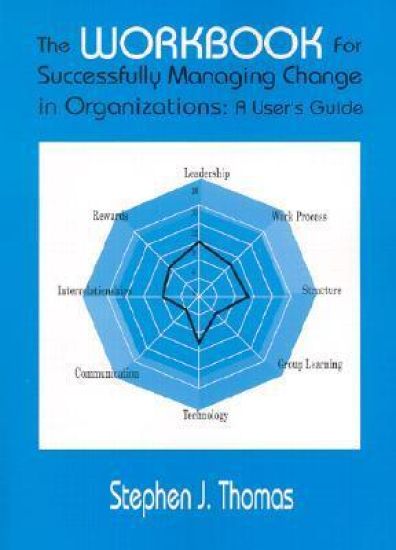
Successfully Managing Change in Organizations: A Users Guide is an innovative book that provides concepts, ideas, examples, insights, and new ways to think about and approach change. This accompanying workbook goes one very valuable step further by providing practical working exercises that help you focus your thinking and your future work. And it will help you successfully turn the concepts you presented in the book into reality within your organization. Contains exercises that will provide an in-depth understanding of the material as it relates to your specific circumstances.Logically organized so that the workbook chapters cover the same material as the corresponding chapters in the book.Works as an effective group learning tool to use with your peers and managers to help you collectively think about the concepts and relate them to your efforts.Provides chapter summaries through definitions, charts, and lists.Includes valuable forms that can be copied and used to work through the change process.Contains numerous writing exercises, checklists and work activities, helping to clarify the issues that exist within your organization.Includes an ongoing case study with exercises revolving around a fictitious company.Introduction Laying the Foundation Change: Not Linear, but Nonlinear Vision From Vision to Reality The Roadmap of Change A Case of Teams Working with Consultants Resistance to Change The Web of Change The Elements—Part 1 The Elements—Part 2 Fitting the Elements Together How to Handle the Process of Change Measurement Appendix 1 Appendix 2
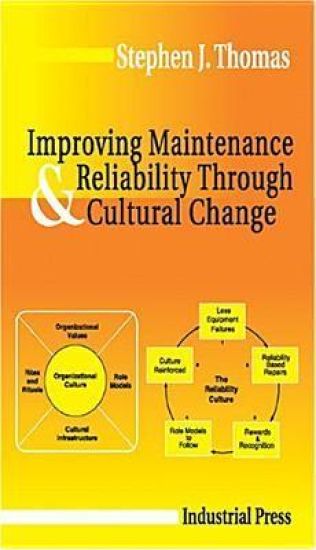
Improving Maintenance and Reliability Through Cultural Change

Improving Maintenance and Reliability Through Cultural Change

Stephen Thomas

Industrial Press Inc.,U.S.
2005
sidottu
This unique and innovative book explains how to improve your maintenance and reliability performance at the plant level by changing the organizations culture. It is specifically intended for middle managers in the manufacturing and process industries. This book demystifies the concept of organizational culture and links it with the eight elements of change: leadership, work process, structure, group learning, technology, communication, interrelationships, and rewards. If you want to break the cycle of failed improvement programs and instead use cultural change to help make significant and lasting improvements in plant performance, this book will show you how. Explains in-depth the eight elements of change and how they relate to cultural change.Discusses cultural change with a reliability focus.Includes a PowerPoint presentation with audio on the enclosed CD-ROM, together with a web survey model, the Web of Organizational Change.The BeginningCulture DefinedVision and the Goal Achievement ModelOrganizational ValuesRole ModelsRites and RitualsThe Culture InfrastructureThe Elements of ChangePart 1 Leadership The BasicsPart 2 Leadership and Change ManagementWork ProcessStructureGroup LearningTechnologyCommunicationInterrelationshipsRewardsThe Web of Cultural ChangeAssessment and Corrective ActionMoving ForwardAppendicesBibliographyFigure IndexIndex
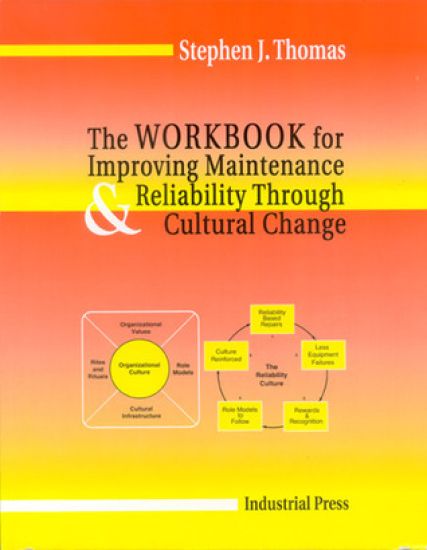
Workbook for Improving Maintenance and Reliability Through Cultural Change
In Improving Maintenance and Reliability through Cultural Change Steve Thomas explains to middle managers in the manufacturing and process industries how to improve maintenance and reliability performance at the plant level by changing their organization’s culture. In so doing he demystifies the concept of organizational culture and links it with the eight elements of change: leadership, work process, structure, group learning, technology, communication, inter-relationships, and rewards. He goes on to effectively demonstrate how to break the cycle of failed improvement programs and instead use cultural change to help make significant and lasting improvements in plant performance. Contains exercises that will provide an in-depth understanding of the material as it relates to the specific circumstances of your organization.Logically organized, so that the workbook chapters complement the corresponding chapters in the book.Works as an effective group-learning tool to use with your peers and managers to help you collectively think about the book’s key concepts and relate them to your efforts.Provides chapter summaries through definitions, charts, and lists.Includes valuable forms that can be copied and used to work through the change process.Contains numerous writing exercises, checklists and work activities, helping to clarify the issues that exist within your organization.Includes an ongoing case study that simulates the change process.The BeginningCulture DefinedVision and the Goal Achievement ModelOrganizational ValuesRole ModelsRites and RitualsThe Culture InfrastructureThe Elements of Change LeadershipWork ProcessStructureGroup LearningTechnologyCommunicationInterrelationshipsRewardsThe Web of Cultural ChangeAssessment and Corrective ActionMoving ForwardAppendixBibliographyFigure IndexIndex
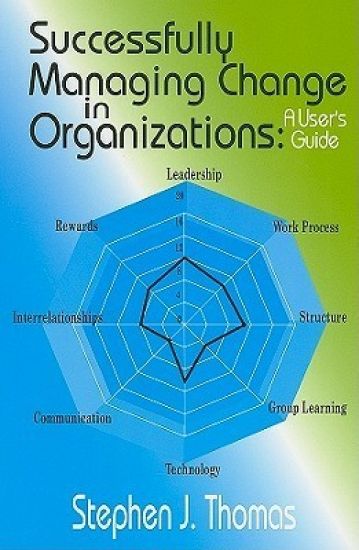
Successfully Managing Change in Organizations

Successfully Managing Change in Organizations

Stephen Thomas

Industrial Press Inc.,U.S.
2001
pokkari
Now in paperback, this book was written for all managers who have been given the difficult task of bringing change to their organizations. It addresses organizational change at the working level. It is a “user's guide” in change management, written by a user, for users. This is an invaluable resource for anyone who wants to know, step by step, how to implement change successfully. Draws on the author's wealth of practical experience and emphasizes that the elements of change are interrelated, that they constitute a “Web of Change”: change one element and you must see what the impact will be on the others. Identifies and explains eight key elements of change. A way to measure change in each element and its affect on the others is presented on paper and through a computer program on an enclosed disk. Part One: Getting StartedIntroduction to the Process of Change Laying the Foundation Change: Not Linear, But Nonlinear The Vision of the Future or How Do We Know Where We Are Going So We'll Know When We Have Arrived Part Two Concepts Which Will Contribute To Success From Vision To Reality The Roadmap Of Change A Case For Teams Working with Consultants Resistance To Change The Web Of ChangePart Three Execution: It's More Than Magic The Elements Fitting The Elements Together How to Handle the Process Of Change Measurement Part Four Completion And A New Beginning Techniques Of Continued Growth Conclusion
Using Automated Fix Generation

Using Automated Fix Generation

Stephen Thomas

AV Akademikerverlag
2012
pokkari
Revision with unchanged content. Since 2002, over 10% of total cyber vulnerabilities were SQL injection vulnerabilities (SQLIVs). Since most developers are not experienced software security practitioners, a solution for correctly removing SQLIVs that does not require security expertise is desirable. In this paper, an automated fix generation algorithm for removing SQLIVs by replacing SQL statements with prepared SQL statements is described. Automated fix generation is a type of automated code generation that analyzes project artifacts containing faults and uses the analysis to generate fault free alternative or replacement code. Prepared SQL statements have a static structure and take type-specific input parameters, which prevents SQL injection attack input from changing the structure and logic of a statement. The automated fix algorithm is evolved over the course of preparing for and analyzing the results of four formative and evaluative case studies.
The Controller

The Controller

Stephen Thomas

TROUBADOR PUBLISHING
2026
nidottu
In a career lasting over 30 years, Stephen Thomas served in a number of the most sensitive areas of the fight against serious organised crime. his service in the variety of these positions is unrivalled. After joining the ID in 1990, in 1996 he became an investigation officer on a Drugs Team. And then in 1997, joined an elite Target Drugs Team, investigating the highest levels of organised crime. In 2001 the author moved to the Project Team, becoming an informant (CHIS) handler, running long term, deep penetration, informants into every area of the Department's responsibilities. He went to be promoted, in 2004, to a CHIS Controller, responsible for the management of all CHIS being handled by the Project Team. Then in 2006 he joined HMRC's International Source Management Unit. ISMU managed all overseas informants run by HMRC. It was also responsible for providing training in source recruitment and management, to overseas law enforcement agencies. In 2015 he moved to the PPU, better known as Witness Protection, providing protective measures to those for whom HMRC had such a responsibility. Finally in 2017, he joined HMRC's Undercover Unit (UCU), as a Cover Officer. Throughout all of this service, Thomas was engaged in a large number of highly sensitive operations.
Reputations of Value

Reputations of Value

Stephen Thomas

Penguin Random House SEA
2024
pokkari
Companies today operate in an era characterised by volatility, crisis, lack of trust and intense scrutiny. People have a growing expectation that the private sector not only markets a particular product or service but also takes an active role in making broader contributions to society. The spotlight has never shone more fiercely on what companies say— and do. Yet, a significant number of companies grapple with the challenge of proactively earning and safeguarding their multifaceted reputations. The stakes are higher than ever, as the trajectory of a company's growth is intricately linked to its ability to strategically enhance its standing in the eyes of stakeholders – including investors, customers, employees, regulators and activists. Reputations of Value examines the profound impact of corporate reputations on any company's ability to advance its business agenda over time. The book features insights from subject matter experts around the world. It serves as a guide for those wanting to better understand how companies can operate on a stronger, more resilient, and authentic basis in the face of a dynamic and unpredictable landscape.