Kirjojen hintavertailu. Mukana 11 244 527 kirjaa ja 12 kauppaa.

Kirjahaku

Etsi kirjoja tekijän nimen, kirjan nimen tai ISBN:n perusteella.

36 kirjaa tekijältä Steve Fuller

Thomas Kuhn

Thomas Kuhn

Steve Fuller

University of Chicago Press
2000
sidottu
Thomas Kuhn's "The Structure of Scientific Revolutions" is one of the best known and most influential books of the 20th century. Whether they adore or revile him, critics and fans alike have tended to agree on one thing: Kuhn's ideas were revolutionary. But were they? Steve Fuller argues that Kuhn actually held a profoundly conservative view of science and how one ought to study its history. Early on, Kuhn came under the influence of Harvard President James Bryant Conant (to whom "Structure" is dedicated), who had developed an educational programme intended to help deflect Cold War unease over science's uncertain future by focusing on its illustrious past. Fuller argues that this rhetoric made its way into "Structure", which Fuller sees as preserving and reinforcing the old view that science really is just a steady accumulation of truths about the world (once "paradigm shifts" are resolved). Fuller suggests that Kuhn, consciously or not, shared the tendency in Western culture to conceal possible negative effects of new knowledge from the general public. Because it insists on a difference between a history of science for scientists and one suited to historians, Fuller charges that "Structure" created the awkward divide that has led directly to the "Science Wars" and has stifled much innovative research. In conclusion, Fuller offers a way forward that rejects Kuhn's fixation on paradigms in favour of a conception of science as a social movement designed to empower society's traditionally disenfranchised elements. Certain to be controversial, "Thomas Kuhn" should be read by anyone who has adopted, challenged or otherwise engaged with "The Structure of Scientific Revolutions".
Thomas Kuhn

Thomas Kuhn

Steve Fuller

University of Chicago Press
2001
nidottu
Thomas Kuhn's "The Structure of Scientific Revolutions" is one of the best known and most influential books of the 20th century. Whether they adore or revile him, critics and fans alike have tended to agree on one thing: Kuhn's ideas were revolutionary. But were they? Steve Fuller argues that Kuhn actually held a profoundly conservative view of science and how one ought to study its history. Early on, Kuhn came under the influence of Harvard President James Bryant Conant (to whom "Structure" is dedicated), who had developed an educational programme intended to help deflect Cold War unease over science's uncertain future by focusing on its illustrious past. Fuller argues that this rhetoric made its way into "Structure", which Fuller sees as preserving and reinforcing the old view that science really is just a steady accumulation of truths about the world (once "paradigm shifts" are resolved). Fuller suggests that Kuhn, consciously or not, shared the tendency in Western culture to conceal possible negative effects of new knowledge from the general public. Because it insists on a difference between a history of science for scientists and one suited to historians, Fuller charges that "Structure" created the awkward divide that has led directly to the "Science Wars" and has stifled much innovative research. In conclusion, Fuller offers a way forward that rejects Kuhn's fixation on paradigms in favour of a conception of science as a social movement designed to empower society's traditionally disenfranchised elements. Certain to be controversial, "Thomas Kuhn" should be read by anyone who has adopted, challenged or otherwise engaged with "The Structure of Scientific Revolutions".
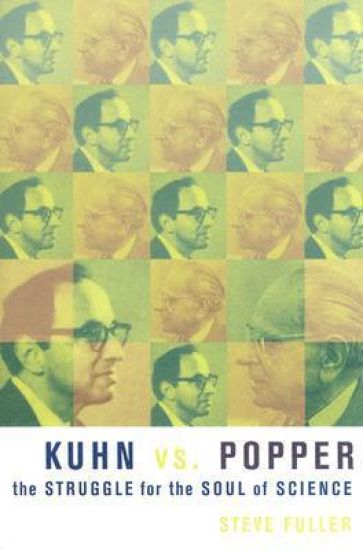
Kuhn vs. Popper

Kuhn vs. Popper

Steve Fuller

Columbia University Press
2004
sidottu
Thomas Kuhn's Structure of Scientific Revolutions has sold over a million copies in more than twenty languages and has remained one of the ten most cited academic works for the past half century. In contrast, Karl Popper's seminal book The Logic of Scientific Discovery has lapsed into relative obscurity. Although the two men debated the nature of science only once, the legacy of this encounter has dominated intellectual and public discussions on the topic ever since. Almost universally recognized as the modern watershed in the philosophy of science, Kuhn's relativistic vision of shifting paradigms-which asserted that science was just another human activity, like art or philosophy, only more specialized-triumphed over Popper's more positivistic belief in science's revolutionary potential to falsify society's dogmas. But has this victory been beneficial for science? Steve Fuller argues that not only has Kuhn's dominance had an adverse impact on the field but both thinkers have been radically misinterpreted in the process. This debate raises a vital question: Can science remain an independent, progressive force in society, or is it destined to continue as the technical wing of the military-industrial complex? Drawing on original research-including the Kuhn archives at MIT-Fuller offers a clear account of "Kuhn vs. Popper" and what it will mean for the future of scientific inquiry.
The Philosophy of Science and Technology Studies
As the field of Science and Technology Studies (STS) has become more established, it has increasingly hidden its philosophical roots. While the trend is typical of disciplines striving for maturity, Steve Fuller, a leading figure in the field, argues that STS has much to lose if it abandons philosophy.In his characteristically provocative style, he offers the first sustained treatment of the philosophical foundations of STS and suggests fruitful avenues for further research. With stimulating discussions of the Science Wars, the Intelligent Design Theory controversy, and theorists such as Donna Haraway and Bruno Latour, Philosophy of Science and Technology Studies is required reading for students and scholars in STS and the philosophy of science.
The Philosophy of Science and Technology Studies
As the field of Science and Technology Studies (STS) has become more established, it has increasingly hidden its philosophical roots. While the trend is typical of disciplines striving for maturity, Steve Fuller, a leading figure in the field, argues that STS has much to lose if it abandons philosophy.In his characteristically provocative style, he offers the first sustained treatment of the philosophical foundations of STS and suggests fruitful avenues for further research. With stimulating discussions of the Science Wars, the Intelligent Design Theory controversy, and theorists such as Donna Haraway and Bruno Latour, Philosophy of Science and Technology Studies is required reading for students and scholars in STS and the philosophy of science.
New Frontiers in Science and Technology Studies
Steve Fuller has a reputation for setting the terms of debate within science and technology studies. In his latest book, New Frontiers in Science and Technology Studies he charts the debates likely to be of relevance in the coming years. Should science and technology be treated as separate entities?What impact has globalization had on science and technology?Can science be clearly distinguished from other forms of knowledge?Does the politicization of science really matter?Is there a role for the social regulation of scientific inquiry?Should we be worried about research fraud? These questions are explored by examining an array of historical, philosophical and contemporary sources. Attention is paid, for example, to the Bruno Latour's The Politics of Nature as a model for science policy, as well as the global controversy surrounding Bjorn Lomborg's The Sceptical Environmentalist, which led to the dismantling and re-establishment of the Danish national research ethics board. New Frontiers in Science and Technology Studies will appeal strongly to scholars and advanced undergraduate and graduate students in courses concerned with the social dimensions of science and technology, and anyone who cares about the future of science.
New Frontiers in Science and Technology Studies
Steve Fuller has a reputation for setting the terms of debate within science and technology studies. In his latest book, New Frontiers in Science and Technology Studies he charts the debates likely to be of relevance in the coming years. Should science and technology be treated as separate entities?What impact has globalization had on science and technology?Can science be clearly distinguished from other forms of knowledge?Does the politicization of science really matter?Is there a role for the social regulation of scientific inquiry?Should we be worried about research fraud? These questions are explored by examining an array of historical, philosophical and contemporary sources. Attention is paid, for example, to the Bruno Latour's The Politics of Nature as a model for science policy, as well as the global controversy surrounding Bjorn Lomborg's The Sceptical Environmentalist, which led to the dismantling and re-establishment of the Danish national research ethics board. New Frontiers in Science and Technology Studies will appeal strongly to scholars and advanced undergraduate and graduate students in courses concerned with the social dimensions of science and technology, and anyone who cares about the future of science.
Science vs. Religion

Science vs. Religion

Steve Fuller

Polity Press
2007
sidottu
For centuries, science and religion have been portrayed as diametrically opposed. In this provocative new book, Steve Fuller examines the apparent clash between science and religion by focusing on the heated debates about evolution and intelligent design theory. In so doing, he claims that science vs. religion is in fact a false dichotomy. For Fuller, supposedly intellectual disputes, such as those between creationist and evolutionist accounts of life, often disguise other institutionally driven conflicts, such as the struggle between State and Church to be the source of legitimate authority in society. Nowadays many conservative anti-science groups support intelligent design theory, but Fuller argues that the theory's theological roots are much more radical, based on the idea that humans were created to fathom the divine plan, perhaps even complete it. He goes on to examine the unique political circumstances in the United States that make the emergence of intelligent design theory so controversial, yet so persistent. Finally, he considers the long-term prognosis, arguing that the future remains very much undecided as society reopens the question of what it means to be human. This book will appeal to all readers intrigued by the debates about creationism, intelligent design and evolution, especially those looking for an intellectually exciting confrontation with the politics and promise of intelligent design theory.
Science vs. Religion

Science vs. Religion

Steve Fuller

Polity Press
2007
nidottu
For centuries, science and religion have been portrayed as diametrically opposed. In this provocative new book, Steve Fuller examines the apparent clash between science and religion by focusing on the heated debates about evolution and intelligent design theory. In so doing, he claims that science vs. religion is in fact a false dichotomy. For Fuller, supposedly intellectual disputes, such as those between creationist and evolutionist accounts of life, often disguise other institutionally driven conflicts, such as the struggle between State and Church to be the source of legitimate authority in society. Nowadays many conservative anti-science groups support intelligent design theory, but Fuller argues that the theory's theological roots are much more radical, based on the idea that humans were created to fathom the divine plan, perhaps even complete it. He goes on to examine the unique political circumstances in the United States that make the emergence of intelligent design theory so controversial, yet so persistent. Finally, he considers the long-term prognosis, arguing that the future remains very much undecided as society reopens the question of what it means to be human. This book will appeal to all readers intrigued by the debates about creationism, intelligent design and evolution, especially those looking for an intellectually exciting confrontation with the politics and promise of intelligent design theory.
Knowledge Management Foundations

Knowledge Management Foundations

Steve Fuller

Butterworth-Heinemann Ltd
2001
nidottu
'Knowledge Management Foundations' is just what it claims, the first attempt to provide a secure intellectual footing for the myriad of practices called "knowledge management." A breath of fresh air from the usual KM gurus, Fuller openly admits that the advent of KM is a mixed blessing that often amounts to the conduct of traditional management by subtler means. However, Fuller's deep understanding of both the history of management theory and knowledge production more generally enables him to separate the wheat from the chaff of the KM literature. This ground-breaking book will prove of interest to both academics and practitioners of knowledge management. It highlights the ways in which KM has challenged the values associated with knowledge that academics have taken for granted for centuries. At the same time, Fuller resists the conclusion of many KM gurus, that the value of knowledge lies in whatever the market will bear in the short term. He pays special attention to how information technology has not only facilitated knowledge work but also has radically altered its nature. There are chapters devoted to the revolution in intellectual property and an evaluation of peer review as a quality control mechanism. The book culminates in a positive re-evaluation of universities as knowledge producing institutions from which the corporate sector still has much to learn.
The New Sociological Imagination

The New Sociological Imagination

Steve Fuller

SAGE Publications Inc
2006
sidottu
C. Wright Mills' classic The Sociological Imagination has inspired generations of students to study Sociology. However, the book is nearly half a century old. What would a book address, aiming to attract and inform students in the 21st century? This is the task that Steve Fuller sets himself in this major new invitation to study Sociology. The book: Critically examines the history of the social sciences to discover what the key contributions of sociology have been and how relevant they remain.Demonstrates how biological and sociological themes have been intertwined from the beginning of both disciplines, from the 19th century to the present day.Covers virtually all of sociology's classic theorists and themes.Provides a glossary of key thinkers and concepts. This book sets the agenda for imagining sociology in the 21st century and will attract students and professionals alike.
The New Sociological Imagination

The New Sociological Imagination

Steve Fuller

SAGE Publications Inc
2006
nidottu
C. Wright Mills' classic The Sociological Imagination has inspired generations of students to study Sociology. However, the book is nearly half a century old. What would a book address, aiming to attract and inform students in the 21st century? This is the task that Steve Fuller sets himself in this major new invitation to study Sociology. The book: Critically examines the history of the social sciences to discover what the key contributions of sociology have been and how relevant they remain.Demonstrates how biological and sociological themes have been intertwined from the beginning of both disciplines, from the 19th century to the present day.Covers virtually all of sociology's classic theorists and themes.Provides a glossary of key thinkers and concepts. This book sets the agenda for imagining sociology in the 21st century and will attract students and professionals alike.
Science

Science

Steve Fuller

Routledge
2016
sidottu
In this challenging and provocative book, Steve Fuller contends that our continuing faith in science in the face of its actual history is best understood as the secular residue of a religiously inspired belief in divine providence. Our faith in science is the promise of a life as it shall be, as science will make it one day. Just as men once put their faith in God's activity in the world, so we now travel to a land promised by science. In "Science", Fuller suggests that the two destinations might be the same one. Fuller sympathetically explores what it might mean to live scientifically. Can science give a sense of completeness to one's life? Can it account for the entirety of what it is to be human? And what does our continuing belief in scientific progress say about us as a species? In answering these questions, Fuller ranges widely over the history of science and religion - from Aristotle and the atomists to Dawkins and the neo-Darwinists - and takes a close look at what science is, how its purpose has changed over the years, and what role religion and in more recent years atheism have played in its progression. Science, argues Fuller, is now undergoing its own version of secularization. We are ceasing to trust science in its institutional forms, formulated by an anointed class of science priests, and instead we are witnessing the emergence of what Fuller calls Protscience' - all sorts of people, from the New Age movement to anti-evolutionists, claiming scientific authority as their own. Fuller shows that these groups are no more anti-scientific than Protestant sects were atheistic. Fearless and thought-provoking, Science questions some of our most fundamental beliefs about the nature and role of science, and is a distinct and important contribution to debates about evolution, intelligent design, atheism, humanism, the notion of scientific progress, and the public understanding of science.
Knowledge Management Foundations

Knowledge Management Foundations

Steve Fuller

Routledge
2016
sidottu
'Knowledge Management Foundations' is just what it claims, the first attempt to provide a secure intellectual footing for the myriad of practices called "knowledge management." A breath of fresh air from the usual KM gurus, Fuller openly admits that the advent of KM is a mixed blessing that often amounts to the conduct of traditional management by subtler means. However, Fuller's deep understanding of both the history of management theory and knowledge production more generally enables him to separate the wheat from the chaff of the KM literature. This ground-breaking book will prove of interest to both academics and practitioners of knowledge management. It highlights the ways in which KM has challenged the values associated with knowledge that academics have taken for granted for centuries. At the same time, Fuller resists the conclusion of many KM gurus, that the value of knowledge lies in whatever the market will bear in the short term. He pays special attention to how information technology has not only facilitated knowledge work but also has radically altered its nature. There are chapters devoted to the revolution in intellectual property and an evaluation of peer review as a quality control mechanism. The book culminates in a positive re-evaluation of universities as knowledge producing institutions from which the corporate sector still has much to learn.
The Sociology of Intellectual Life

The Sociology of Intellectual Life

Steve Fuller

SAGE Publications Inc
2009
sidottu
The Sociology of Intellectual Life outlines a social theory of knowledge for the 21st century. With characteristic subtlety and verve, Steve Fuller deals directly with a world in which it is no longer taken for granted that universities and academics are the best places and people to embody the life of the mind. While Fuller defends academic privilege, he takes very seriously the historic divergences between academics and intellectuals, attending especially to the different features of knowledge production that they value. The boook's features include: - an account of the problematic relationship between postmodernism and the university as an institution - the problems facing an academic who wishes also to function as an intellectual - a critical survey of the emerging fields of social epistemology and the sociology of philosophy - a discussion of the ethics and politics of public intellectual life, especially given its largely improvisational (or as Fuller himself terms it, 'bullshit') character.
Theistic Evolution

Theistic Evolution

Steve Fuller

Crossway Books
2017
sidottu
This volume of more than two dozen essays written by highly credentialed scientists, philosophers, and theologians from Europe and North America provides the most comprehensive critique of theistic evolution yet produced, opening the door to scientific and theological alternatives.
The Academic Caesar

The Academic Caesar

Steve Fuller

SAGE Publications Ltd
2016
sidottu
Aimed directly at those who aspire to be university leaders in these turbulent times, and written as an academic counterpart to Machiavelli's The Prince, The Academic Caesar explores four themes that are central to the contemporary university: its Caesar-leaders, its economics, its disciplines, and whether academics have a future in the universities. Drawing on a wealth of experience writing about the social epistemology of higher education, Steve Fuller makes a witty, robust and provocative contribution to the ongoing debate about where the university has come from and where it is going. The Academic Caesar will prove a fascinating read for those seeking new insights into current crisis in higher education as well as researchers and academics interested in the sociology of leadership.