Kirjojen hintavertailu. Mukana 11 244 527 kirjaa ja 12 kauppaa.

Kirjahaku

Etsi kirjoja tekijän nimen, kirjan nimen tai ISBN:n perusteella.

3 kirjaa tekijältä Steven Carlip

General Relativity

General Relativity

Steven Carlip

Oxford University Press
2019
sidottu
Einstein's general theory of relativity -- currently our best theory of gravity -- is important not only to specialists, but to a much wider group of physicists. This short textbook on general relativity and gravitation offers students glimpses of the vast landscape of science connected to general relativity. It incorporates some of the latest research in the field. The book is aimed at readers with a broad range of interests in physics, from cosmology, to gravitational radiation, to high energy physics, to condensed matter theory. The pedagogical approach is "physics first": readers move very quickly to the calculation of observational predictions, and only return to the mathematical foundations after the physics is established. In addition to the "standard" topics covered by most introductory textbooks, it contains short introductions to more advanced topics: for instance, why field equations are second order, how to treat gravitational energy, and what is required for a Hamiltonian formulation of general relativity. A concluding chapter discusses directions for further study, from mathematical relativity, to experimental tests, to quantum gravity. This is an introductory text, but it has also been written as a jumping-off point for readers who plan to study more specialized topics.
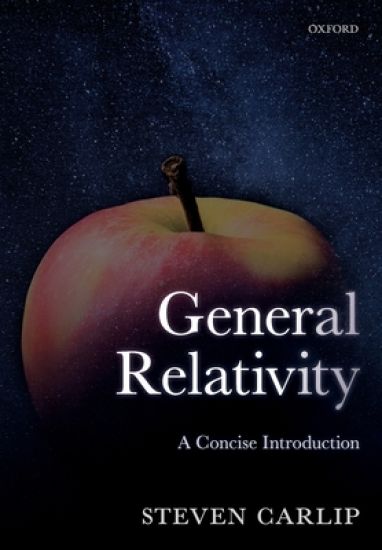
General Relativity

General Relativity

Steven Carlip

Oxford University Press
2019
nidottu
Einstein's general theory of relativity -- currently our best theory of gravity -- is important not only to specialists, but to a much wider group of physicists. This short textbook on general relativity and gravitation offers students glimpses of the vast landscape of science connected to general relativity. It incorporates some of the latest research in the field. The book is aimed at readers with a broad range of interests in physics, from cosmology, to gravitational radiation, to high energy physics, to condensed matter theory. The pedagogical approach is "physics first": readers move very quickly to the calculation of observational predictions, and only return to the mathematical foundations after the physics is established. In addition to the "standard" topics covered by most introductory textbooks, it contains short introductions to more advanced topics: for instance, why field equations are second order, how to treat gravitational energy, and what is required for a Hamiltonian formulation of general relativity. A concluding chapter discusses directions for further study, from mathematical relativity, to experimental tests, to quantum gravity. This is an introductory text, but it has also been written as a jumping-off point for readers who plan to study more specialized topics.
Quantum Gravity in 2+1 Dimensions

Quantum Gravity in 2+1 Dimensions

Steven Carlip

Cambridge University Press
2003
pokkari
This timely volume provides a broad survey of (2+1)-dimensional quantum gravity. It emphasises the ‘quantum cosmology’ of closed universes and the quantum mechanics of the (2+1)-dimensional black hole. It compares and contrasts a variety of approaches, and examines what they imply for a realistic theory of quantum gravity. General relativity in three spacetime dimensions has become a popular arena in which to explore the ramifications of quantum gravity. As a diffeomorphism-invariant theory of spacetime structure, this model shares many of the conceptual problems of realistic quantum gravity. But it is also simple enough that many programs of quantization can be carried out explicitly. After analysing the space of classical solutions, this book introduces some fifteen approaches to quantum gravity - from canonical quantization in York’s ‘extrinsic time’ to Chern-Simons quantization, from the loop representation to covariant path integration to lattice methods. Relationships among quantizations are explored, as well as implications for such issues as topology change and the ‘problem of time’. This book is an invaluable resource for all graduate students and researchers working in quantum gravity.