Kirjojen hintavertailu. Mukana 11 717 486 kirjaa ja 12 kauppaa.

Kirjahaku

Etsi kirjoja tekijän nimen, kirjan nimen tai ISBN:n perusteella.

8 kirjaa tekijältä Steven Cassedy

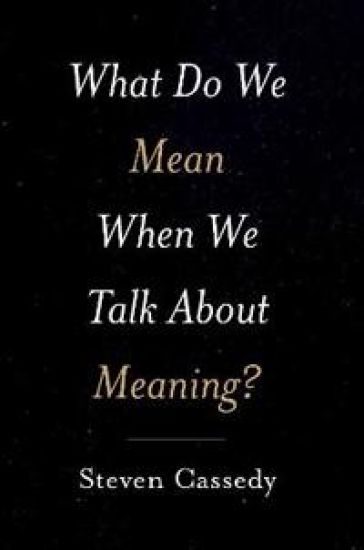
What Do We Mean When We Talk about Meaning?

What Do We Mean When We Talk about Meaning?

Steven Cassedy

OXFORD UNIVERSITY PRESS INC
2022
sidottu
A comprehensive journey through the history of "meaning," from antiquity to modern day. The word meaning appears often in our daily lives: religious leaders holding out the promise of meaning for their followers, self-help manuals seeking to demonstrate the power of meaning to enrich our lives, and most frequently people questioning the meaning of life. The word carries a multitude of connotations, from "purpose" to "value" and "essence" to "mysterious truth", but this diversity of understanding is rarely explored. In What Do We Mean When We Talk About Meaning?, Steven Cassedy tells the story of how a word that began by denoting "signifying" and "intending" came to acquire such a broad array of sub-definitions. The book begins with the early Christian thinkers who believed meaning could be "read" from the world as if it were holy scripture, then moves into the philosophers who adapted this notion and eventually the Romantic-era Germans that coined "the meaning of life," a phrase that later traveled to Great Britain, the United States, and Russia. The book also extends into the twentieth century, when "meaning" acquired its greatest power in the realms of religion, psychotherapy, and self-help, all of which helped it to accumulate the fluidity and ambiguity it still displays today.

Flight from Eden

Flight from Eden

Steven Cassedy

University of California Press
2022
pokkari
Steven Cassedy takes aim at two of the most enduring myths of modern criticism: that it is secular, and that it is new and autonomous. He argues that though modern criticism is often forbiddingly scientific and technical, the modern critic remains something of a mystic. Every school of modern criticism—from structuralism to postmodern criticism—rests on a faith in an "Eden," an irreducible essence, a myth, like the common myth that there is an intrinsic distinction between "poetic" language and "ordinary" language. The modern critic attempts to abandon all mystical faith; this is the "flight from Eden." But it is always in vain. It is traditionally assumed that modern literary criticism and theory came from France, and relatively recently. In fact, according to Cassedy, the entire modern critical consciousness was already formed by the early twentieth century in the minds of writers who were primarily neither professional critics nor philosophers, but poets. Some were French (Mallarmé, and Valéry); others were not (Rilke, Bely, and the Russian avant-garde poet Velimir Khlebnikov). In them we find the same Edenic faith, the same effort to abandon it, and the same failure of that effort. This title is part of UC Press's Voices Revived program, which commemorates University of California Press’s mission to seek out and cultivate the brightest minds and give them voice, reach, and impact. Drawing on a backlist dating to 1893, Voices Revived makes high-quality, peer-reviewed scholarship accessible once again using print-on-demand technology. This title was originally published in 1990.
Flight from Eden

Flight from Eden

Steven Cassedy

University of California Press
2022
sidottu
Steven Cassedy takes aim at two of the most enduring myths of modern criticism: that it is secular, and that it is new and autonomous. He argues that though modern criticism is often forbiddingly scientific and technical, the modern critic remains something of a mystic. Every school of modern criticism—from structuralism to postmodern criticism—rests on a faith in an "Eden," an irreducible essence, a myth, like the common myth that there is an intrinsic distinction between "poetic" language and "ordinary" language. The modern critic attempts to abandon all mystical faith; this is the "flight from Eden." But it is always in vain. It is traditionally assumed that modern literary criticism and theory came from France, and relatively recently. In fact, according to Cassedy, the entire modern critical consciousness was already formed by the early twentieth century in the minds of writers who were primarily neither professional critics nor philosophers, but poets. Some were French (Mallarmé, and Valéry); others were not (Rilke, Bely, and the Russian avant-garde poet Velimir Khlebnikov). In them we find the same Edenic faith, the same effort to abandon it, and the same failure of that effort. This title is part of UC Press's Voices Revived program, which commemorates University of California Press’s mission to seek out and cultivate the brightest minds and give them voice, reach, and impact. Drawing on a backlist dating to 1893, Voices Revived makes high-quality, peer-reviewed scholarship accessible once again using print-on-demand technology. This title was originally published in 1990.
To the Other Shore

To the Other Shore

Steven Cassedy

Princeton University Press
2014
pokkari
To the Other Shore tells the story of a small but influential group of Jewish intellectuals who immigrated to the United States from the Russian Empire between 1881 and the early 1920s--the era of "mass immigration." This pioneer group of Jewish intellectuals, many of whom were raised in Orthodox homes, abandoned their Jewish identity, absorbed the radical political theories circulating in nineteenth-century Russia, and brought those theories with them to America. When they became leaders in the labor movement in the United States and wrote for the Yiddish, Russian, and English-language radical press, they generally retained the secularized Russian cultural identity they had adopted in their homeland, together with their commitment to socialist theories. This group includes Abraham Cahan, longtime editor of The Jewish Daily Forward and one of the most influential Jews in America during the first half of this century; Morris Hillquit, a founding figure of the American socialist movement; Michael Zametkin and his wife, Adella Kean, both journalists and labor activists in the early decades of this century; and Chaim Zhitlovsky, one of the most important Yiddish writers in modern times. These immigrants were part of the generation of Jewish intellectuals that preceded the better-known New York Intellectuals of the late 1920s and 1930s--the group chronicled in Irving Howe's World of Our Fathers. In To the Other Shore, Steven Cassedy offers a broad, clear-eyed portrait of the early Jewish emigre intellectuals in America and the Russian cultural and political doctrines that inspired them. Originally published in 1997. The Princeton Legacy Library uses the latest print-on-demand technology to again make available previously out-of-print books from the distinguished backlist of Princeton University Press. These editions preserve the original texts of these important books while presenting them in durable paperback and hardcover editions. The goal of the Princeton Legacy Library is to vastly increase access to the rich scholarly heritage found in the thousands of books published by Princeton University Press since its founding in 1905.
To the Other Shore

To the Other Shore

Steven Cassedy

Princeton University Press
2016
sidottu
To the Other Shore tells the story of a small but influential group of Jewish intellectuals who immigrated to the United States from the Russian Empire between 1881 and the early 1920s--the era of "mass immigration." This pioneer group of Jewish intellectuals, many of whom were raised in Orthodox homes, abandoned their Jewish identity, absorbed the radical political theories circulating in nineteenth-century Russia, and brought those theories with them to America. When they became leaders in the labor movement in the United States and wrote for the Yiddish, Russian, and English-language radical press, they generally retained the secularized Russian cultural identity they had adopted in their homeland, together with their commitment to socialist theories. This group includes Abraham Cahan, longtime editor of The Jewish Daily Forward and one of the most influential Jews in America during the first half of this century; Morris Hillquit, a founding figure of the American socialist movement; Michael Zametkin and his wife, Adella Kean, both journalists and labor activists in the early decades of this century; and Chaim Zhitlovsky, one of the most important Yiddish writers in modern times. These immigrants were part of the generation of Jewish intellectuals that preceded the better-known New York Intellectuals of the late 1920s and 1930s--the group chronicled in Irving Howe's World of Our Fathers. In To the Other Shore, Steven Cassedy offers a broad, clear-eyed portrait of the early Jewish emigre intellectuals in America and the Russian cultural and political doctrines that inspired them. Originally published in 1997. The Princeton Legacy Library uses the latest print-on-demand technology to again make available previously out-of-print books from the distinguished backlist of Princeton University Press. These editions preserve the original texts of these important books while presenting them in durable paperback and hardcover editions. The goal of the Princeton Legacy Library is to vastly increase access to the rich scholarly heritage found in the thousands of books published by Princeton University Press since its founding in 1905.
Dostoevsky's Religion

Dostoevsky's Religion

Steven Cassedy

Stanford University Press
2005
sidottu
Any reader of Dostoevsky is immediately struck by the importance of religion within the world of his fiction. That said, it is very difficult to locate a coherent set of religious beliefs within Dostoevsky's works, and to argue that the writer embraced these beliefs. This book provides a trenchant reassessment of his religion by showing how Dostoevsky used his writings as the vehicle for an intense probing of the nature of Christianity, of the individual meaning of belief and doubt, and of the problems of ethical behavior that arise from these questions. The author argues that religion represented for Dostoevsky a welter of conflicting views and stances, from philosophical idealism to nationalist messianism. The strength of this study lies in its recognition of the absence of a single religious prescription in Dostoevsky's works, as well as in its success in tracing the background of the ideas animating Dostoevsky's religious probing.
Connected

Connected

Steven Cassedy

Stanford University Press
2014
sidottu
Between the end of the nineteenth century and the beginning of the twentieth, Americans underwent a dramatic transformation in self-conception: having formerly lived as individuals or members of small communities, they now found themselves living in networks, which arose out of scientific and technological innovations. There were transportation and communication networks. There was the network of the globalized marketplace, which brought into the American home exotic goods previously affordable to only a few. There was the network of standard time, which bound together all but the most rural Americans. There was the public health movement, which joined individuals to their fellow citizens by making everyone responsible for the health of everyone else. There were social networks that joined individuals to their fellows at the municipal, state, national, and global levels. Previous histories of this era focus on alienation and dislocation that new technologies caused. This book shows that American individuals in this era were more connected to their fellow citizens than ever—but by bonds that were distinctly modern.
Connected

Connected

Steven Cassedy

Stanford University Press
2014
pokkari
Between the end of the nineteenth century and the beginning of the twentieth, Americans underwent a dramatic transformation in self-conception: having formerly lived as individuals or members of small communities, they now found themselves living in networks, which arose out of scientific and technological innovations. There were transportation and communication networks. There was the network of the globalized marketplace, which brought into the American home exotic goods previously affordable to only a few. There was the network of standard time, which bound together all but the most rural Americans. There was the public health movement, which joined individuals to their fellow citizens by making everyone responsible for the health of everyone else. There were social networks that joined individuals to their fellows at the municipal, state, national, and global levels. Previous histories of this era focus on alienation and dislocation that new technologies caused. This book shows that American individuals in this era were more connected to their fellow citizens than ever—but by bonds that were distinctly modern.