Kirjojen hintavertailu. Mukana 11 244 527 kirjaa ja 12 kauppaa.

Kirjahaku

Etsi kirjoja tekijän nimen, kirjan nimen tai ISBN:n perusteella.

5 kirjaa tekijältä Steven D. Carter

Haiku Before Haiku

Haiku Before Haiku

Steven D. Carter

Columbia University Press
2011
pokkari
While the rise of the charmingly simple, brilliantly evocative haiku is often associated with the seventeenth-century Japanese poet Matsuo Basho, the form had already flourished for more than four hundred years before Basho even began to write. These early poems, known as hokku, are identical to haiku in syllable count and structure but function differently as a genre. Whereas each haiku is its own constellation of image and meaning, a hokku opens a series of linked, collaborative stanzas in a sequence called renga. Under the mastery of Basho, hokku first gained its modern independence. His talents contributed to the evolution of the style into the haiku beloved by so many poets around the world--Richard Wright, Jack Kerouac, and Billy Collins being notable devotees. Haiku Before Haiku presents 320 hokku composed between the thirteenth and early eighteenth centuries, from the poems of the courtier Nijo Yoshimoto to those of the genre's first "professional" master, Sogi, and his disciples. It features 20 masterpieces by Basho himself. Steven D. Carter introduces the history of haiku and its aesthetics, classifying these poems according to style and context. His rich commentary and notes on composition and setting illuminate each work, and he provides brief biographies of the poets, the original Japanese text in romanized form, and earlier, classical poems to which some of the hokku allude.
Haiku Before Haiku

Haiku Before Haiku

Steven D. Carter

Columbia University Press
2011
sidottu
While the rise of the charmingly simple, brilliantly evocative haiku is often associated with the seventeenth-century Japanese poet Matsuo Basho, the form had already flourished for more than four hundred years before Basho even began to write. These early poems, known as hokku, are identical to haiku in syllable count and structure but function differently as a genre. Whereas each haiku is its own constellation of image and meaning, a hokku opens a series of linked, collaborative stanzas in a sequence called renga. Under the mastery of Basho, hokku first gained its modern independence. His talents contributed to the evolution of the style into the haiku beloved by so many poets around the world--Richard Wright, Jack Kerouac, and Billy Collins being notable devotees. Haiku Before Haiku presents 320 hokku composed between the thirteenth and early eighteenth centuries, from the poems of the courtier Nijo Yoshimoto to those of the genre's first "professional" master, Sogi, and his disciples. It features 20 masterpieces by Basho himself. Steven D. Carter introduces the history of haiku and its aesthetics, classifying these poems according to style and context. His rich commentary and notes on composition and setting illuminate each work, and he provides brief biographies of the poets, the original Japanese text in romanized form, and earlier, classical poems to which some of the hokku allude.
How to Read a Japanese Poem

How to Read a Japanese Poem

Steven D. Carter

Columbia University Press
2019
sidottu
How to Read a Japanese Poem offers a comprehensive approach to making sense of traditional Japanese poetry of all genres and periods. Steven D. Carter explains to Anglophone students the methods of composition and literary interpretation used by Japanese poets, scholars, and critics from ancient times to the present, and adds commentary that will assist the modern reader.How to Read a Japanese Poem presents readings of poems by major figures such as Saigyo and Basho as well as lesser known poets, with nearly two hundred examples that encompass all genres of Japanese poetry. The book gives attention to well-known forms such as haikai or haiku, as well as ancient songs, comic poems, and linked verse. Each chapter provides examples of a genre in chronological order, followed by notes about authorship and other contextual details, including the time of composition, physical setting, and social occasion. The commentaries focus on a central feature of Japanese poetic discourse: that poems are often occasional, written in specific situations, and are best read in light of their milieu. Carter elucidates key concepts useful in examining Japanese poetics as well as the technical vocabulary of Japanese poetic discourse, familiarizing students with critical terms and concepts. An appendix offers succinct definitions of technical terms and essays on aesthetic ideals and devices.
How to Read a Japanese Poem

How to Read a Japanese Poem

Steven D. Carter

Columbia University Press
2019
pokkari
How to Read a Japanese Poem offers a comprehensive approach to making sense of traditional Japanese poetry of all genres and periods. Steven D. Carter explains to Anglophone students the methods of composition and literary interpretation used by Japanese poets, scholars, and critics from ancient times to the present, and adds commentary that will assist the modern reader.How to Read a Japanese Poem presents readings of poems by major figures such as Saigyo and Basho as well as lesser known poets, with nearly two hundred examples that encompass all genres of Japanese poetry. The book gives attention to well-known forms such as haikai or haiku, as well as ancient songs, comic poems, and linked verse. Each chapter provides examples of a genre in chronological order, followed by notes about authorship and other contextual details, including the time of composition, physical setting, and social occasion. The commentaries focus on a central feature of Japanese poetic discourse: that poems are often occasional, written in specific situations, and are best read in light of their milieu. Carter elucidates key concepts useful in examining Japanese poetics as well as the technical vocabulary of Japanese poetic discourse, familiarizing students with critical terms and concepts. An appendix offers succinct definitions of technical terms and essays on aesthetic ideals and devices.
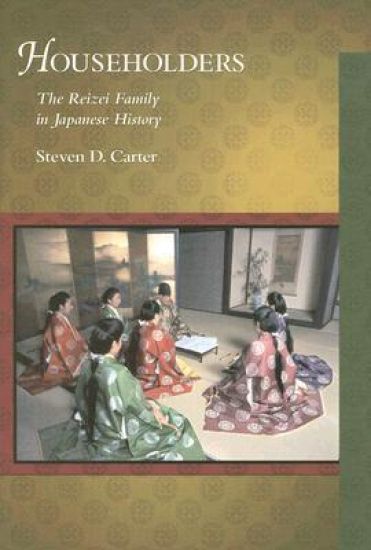
Householders

Householders

Steven D. Carter

Harvard University, Asia Center
2007
sidottu
As direct descendants of the great courtier-poets Fujiwara no Shunzei (1114–1204) and his son Teika (1162–1244), the heirs of the noble Reizei house can claim an unbroken literary lineage that spans over eight hundred years. During all that time, their primary goal has been to sustain the poetic enterprise, or michi (way), of the house and to safeguard its literary assets.Steven D. Carter weaves together strands of family history, literary criticism, and historical research into a coherent narrative about the evolution of the Reizei Way. What emerges from this innovative approach is an elegant portrait of the Reizei poets as participants in a collective institution devoted more to the continuity of family poetic practices and ideals than to the concept of individual expression that is so central to more modern poetic culture.In addition to the narrative chapters, the book also features an extensive appendix of one hundred poems from over the centuries, by poets who were affiliated with the Reizei house. Carter’s annotations provide essential critical context for this selection of poems, and his deft translations underscore the rich contributions of the Reizei family and their many disciples to the Japanese poetic tradition.