Kirjojen hintavertailu. Mukana 11 244 527 kirjaa ja 12 kauppaa.

Kirjahaku

Etsi kirjoja tekijän nimen, kirjan nimen tai ISBN:n perusteella.

9 kirjaa tekijältä Steven Goldberg

Bleached Faith

Bleached Faith

Steven Goldberg

Stanford University Press
2008
sidottu
Public recognition of religion has been a part of American political life from the beginning of our country, and that is not going to change. But in recent years, the effort by some to challenge the long held separation of church and state by imposing religion in the public sphere has caused more harm than good. Along the lines of other incredulous "neo-Enlightenment" books, Bleached Faith makes a forceful case that the gravest threat to real faith comes from those who would water down religion in order to win the dubious honor of forcing it into public buildings and classrooms. The freedom of religion we enjoy in the United States, both as a matter of law and practice, is extraordinary by any measure. However, when American courts allow the government to insert religious symbolism in public spaces, real religion is the loser. Goldberg argues that people on both sides of this debate should resist this corruption of religion. The book provides a survey of the legal and political environment in which battles over the public display of the Ten Commandments, the teaching of intelligent design in our schools, and the celebration of religious holidays take place. Goldberg firmly maintains that, "if American religion becomes a watered-down broth that is indistinguishable from consumerism and science, we will have no one to blame but ourselves. My opposition to pushing religion into the courthouse and the biology classroom does not stem from hostility to religion. I am opposed to bleached faith—the empty symbolism that diminishes the power of real belief."
Why Men Rule

Why Men Rule

Steven Goldberg

Open Court Publishing Co ,U.S.
1999
pokkari
The first edition of this book was lavishly praised by many authorities as the most formidable demonstration of an unpopular truth: males rule in all societies known to history or anthropology, for reasons arising from innate physiology, a brute fact that can never be conjured away by tinkering with social institutions. This new edition has been completely rewritten in the light of two decades of scholarship and debate, taking account of all published criticisms of earlier editions.
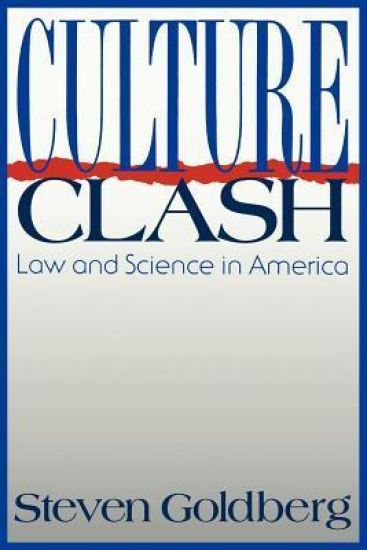
Culture Clash

Culture Clash

Steven Goldberg

New York University Press
1994
sidottu
It is an article of faith in America that scientific advances will lead to wondrous progress in our daily lives. Americans proudly support scientific research that yields stunning breakthroughs and Nobel prizes. We relish the ensuing debate about the implications—moral, ethical, practical—of these advances. Will genetic engineering change our basic nature? Will artificial intelligence challenge our sense of human uniqueness? And yet the actual implementation of these technologies is often sluggish and much-delayed. From Star Trek to Jurassic Park, the American imagination has always been fascinated by the power of scientific technology. But what does the reality of scientific progress mean for our society? In this controversial book, Steven Goldberg provides a compelling look at the intersection of two of America's most powerful communities—law and science—to explain this apparent contradiction. Rarely considered in tandem, law and science highlight a fundamental paradox in the American character, the struggle between progress and process. Science, with its ethic of endless progress, has long fit beautifully with America's self image. Law, in accordance with the American ideal of giving everyone a fair say, stresses process above all else, seeking an acceptable, rather than a scientifically correct, result. This characteristic has been especially influential in light of the explosive growth of the legal community in recent years. Exposing how the legal system both supports and restricts American science and technology, Goldberg considers the role and future of three projects—artificial intelligence, nuclear fusion, and the human genome initiative—to argue for a scientific vision that infuses research with social goals beyond the pure search for truth. Certain to provoke debate within a wide range of academic and professional communities, Culture Clash reveals one of the most important and defining conflicts in contemporary American life.
Culture Clash

Culture Clash

Steven Goldberg

New York University Press
1996
pokkari
It is an article of faith in America that scientific advances will lead to wondrous progress in our daily lives. Americans proudly support scientific research that yields stunning breakthroughs and Nobel prizes. We relish the ensuing debate about the implications—moral, ethical, practical—of these advances. Will genetic engineering change our basic nature? Will artificial intelligence challenge our sense of human uniqueness? And yet the actual implementation of these technologies is often sluggish and much-delayed. From Star Trek to Jurassic Park, the American imagination has always been fascinated by the power of scientific technology. But what does the reality of scientific progress mean for our society? In this controversial book, Steven Goldberg provides a compelling look at the intersection of two of America's most powerful communities—law and science—to explain this apparent contradiction. Rarely considered in tandem, law and science highlight a fundamental paradox in the American character, the struggle between progress and process. Science, with its ethic of endless progress, has long fit beautifully with America's self image. Law, in accordance with the American ideal of giving everyone a fair say, stresses process above all else, seeking an acceptable, rather than a scientifically correct, result. This characteristic has been especially influential in light of the explosive growth of the legal community in recent years. Exposing how the legal system both supports and restricts American science and technology, Goldberg considers the role and future of three projects—artificial intelligence, nuclear fusion, and the human genome initiative—to argue for a scientific vision that infuses research with social goals beyond the pure search for truth. Certain to provoke debate within a wide range of academic and professional communities, Culture Clash reveals one of the most important and defining conflicts in contemporary American life.
Seduced by Science

Seduced by Science

Steven Goldberg

New York University Press
1999
sidottu
American religion, Steven Goldberg claims, has fallen into a trap. Just at the moment when it has amassed the political strength and won the legal right to participate effectively in public debate, it has lost its distinctive voice. Instead of speaking of human values, goals, and limits, it speaks in the language of science. In the United States, science has extraordinary influence and respect. American religious leaders seeking prestige for their point of view regularly couch their responses to technological developments, or defend their faith, in scientific terms. They claim, for instance, that medical studies demonstrate the power of prayer, that science validates the Bible, including its account of creation, and that patenting the genetic code is dangerous because genes are the essence of who we are. But when ministers, priests, and rabbis expound on double-blind studies and the genetic causes of behavior, they do not elevate religion, Goldberg maintains, they trivialize it.Seduced by Science examines how, by allowing scientific discourse to set the terms of the debate, American religious leaders facilitate religion's move away from its more appropriate and important concerns of values, morality, and humility. Science can tell us a lot about what is but precious little about what ought to be and our religious leaders often miss the chance to add an important voice from a faith-based perspective to the public debate that follows scientific advances. Discussing the most recent and pressing collisions between science and religion-such as the medicinal benefits of prayer, the human genome project, and cloning-Goldberg raises the timely question of what the appropriate role of religion might be in public life today. Tackling the legal aspects of religious debate, Goldberg suggests ways that religious leaders might confront new scientific developments in a more meaningful fashion.
Seduced by Science

Seduced by Science

Steven Goldberg

New York University Press
2000
pokkari
American religion, Steven Goldberg claims, has fallen into a trap. Just at the moment when it has amassed the political strength and won the legal right to participate effectively in public debate, it has lost its distinctive voice. Instead of speaking of human values, goals, and limits, it speaks in the language of science. In the United States, science has extraordinary influence and respect. American religious leaders seeking prestige for their point of view regularly couch their responses to technological developments, or defend their faith, in scientific terms. They claim, for instance, that medical studies demonstrate the power of prayer, that science validates the Bible, including its account of creation, and that patenting the genetic code is dangerous because genes are the essence of who we are. But when ministers, priests, and rabbis expound on double-blind studies and the genetic causes of behavior, they do not elevate religion, Goldberg maintains, they trivialize it. Seduced by Science examines how, by allowing scientific discourse to set the terms of the debate, American religious leaders facilitate religion's move away from its more appropriate and important concerns of values, morality, and humility. Science can tell us a lot about what is but precious little about what ought to be and our religious leaders often miss the chance to add an important voice from a faith-based perspective to the public debate that follows scientific advances. Discussing the most recent and pressing collisions between science and religion-such as the medicinal benefits of prayer, the human genome project, and cloning-Goldberg raises the timely question of what the appropriate role of religion might be in public life today. Tackling the legal aspects of religious debate, Goldberg suggests ways that religious leaders might confront new scientific developments in a more meaningful fashion.

Mathematical Elegance

Mathematical Elegance

Steven Goldberg

AldineTransaction
2015
sidottu
The heart of mathematics is its elegance; the way it all fits together. Unfortunately, its beauty often eludes the vast majority of people who are intimidated by fear of the difficulty of numbers. Mathematical Elegance remedies this. Using hundreds of examples, the author presents a view of the mathematical landscape that is both accessible and fascinating.At a time of concern that American youth are bored by math, there is renewed interest in improving math skills. Mathematical Elegance stimulates students, along with those already experienced in the discipline, to explore some of the unexpected pleasures of quantitative thinking. Invoking mathematical proofs famous for their simplicity and brainteasers that are fun and illuminating, the author leaves readers feeling exuberant—as well as convinced that their IQs have been raised by ten points.A host of anecdotes about well-known mathematicians humanize and provide new insights into their lofty subjects. Recalling such classic works as Lewis Carroll's Introduction to Logic and A Mathematician Reads the Newspaper by John Allen Paulos, Mathematical Elegance will energize and delight a wide audience, ranging from intellectually curious students to the enthusiastic general reader.