Kirjojen hintavertailu. Mukana 11 244 527 kirjaa ja 12 kauppaa.

Kirjahaku

Etsi kirjoja tekijän nimen, kirjan nimen tai ISBN:n perusteella.

13 kirjaa tekijältä Steven J. Dick

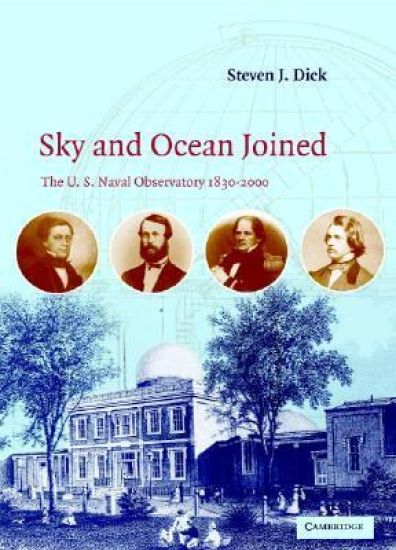
Sky and Ocean Joined

Sky and Ocean Joined

Steven J. Dick

Cambridge University Press
2007
pokkari
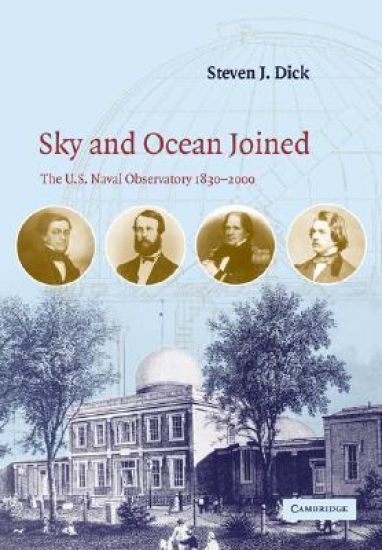
As one of the oldest scientific institutions in the United States, the US Naval Observatory has a rich and colourful history. This volume is, first and foremost, a story of the relations between space, time and navigation, from the rise of the chronometer in the United States to the Global Positioning System of satellites, for which the Naval Observatory provides the time to a billionth of a second per day. It is a story of the history of technology, in the form of telescopes, lenses, detectors, calculators, clocks and computers over 170 years. It describes how one scientific institution under government and military patronage has contributed, through all the vagaries of history, to almost two centuries of unparalleled progress in astronomy. Sky and Ocean Joined will appeal to historians of science, technology, scientific institutions and American science, as well as astronomers, meteorologists and physicists.
The Biological Universe

The Biological Universe

Steven J. Dick

Cambridge University Press
1996
sidottu
Throughout the twentieth century, from the furor over Percival Lowell’s claim of canals on Mars to the sophisticated Search for Extraterrestrial Intelligence, otherworldly life has often intrigued and occasionally consumed science and the public. Does ‘biological law’ reign throughout the universe? Are there other histories, religions, and philosophies outside of those on Earth? Do extraterrestrial minds ponder the mysteries of the universe? The attempts to answer these often asked questions form one of the most interesting chapters in the history of science and culture, and The Biological Universe is the first book to provide a rich and colorful history of those attempts during the twentieth century. Covering a broad range of topics, including the search for life in the solar system, the origins of life, UFOs, and aliens in science fiction, Steven J. Dick shows how the concept of extraterrestrial intelligence is a world view of its own, a ‘biophysical cosmology’ that seeks confirmation no less than physical views of the universe.
Life on Other Worlds

Life on Other Worlds

Steven J. Dick

Cambridge University Press
1998
sidottu
The recent discoveries of extrasolar planets and possible microfossils in Martian meteorite ALH 84001 are only the latest developments in a debate that spans millennia, and that has been especially heated in the twentieth century. From the furore over Percival Lowell's claim of canals on Mars at the beginning of the century to the biological experiments of the Viking spacecraft, the controversial 'Mars rock', and the sophisticated Search for Extraterrestrial Intelligence (SETI) at its end, otherworldly life has often titillated and occasionally consumed science and the public. So too have crucially related areas such as the search for planetary systems, the quest for an explanation of UFOs, and inquiries into the origin of life. The theme has been elaborated in science fiction from H. G. Wells to Arthur C. Clarke, and resulted in some of the most popular films of all time, including ET, Aliens, Independence Day, and Contact. Life on Other Worlds details in a readable and non-technical manner the history of the twentieth century extraterrestrial life debate, one of the pervasive themes of our century.
The Biological Universe

The Biological Universe

Steven J. Dick

Cambridge University Press
1999
pokkari
Throughout the twentieth century, from the furor over Percival Lowell’s claim of canals on Mars to the sophisticated Search for Extraterrestrial Intelligence, otherworldly life has often intrigued and occasionally consumed science and the public. Does ‘biological law’ reign throughout the universe? Are there other histories, religions, and philosophies outside of those on Earth? Do extraterrestrial minds ponder the mysteries of the universe? The attempts to answer these often asked questions form one of the most interesting chapters in the history of science and culture, and The Biological Universe is the first book to provide a rich and colorful history of those attempts during the twentieth century. Covering a broad range of topics, including the search for life in the solar system, the origins of life, UFOs, and aliens in science fiction, Steven J. Dick shows how the concept of extraterrestrial intelligence is a world view of its own, a ‘biophysical cosmology’ that seeks confirmation no less than physical views of the universe.
Life on Other Worlds

Life on Other Worlds

Steven J. Dick

Cambridge University Press
2001
pokkari
The recent discoveries of extrasolar planets and possible microfossils in Martian meteorite ALH 84001 are only the latest developments in a debate that spans millennia, and that has been especially heated in the twentieth century. From the furore over Percival Lowell’s claim of canals on Mars at the beginning of the century to the biological experiments of the Viking spacecraft, the controversial ‘Mars rock’, and the sophisticated Search for Extraterrestrial Intelligence (SETI) at its end, otherworldly life has often titillated and occasionally consumed science and the public. So too have crucially related areas such as the search for planetary systems, the quest for an explanation of UFOs, and inquiries into the origin of life. The theme has been elaborated in science fiction from H. G. Wells to Arthur C. Clarke, and resulted in some of the most popular films of all time, including ET, Aliens, Independence Day, and Contact. Life on Other Worlds details in a readable and non-technical manner the history of the twentieth century extraterrestrial life debate, one of the pervasive themes of our century.
Sky and Ocean Joined

Sky and Ocean Joined

Steven J. Dick

Cambridge University Press
2002
sidottu
As one of the oldest scientific institutions in the United States, the U. S. Naval Observatory has a rich and colorful history. This volume is, first and foremost, a story of the relations between space, time and navigation, from the rise of the chronometer in the United States to the Global Positioning System of satellites, for which the Naval Observatory provides the time to a billionth of a second per day. It is a story of the history of technology, in the form of telescopes, lenses, detectors, calculators, clocks and computers over 170 years. It describes how one scientific institution under government and military patronage has contributed, through all the vagaries of history, to almost two centuries of unparalleled progress in astronomy. Sky and Ocean Joined will appeal to historians of science, technology, scientific institutions and American science, as well as astronomers, meteorologists and physicists.

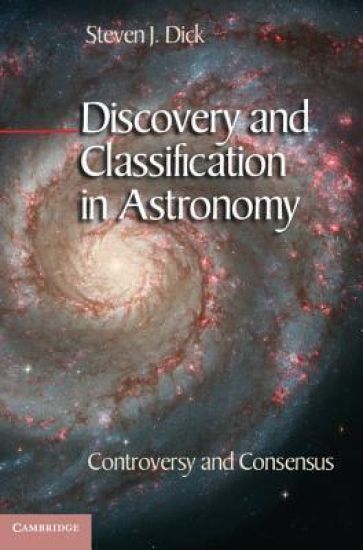
Discovery and Classification in Astronomy

Discovery and Classification in Astronomy

Steven J. Dick

Cambridge University Press
2013
sidottu
Astronomical discovery involves more than detecting something previously unseen. The reclassification of Pluto as a dwarf planet in 2006, and the controversy it generated, shows that discovery is a complex and ongoing process – one comprising various stages of research, interpretation and understanding. Ranging from Galileo's observation of Jupiter's satellites, Saturn's rings and star clusters, to Herschel's nebulae and the modern discovery of quasars and pulsars, Steven J. Dick's comprehensive history identifies the concept of 'extended discovery' as the engine of progress in astronomy. The text traces more than 400 years of telescopic observation, exploring how the signal discoveries of new astronomical objects relate to and inform one another, and why controversies such as Pluto's reclassification are commonplace in the field. The volume is complete with a detailed classification system for known classes of astronomical objects, offering students, researchers and amateur observers a valuable reference and guide.
Astrobiology, Discovery, and Societal Impact

Astrobiology, Discovery, and Societal Impact

Steven J. Dick

Cambridge University Press
2018
sidottu
The search for life in the universe, once the stuff of science fiction, is now a robust worldwide research program with a well-defined roadmap probing both scientific and societal issues. This volume examines the humanistic aspects of astrobiology, systematically discussing the approaches, critical issues, and implications of discovering life beyond Earth. What do the concepts of life and intelligence, culture and civilization, technology and communication mean in a cosmic context? What are the theological and philosophical implications if we find life - and if we do not? Steven J. Dick argues that given recent scientific findings, the discovery of life in some form beyond Earth is likely and so we need to study the possible impacts of such a discovery and formulate policies to deal with them. The remarkable and often surprising results are presented here in a form accessible to disciplines across the sciences, social sciences, and humanities.
Astrobiology, Discovery, and Societal Impact

Astrobiology, Discovery, and Societal Impact

Steven J. Dick

Cambridge University Press
2020
pokkari
The search for life in the universe, once the stuff of science fiction, is now a robust worldwide research program with a well-defined roadmap probing both scientific and societal issues. This volume examines the humanistic aspects of astrobiology, systematically discussing the approaches, critical issues, and implications of discovering life beyond Earth. What do the concepts of life and intelligence, culture and civilization, technology and communication mean in a cosmic context? What are the theological and philosophical implications if we find life - and if we do not? Steven J. Dick argues that given recent scientific findings, the discovery of life in some form beyond Earth is likely and so we need to study the possible impacts of such a discovery and formulate policies to deal with them. The remarkable and often surprising results are presented here in a form accessible to disciplines across the sciences, social sciences, and humanities.
Classifying the Cosmos

Classifying the Cosmos

Steven J. Dick

Springer Nature Switzerland AG
2019
nidottu
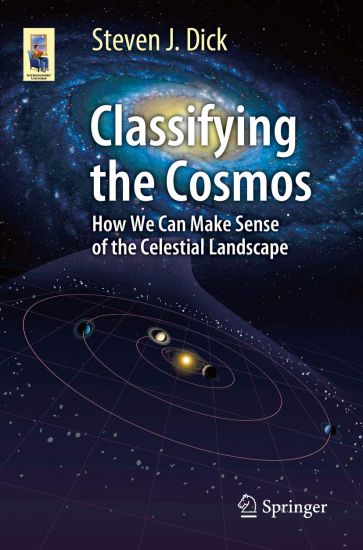
Since the invention of the telescope 400 years ago, astronomers have rapidly discovered countless celestial objects. But how does one make sense of it all?Astronomer and former NASA Chief Historian Steven J. Dick brings order to this menagerie by defining 82 classes of astronomical objects, which he places in a beginner-friendly system known as "Astronomy’s Three Kingdoms.” Rather than concentrating on technicalities, this system focuses on the history of each object, the nature of its discovery, and our current knowledge about it.The ensuing book can therefore be read on at least two levels. On one level, it is an illustrated guide to various types of astronomical wonders. On another level, it is considerably more: the first comprehensive classification system to cover all celestial objects in a consistent manner.Accompanying each spread are spectacular historical and modern images. The result is a pedagogical tour-de-force, whereby readers can easily master astronomy’s three realms of planets, stars, and galaxies.
Space, Time, and Aliens

Space, Time, and Aliens

Steven J. Dick

Springer Nature Switzerland AG
2020
sidottu
In this comprehensive and interdisciplinary volume, former NASA Chief Historian Steven Dick reflects on the exploration of space, astrobiology and its implications, cosmic evolution, astronomical institutions, discovering and classifying the cosmos, and the philosophy of astronomy. The unifying theme of the book is the connection between cosmos and culture, or what Carl Sagan many years ago called the “cosmic connection.”As both an astronomer and historian of science, Dr. Dick has been both a witness to and a participant in many of the astronomical events of the last half century. This collection of papers presents his reflections over the last forty years in a way accessible to historians, philosophers, and scientists alike. From the search for alien life to ongoing space exploration efforts, readers will find this volume full of engaging topics relevant to science, society, and our collective future on planet Earth and beyond.
Space, Time, and Aliens

Space, Time, and Aliens

Steven J. Dick

Springer Nature Switzerland AG
2021
nidottu
In this comprehensive and interdisciplinary volume, former NASA Chief Historian Steven Dick reflects on the exploration of space, astrobiology and its implications, cosmic evolution, astronomical institutions, discovering and classifying the cosmos, and the philosophy of astronomy. The unifying theme of the book is the connection between cosmos and culture, or what Carl Sagan many years ago called the “cosmic connection.”As both an astronomer and historian of science, Dr. Dick has been both a witness to and a participant in many of the astronomical events of the last half century. This collection of papers presents his reflections over the last forty years in a way accessible to historians, philosophers, and scientists alike. From the search for alien life to ongoing space exploration efforts, readers will find this volume full of engaging topics relevant to science, society, and our collective future on planet Earth and beyond.