Kirjojen hintavertailu. Mukana 11 717 486 kirjaa ja 12 kauppaa.

Kirjahaku

Etsi kirjoja tekijän nimen, kirjan nimen tai ISBN:n perusteella.

7 kirjaa tekijältä Steven Palmer

Rock Songs

Rock Songs

Steven Palmer

Tellwell Talent
2021
pokkari
"Long Live Rock ""Rock Songs" is a collection of dramatic visual interpretations of songs I've chosen to illustrate from a time when I feel music was at its finest. This book displays fantasy concepts depicting these individual pieces of music throughout the pages. Twenty-four compositions that represent a broad range of incredible music styles from the 70's and 80's genres: progressive, new wave, glam, alternative, soft rock, hard rock and onward. It was a very interesting and innovative era in the music industry during these times: impressive, powerful stage presentations and experimentation in the recording studios with new techniques. The songwriting and lyric content were absolutely astounding, creating rock songs that oozed with amazement and heartfelt significance. So pick up the book, choose an Illustration page, dig into your library of vinyl or CDs and crank it up: then relax and enjoy
Rock Songs

Rock Songs

Steven Palmer

Tellwell Talent
2021
sidottu
"Long Live Rock ""Rock Songs" is a collection of dramatic visual interpretations of songs I've chosen to illustrate from a time when I feel music was at its finest. This book displays fantasy concepts depicting these individual pieces of music throughout the pages. Twenty-four compositions that represent a broad range of incredible music styles from the 70's and 80's genres: progressive, new wave, glam, alternative, soft rock, hard rock and onward. It was a very interesting and innovative era in the music industry during these times: impressive, powerful stage presentations and experimentation in the recording studios with new techniques. The songwriting and lyric content were absolutely astounding, creating rock songs that oozed with amazement and heartfelt significance. So pick up the book, choose an Illustration page, dig into your library of vinyl or CDs and crank it up: then relax and enjoy
Launching Global Health

Launching Global Health

Steven Palmer

The University of Michigan Press
2010
sidottu
"With a clear and engaging narrative that delves into complex and debatable issues and, at the same time, tells very entertaining stories, this book is a wonderful addition to the historiography of international health."---Diego Armus, Swarthmore CollegeFrom the Rockefeller Foundation to the Bill and Melinda Gates Foundation, U.S. philanthropies have played a leading role in the evolution of international health. Launching Global Health examines one of the earliest of these initiatives abroad, the Rockefeller Foundation's International Health Board. The flagship agency made its first call in British Guiana in 1914 to experiment with its new "American method" for the treatment of hookworm disease. Within months it was involved in ambitious hookworm programs in six Central American and Caribbean sites, its directors self-consciously choosing to test run the prototype for their global project in the nearest and clearest domain of American imperial influence. These efforts continued until 1930, when most of the International Health Board hookworm campaigns had evolved into public health projects of a different nature.Launching Global Health is the first book to explore the inaugural Rockefeller Foundation campaigns in depth and to treat them as an ensemble---as a laboratory for discovering and testing the elements of a global health system for the twentieth century. Orienting the study according to the priorities and perspectives of the social and cultural history of medicine and marrying the results with social science and institutional approaches, Steven Palmer rediscovers elements and dynamics in the original history of global health that were either discarded or that have continued to operate beneath the radar of scholarship. In particular, Palmer examines the extraordinary encounters that took place between the Rockefeller proselytizers of biomedicine and public health and the diverse populations whom they were attempting to help. Launching Global Health devotes special attention to the health narratives and practices of laboring people of different ethnicities and how they clashed and blended with the stories and rituals being promoted by the Rockefeller Foundation, ultimately showing the locally assembled health teams of microscopists, inspectors, and dispensers to have been active agents in the shaping of encounters between imperial and popular medicine.Steven Palmer is Canada Research Chair in the History of International Health at the University of Windsor and author of From Popular Medicine to Medical Populism: Doctors, Healers, and Public Power in Costa Rica, 1800-1940. Illustration: Lecture on hookworm disease on public building porch. Courtesy Rockefeller Archive Center.A volume in the series Conversations in Medicine and Society.
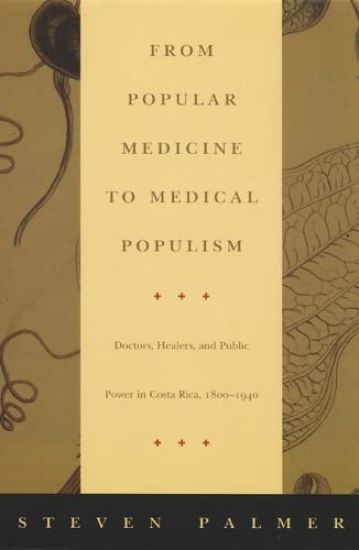
From Popular Medicine to Medical Populism

From Popular Medicine to Medical Populism

Steven Palmer

Duke University Press
2003
sidottu
From Popular Medicine to Medical Populism presents the history of medical practice in Costa Rica from the late colonial era-when none of the fifty thousand inhabitants had access to a titled physician, pharmacist, or midwife-to the 1940s, when the figure of the qualified medical doctor was part of everyday life for many of Costa Rica’s nearly one million citizens. It is the first book to chronicle the history of all healers, both professional and popular, in a Latin American country during the national period.Steven Palmer breaks with the view of popular and professional medicine as polar opposites-where popular medicine is seen as representative of the authentic local community and as synonymous with oral tradition and religious and magical beliefs and professional medicine as advancing neocolonial interests through the work of secular, trained academicians. Arguing that there was significant and formative overlap between these two forms of medicine, Palmer shows that the relationship between practitioners of each was marked by coexistence, complementarity, and dialogue as often as it was by rivalry. Palmer explains that while the professionalization of medical practice was intricately connected to the nation-building process, the Costa Rican state never consistently displayed an interest in suppressing the practice of popular medicine. In fact, it persistently found both tacit and explicit ways to allow untitled healers to practice. Using empirical and archival research to bring people (such as the famous healer or curandero Professor Carlos Carbell), events, and institutions (including the Rockefeller Foundation) to life, From Popular Medicine to Medical Populism demonstrates that it was through everyday acts of negotiation among agents of the state, medical professionals, and popular practitioners that the contours of Costa Rica’s modern, heterogeneous health care system were established.
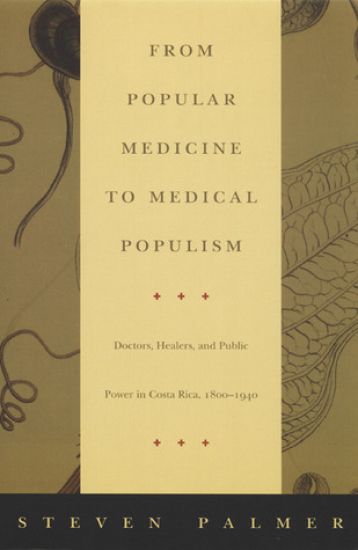
From Popular Medicine to Medical Populism

From Popular Medicine to Medical Populism

Steven Palmer

Duke University Press
2003
pokkari
From Popular Medicine to Medical Populism presents the history of medical practice in Costa Rica from the late colonial era-when none of the fifty thousand inhabitants had access to a titled physician, pharmacist, or midwife-to the 1940s, when the figure of the qualified medical doctor was part of everyday life for many of Costa Rica’s nearly one million citizens. It is the first book to chronicle the history of all healers, both professional and popular, in a Latin American country during the national period.Steven Palmer breaks with the view of popular and professional medicine as polar opposites-where popular medicine is seen as representative of the authentic local community and as synonymous with oral tradition and religious and magical beliefs and professional medicine as advancing neocolonial interests through the work of secular, trained academicians. Arguing that there was significant and formative overlap between these two forms of medicine, Palmer shows that the relationship between practitioners of each was marked by coexistence, complementarity, and dialogue as often as it was by rivalry. Palmer explains that while the professionalization of medical practice was intricately connected to the nation-building process, the Costa Rican state never consistently displayed an interest in suppressing the practice of popular medicine. In fact, it persistently found both tacit and explicit ways to allow untitled healers to practice. Using empirical and archival research to bring people (such as the famous healer or curandero Professor Carlos Carbell), events, and institutions (including the Rockefeller Foundation) to life, From Popular Medicine to Medical Populism demonstrates that it was through everyday acts of negotiation among agents of the state, medical professionals, and popular practitioners that the contours of Costa Rica’s modern, heterogeneous health care system were established.

Web Application Vulnerabilities

Web Application Vulnerabilities

Steven Palmer

Syngress Media,U.S.
2007
nidottu
In this book, we aim to describe how to make a computer bend to your will by finding and exploiting vulnerabilities specifically in Web applications. We will describe common security issues in Web applications, tell you how to find them, describe how to exploit them, and then tell you how to fix them. We will also cover how and why some hackers (the bad guys) will try to exploit these vulnerabilities to achieve their own end. We will also try to explain how to detect if hackers are actively trying to exploit vulnerabilities in your own Web applications.