First published in 1998, this volume offers some solutions to the inherent difficulties with moving from philosophical generalities to specific policies, by exploring how a bridge might be built between political philosophy and social policy analysis. In light of these findings, Steven R. Smith evaluates the relationship between the Centre-Left and the New Right, focusing on the way in which concepts of individual autonomy and equality are used by political philosophers and social policy makers. Smith explores post-1945 training, education, social security and community care policy within the United Kingdom.
First published in 1998, this volume offers some solutions to the inherent difficulties with moving from philosophical generalities to specific policies, by exploring how a bridge might be built between political philosophy and social policy analysis. In light of these findings, Steven R. Smith evaluates the relationship between the Centre-Left and the New Right, focusing on the way in which concepts of individual autonomy and equality are used by political philosophers and social policy makers. Smith explores post-1945 training, education, social security and community care policy within the United Kingdom.
Psychology Graduate School: A User’s Manual provides a user-friendly description of what graduate study in clinical, counseling, and school psychology is really like. Rather than a mere how-to manual, this book describes the nitty-gritty of the graduate student experience in a casual style so that you will be prepared and successful. Written by an experienced graduate school professor, this book cuts to the heart of what you’ll experience as a graduate student (good, bad, and otherwise). Topics include dealing with imposter syndrome, understanding faculty, starting clinical work, applying for your internship, celebrating milestones, and crafting a professional narrative. Equal parts inspirational and instructive, Steven R. Smith cuts to the chase about how to deftly navigate the system while keeping your wits about you. Punctuated with quotes and stories from graduate students from all over the country, this readable and enjoyable text will be of interest to students currently in graduate school and those looking forward to attending.
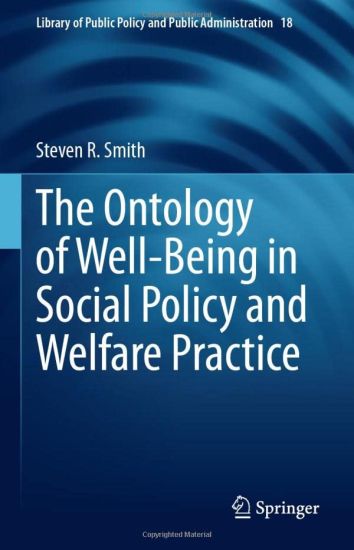
This book provides important philosophical insights concerning the kind of creatures we are such that we can experience something we understand as well-being, with these insights then being applied to various areas of social policy and welfare practice. The author defends what he calls The Ontology of Well-Being Thesis (TOWT), addressing ontological questions about the human condition, and how these questions are fundamental to issues concerning what we might know about human well-being and how we should promote it. Yet, surprisingly, these ontological questions are often side-lined in academic, political, and policy and practice based debates about well-being. Addressing these questions, head-on, six features of the human condition are identified via TOWT: human embodiment, finiteness, sociability, cognition, evaluation, and agency. The main argument of the thesis is that these features reveal the conflicting character of human experiences, which can, in turn, have a profound bearing on our experience of well-being. Notably, it is our conflicting experiences of time, emotion, and self-consciousness, which can potentially help us experience well-being in complex and multi-dimensional ways. The author then applies these insights to various social policies and welfare practices, concerning, for example, pensions, disability, bereavement counselling, social prescribing within health settings, the promotion of mental health, and co-production practices. This book is of importance to philosophers, social policy analysts, and welfare practitioners and is also relevant to the fields of psychology, sociology, politics, and the health sciences.
This book provides important philosophical insights concerning the kind of creatures we are such that we can experience something we understand as well-being, with these insights then being applied to various areas of social policy and welfare practice. The author defends what he calls The Ontology of Well-Being Thesis (TOWT), addressing ontological questions about the human condition, and how these questions are fundamental to issues concerning what we might know about human well-being and how we should promote it. Yet, surprisingly, these ontological questions are often side-lined in academic, political, and policy and practice based debates about well-being. Addressing these questions, head-on, six features of the human condition are identified via TOWT: human embodiment, finiteness, sociability, cognition, evaluation, and agency. The main argument of the thesis is that these features reveal the conflicting character of human experiences, which can, in turn, have a profound bearing on our experience of well-being. Notably, it is our conflicting experiences of time, emotion, and self-consciousness, which can potentially help us experience well-being in complex and multi-dimensional ways. The author then applies these insights to various social policies and welfare practices, concerning, for example, pensions, disability, bereavement counselling, social prescribing within health settings, the promotion of mental health, and co-production practices. This book is of importance to philosophers, social policy analysts, and welfare practitioners and is also relevant to the fields of psychology, sociology, politics, and the health sciences.