Kirjojen hintavertailu. Mukana 11 699 587 kirjaa ja 12 kauppaa.

Kirjahaku

Etsi kirjoja tekijän nimen, kirjan nimen tai ISBN:n perusteella.

3 kirjaa tekijältä Steven Weisenburger

Modern Medea: A Family Story of Slavery and Child-Murder from the Old South
The first in-depth historical account of the events that inspired Toni Morrison's novel Beloved. In the middle of a frigid Sunday night in January 1856, a twenty-two-year-old Kentucky slave named Margaret Garner gathered up her family and raced north, toward Cincinnati and freedom. But Margaret's master followed just hours behind and soon had the fugitives surrounded. Thinking all was lost, Margaret seized a butcher knife and nearly decapitated her two-year-old daughter, crying out that she would rather see her children dead than returned to slavery. She was turning on her other three children when slave catchers burst in and subdued her. Margaret Garner's child-murder electrified the United States, inspiring the longest, most spectacular fugitive-slave trial in history. Abolitionists and slaveholders fought over the meaning of the murder, and the case came to symbolize the ills of the Union in those last dark decades before the Civil War. Newspaper columnists, poets, and dramatists raced to interpret Margaret's deeds, but by the century's end they were all but forgotten. Steven Weisenburger is the first scholar to delve into this astonishing story in more than a century. Weisenburger integrates his innovative archival discoveries into a dramatic narrative that paints a nuanced portrait of the not-so-genteel Southern culture of slavery and its destructive effect on all who lived in and with it.
Fables of Subversion

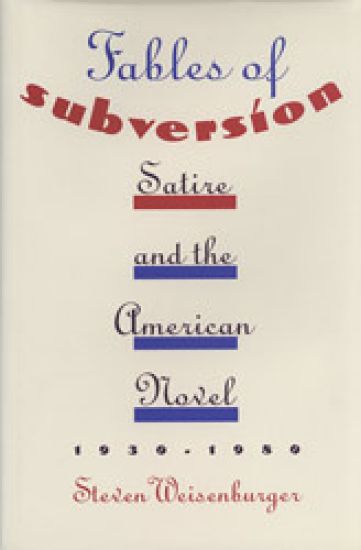
Fables of Subversion

Steven Weisenburger

University of Georgia Press
1995
sidottu
Drawing on more than thirty novels by nineteen writers, Fables of Subversion is both a survey of mid-twentieth century American fiction and a study of how these novels challenged the conventions of satire. Steven Weisenburger focuses on the rise of a radically subversive mode of satire from 1930 to 1980. This postmodern satire, says Weisenburger, stands in crucial opposition to corrective, normative satire, which has served a legitimizing function by generating, through ridicule, a consensus on values. Weisenburger argues that satire in this generative mode does not participate in the oppositional, subversive work of much twentieth-century art.Chapters focus on theories of satire, early subversions of satiric conventions by Nathanael West, Flannery O'Connor, and John Hawkes, the flowering of "Black Humor" fictions of the sixties, and the forms of political and encyclopedic satire prominent throughout the period. Many of the writers included here, such as Vladimir Nabokov, William Gaddis, Kurt Vonnegut, Robert Coover, and Thomas Pynchon, are acknowledged masters of contemporary humor. Others, such as Mary McCarthy, Chester Himes, James Purdy, Charles Wright, and Ishmael Reed, have not previously been considered in this context.Posing a seminal challenge to existing theories of satire, Fables of Subversion explores the iconoclastic energies of the new satires as a driving force in late modern and post-modern novel writing.
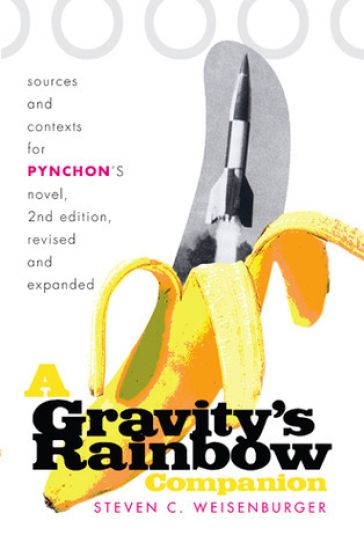
A Gravity's Rainbow Companion

A Gravity's Rainbow Companion

Steven Weisenburger

University of Georgia Press
2006
pokkari
Adding some 20 percent to the original content, this is a completely updated edition of Steven Weisenburger's indispensable guide to Thomas Pynchon's Gravity's Rainbow. Weisenburger takes the reader page by page, often line by line, through the welter of historical references, scientific data, cultural fragments, anthropological research, jokes, and puns around which Pynchon wove his story. Weisenburger fully annotates Pynchon's use of languages ranging from Russian and Hebrew to such subdialects of English as 1940s street talk, drug lingo, and military slang as well as the more obscure terminology of black magic, Rosicrucianism, and Pavlovian psychology. The Companion also reveals the underlying organization of Gravity's Rainbow—how the book's myriad references form patterns of meaning and structure that have eluded both admirers and critics of the novel.The Companion is keyed to the pages of the principal American editions of Gravity's Rainbow: Viking/Penguin (1973), Bantam (1974), and the special, repaginated Penguin paperback (2000) honoring the novel as one of twenty "Great Books of the Twentieth Century."