Kirjojen hintavertailu. Mukana 11 699 587 kirjaa ja 12 kauppaa.

Kirjahaku

Etsi kirjoja tekijän nimen, kirjan nimen tai ISBN:n perusteella.

3 kirjaa tekijältä Stuart A. Klugman

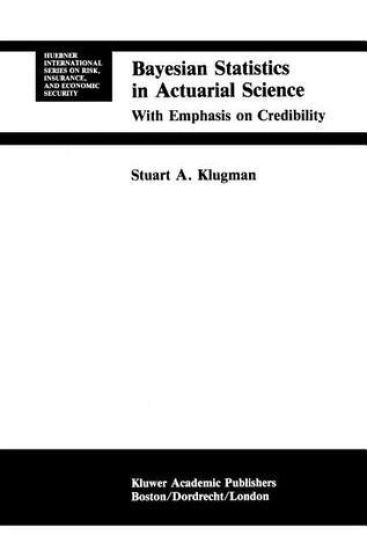
Bayesian Statistics in Actuarial Science
The debate between the proponents of "classical" and "Bayesian" statistica} methods continues unabated. It is not the purpose of the text to resolve those issues but rather to demonstrate that within the realm of actuarial science there are a number of problems that are particularly suited for Bayesian analysis. This has been apparent to actuaries for a long time, but the lack of adequate computing power and appropriate algorithms had led to the use of various approximations. The two greatest advantages to the actuary of the Bayesian approach are that the method is independent of the model and that interval estimates are as easy to obtain as point estimates. The former attribute means that once one learns how to analyze one problem, the solution to similar, but more complex, problems will be no more difficult. The second one takes on added significance as the actuary of today is expected to provide evidence concerning the quality of any estimates. While the examples are all actuarial in nature, the methods discussed are applicable to any structured estimation problem. In particular, statisticians will recognize that the basic credibility problem has the same setting as the random effects model from analysis of variance.
Loss Models: From Data to Decisions, Book + Solutions Manual Set
A modern practical guide to building and using actuarial models.Loss Models: From Data to Decisions is organized around the principle that actuaries build models in order to analyze risks and make decisions about managing the risks based on conclusions drawn from the analysis. In practice, one begins with data and ends with a business decision. The book flows logically from this principle. It begins with a framework for model building and a description of frequency and severity loss data typically available to actuaries. Parametric models are emphasized throughout. The frequency and severity models are used in building aggregate loss models, in credibility-based pricing models, and in loss analysis over multiple time periods. Designed as both an educational text as well as a professional reference, Loss Models:Assumes little prior knowledge of insurance systemsFeatures many fascinating examples taken from insurance filesContains a major instructive case study continued through each chapterCovers the classical areas of risk theory and loss distributionsGives a practical but rigorous treatment of modern credibility theoryUses standard statistical concepts, methods, and notationProvides modern computational algorithms for implementing methodsIncludes free companion software available from an FTP siteDeals with many topics on CAS 4B and SOA 151 and 152 actuarial examsIncludes many exercises based on past CAS and SOA exams.
Bayesian Statistics in Actuarial Science
The debate between the proponents of "classical" and "Bayesian" statistica} methods continues unabated. It is not the purpose of the text to resolve those issues but rather to demonstrate that within the realm of actuarial science there are a number of problems that are particularly suited for Bayesian analysis. This has been apparent to actuaries for a long time, but the lack of adequate computing power and appropriate algorithms had led to the use of various approximations. The two greatest advantages to the actuary of the Bayesian approach are that the method is independent of the model and that interval estimates are as easy to obtain as point estimates. The former attribute means that once one learns how to analyze one problem, the solution to similar, but more complex, problems will be no more difficult. The second one takes on added significance as the actuary of today is expected to provide evidence concerning the quality of any estimates. While the examples are all actuarial in nature, the methods discussed are applicable to any structured estimation problem. In particular, statisticians will recognize that the basic credibility problem has the same setting as the random effects model from analysis of variance.