Kirjojen hintavertailu. Mukana 12 390 323 kirjaa ja 12 kauppaa.

Kirjahaku

Etsi kirjoja tekijän nimen, kirjan nimen tai ISBN:n perusteella.

21 kirjaa tekijältä Stuart Casey-Maslen, Steven Haines

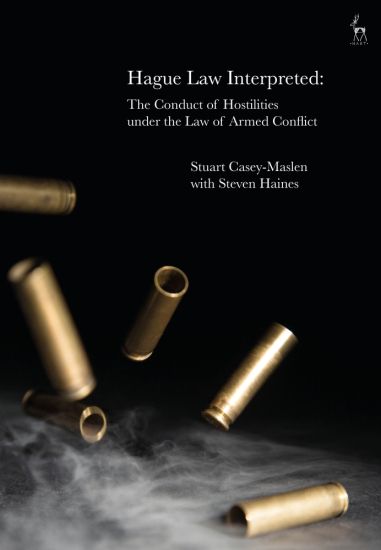
Hague Law Interpreted

Hague Law Interpreted

Stuart Casey-Maslen; Steven Haines

Hart Publishing
2018
sidottu
Given the centrality of Hague Law to the lawful prosecution of warfare, the relative paucity of dedicated works is surprising. The general formulation of Hague Law rules is largely uncontroversial, but this clarity stands in stark contrast to their interpretation and practical application. How precisely, for instance, the fundamental rules of distinction and proportionality in attack are to dictate and constrain the planning and practice of warfare continues to be highly uncertain. This important new publication fills the gap in the literature. Offering a comprehensive assessment of Hague Law, it explores questions of definitions and accountability and navigates the substantive rules and their application to different types of warfare.
Hague Law Interpreted

Hague Law Interpreted

Stuart Casey-Maslen; Steven Haines

Hart Publishing
2021
nidottu
Given the centrality of Hague Law to the lawful prosecution of warfare, the relative paucity of dedicated works is surprising. The general formulation of Hague Law rules is largely uncontroversial, but this clarity stands in stark contrast to their interpretation and practical application. How precisely, for instance, the fundamental rules of distinction and proportionality in attack are to dictate and constrain the planning and practice of warfare continues to be highly uncertain. This important new publication fills the gap in the literature. Offering a comprehensive assessment of Hague Law, it explores questions of definitions and accountability and navigates the substantive rules and their application to different types of warfare.
The Anti-Personnel Mine Ban Convention

The Anti-Personnel Mine Ban Convention

Stuart Casey-Maslen

Oxford University Press
2023
sidottu
In September 1997, the Anti-Personnel Mine Ban Convention (APMBC) was adopted by UN Member States at a dedicated diplomatic conference in Oslo. A disarmament treaty with clear and expansive humanitarian aims, the APMBC represented the culmination of many years of energetic campaigning. The Convention has since garnered the support of over 160 States Parties, yet some of its core provisions remain under scrutiny. Stuart Casey-Maslen's article-by-article commentary on the 1997 Anti-Personnel Mine Ban Convention addresses international law and State practice on anti-personnel mines in the first twenty-five years of the lifetime of this disarmament treaty. It builds upon the author's first commentary on the Convention, published by Oxford University Press in 2003, and the revised edition issued in 2005. Whereas the two earlier editions focused on the negotiating history of the APMBC, this new edition provides insight into State and treaty practice up to now. It comprehensively details the use of anti-personnel mines through to the present day, the destruction of landmine stockpiles, and mine clearance in every affected nation. An authoritative and current commentary on the Anti-Personnel Mine Ban Convention, this new edition will be a crucial asset for diplomats, international lawyers, and academics seeking to interpret this instrumental piece of disarmament law.
The Treaty on the Prohibition of Nuclear Weapons

The Treaty on the Prohibition of Nuclear Weapons

Stuart Casey-Maslen

Oxford University Press
2019
sidottu
This Commentary offers detailed background and analysis of the Treaty on the Prohibition of Nuclear Weapons, which was adopted at the UN Headquarters in New York in July 2017. The Treaty comprehensively prohibits the use, development, export, and possession of nuclear weapons. Stuart Casey-Maslen, a leading expert in the field who served as legal adviser to the Austrian Delegation during the negotiations of this Treaty, works through article by article, describing how each provision was negotiated and what it implies for states that join the Treaty. As the Treaty provisions cut across various branches of international law, the Commentary goes beyond a discussion of disarmament to consider the law of armed conflict, human rights, and the law on inter-state use of force. The Commentary examines the relationship with other treaties addressing nuclear weapons, in particular the Treaty on the Non-Proliferation of Nuclear Weapons (NPT). Background on the development and possession of nuclear weapons and theories of nuclear deterrence is provided. Particular attention is paid to controversial issues such as assistance for prohibited activities, the meaning of 'threaten to use', and the definition of nuclear explosive devices. Casey-Maslen also considers whether a member of NATO or other nuclear alliance can lawfully become a state party to the Treaty.
Arms Control and Disarmament Law

Arms Control and Disarmament Law

Stuart Casey-Maslen

Oxford University Press
2021
sidottu
Arms control and disarmament are key elements in promoting international peace and security. In recent decades the scope of disarmament law has broadened from a traditional focus on weapons of mass destruction to encompass conventional weapons. In this new volume in the Elements series, Stuart Casey-Maslen provides a concise and objective appraisal of international arms control and disarmament law. In seven concise chapters, he traces the history of arms control and disarmament in the modern era, addressing the issues surrounding biological and chemical weapons, the Non-Proliferation of Nuclear Weapons, and conventional weapon and arms transfer regimes. He concludes by considering how, in order to remain relevant, disarmament and arms control will need to adapt to rapidly evolving technologies that defy traditional means of verification and control. Arms Control and Disarmament Law is an accessible, go-to source for practicing international lawyers, judges and arbitrators, government and military officers, scholars, teachers, and students.
Arms Control and Disarmament Law

Arms Control and Disarmament Law

Stuart Casey-Maslen

Oxford University Press
2021
nidottu
Arms control and disarmament are key elements in promoting international peace and security. In recent decades the scope of disarmament law has broadened from a traditional focus on weapons of mass destruction to encompass conventional weapons. In this new volume in the Elements series, Stuart Casey-Maslen provides a concise and objective appraisal of international arms control and disarmament law. In seven concise chapters, he traces the history of arms control and disarmament in the modern era, addressing the issues surrounding biological and chemical weapons, the Non-Proliferation of Nuclear Weapons, and conventional weapon and arms transfer regimes. He concludes by considering how, in order to remain relevant, disarmament and arms control will need to adapt to rapidly evolving technologies that defy traditional means of verification and control. Arms Control and Disarmament Law is an accessible, go-to source for practicing international lawyers, judges and arbitrators, government and military officers, scholars, teachers, and students.
Nuclear Weapons

Nuclear Weapons

Stuart Casey-Maslen

Cambridge University Press
2021
pokkari
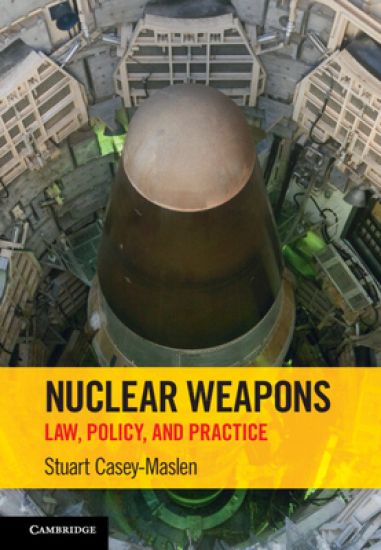
A new nuclear arms race is underway between Russia and the United States, one that focuses on the technology of delivery of nuclear warheads. This book describes how and why this race is happening, who still possesses nuclear weapons, and what constraints apply to those weapons under international law. A global nuclear ban treaty entered into force in January 2021, but the nuclear powers kept distant. The last remaining treaty restraining the arsenals of the two nuclear superpowers will expire in less than five years' time and the risk is that other States will turn to nuclear arms for their defence, further fracturing the non-proliferation regime installed after the Cuban missile crisis.
International Counterterrorism Law

International Counterterrorism Law

Stuart Casey-Maslen

Cambridge University Press
2024
sidottu
International Counterterrorism Law is the first book to consider national terrorism legislation in every one of the 197 States worldwide. It explains how international counterterrorism law has become a distinct branch of international law, and what the different components are in both peacetime and armed conflict. The relevance and contribution of international humanitarian law, international criminal law, national criminal law, and international human rights law are examined in combination with global sectoral terrorism treaties and regional instruments to provide a thorough yet manageable account of the law's application. Real-life examples are used to inform the material, from Ukraine to Syria, to Iran and the unlawful actions of the Global War on Terror, so that the reader can understand how domestic and international terrorism has historically been treated by prosecutors and the courts.
The Prohibition of Torture and Ill-Treatment under International Law

The Prohibition of Torture and Ill-Treatment under International Law

Stuart Casey-Maslen

Cambridge University Press
2025
sidottu
The first comprehensive analysis of domestic and international law defining and prohibiting torture and other forms of ill-treatment, this groundbreaking work reviews the law on torture in countries around the world. It considers how international law governs the use of force by police against suspects held in custody and during protests, and the practice and outlawing of torture both in peacetime and during armed conflict. The analysis also includes the application of universal jurisdiction, which is used in the attempt to prosecute and punish torture committed anywhere in the world. The application and execution of the death penalty are also discussed in detail.
Nuclear Weapons

Nuclear Weapons

Stuart Casey-Maslen

Cambridge University Press
2021
sidottu
A new nuclear arms race is underway between Russia and the United States, one that focuses on the technology of delivery of nuclear warheads. This book describes how and why this race is happening, who still possesses nuclear weapons, and what constraints apply to those weapons under international law. A global nuclear ban treaty entered into force in January 2021, but the nuclear powers kept distant. The last remaining treaty restraining the arsenals of the two nuclear superpowers will expire in less than five years' time and the risk is that other States will turn to nuclear arms for their defence, further fracturing the non-proliferation regime installed after the Cuban missile crisis.
Jus ad Bellum

Jus ad Bellum

Stuart Casey-Maslen

Hart Publishing
2020
nidottu
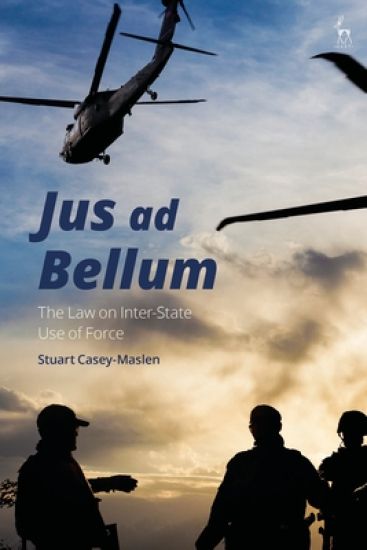
This work expounds, for those in practice and beyond, the rules of international law governing the inter-state use of force. Jus ad bellum determines when a state — or group of states — may lawfully use force against, or on the territory of, another state, and when such action violates international law. The bedrock of the law is found in the Charter of the United Nations, but the interpretation and application of many of the rules codified in the Charter, particularly by the International Court of Justice, are contested. Accordingly, the book clarifies the law as it stands today, explaining its many complexities and controversies, such as when non-state actors may be attacked in another state and when consent is validly given to foreign intervention. The interrelationships between jus ad bellum and the law of armed conflict/international humanitarian law, the law of neutrality, and international human rights law are also illuminated, along with important concepts such as the ‘responsibility to protect’ and humanitarian intervention.
Hybrid Warfare under International Law

Hybrid Warfare under International Law

Stuart Casey-Maslen

BLOOMSBURY PUBLISHING PLC
2024
sidottu
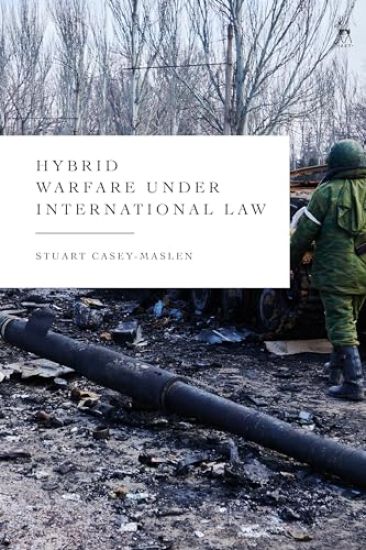
This book addresses the regulation of hybrid warfare under relevant branches of international law, beginning with the law on inter-state use of force (jus ad bellum).Firstly, the book assesses the extent to which forms of hybrid warfare comply with or violate international humanitarian law/the law of armed conflict. It then looks at law enforcement action in response to hybrid warfare, both on land and on the high seas, and addresses hybrid warfare from the perspective of international counterterrorism law. It goes on to tackle the constraints applied to hybrid warfare under international human rights law, and looks at how hybrid warfare could be constrained under disarmament law. The final two chapters look at accountability for the conduct of hybrid warfare, concluding with the question: can we move towards a less fragmented set of international legal rules that will govern hybrid warfare in the future?
Hybrid Warfare under International Law

Hybrid Warfare under International Law

Stuart Casey-Maslen

BLOOMSBURY PUBLISHING PLC
2026
nidottu
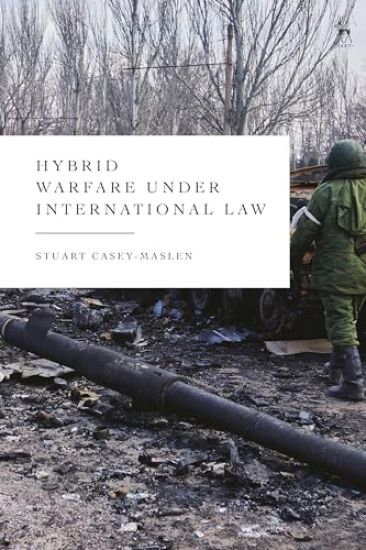
This book addresses the regulation of hybrid warfare under relevant branches of international law, beginning with the law on inter-state use of force (jus ad bellum).Firstly, the book assesses the extent to which forms of hybrid warfare comply with or violate international humanitarian law/the law of armed conflict. It then looks at law enforcement action in response to hybrid warfare, both on land and on the high seas, and addresses hybrid warfare from the perspective of international counterterrorism law. It goes on to tackle the constraints applied to hybrid warfare under international human rights law, and looks at how hybrid warfare could be constrained under disarmament law. The final two chapters look at accountability for the conduct of hybrid warfare, concluding with the question: can we move towards a less fragmented set of international legal rules that will govern hybrid warfare in the future?
A Guide to International Disarmament Law

A Guide to International Disarmament Law

Stuart Casey-Maslen; Tobias Vestner

CRC Press Inc
2019
sidottu
Disarmament is integral to the safeguarding and promotion of security, development, and human rights. Hundreds of millions of dollars are spent each year on disarmament operations, yet no comprehensive guide exists to explain clearly the international rules governing disarmament. This book seeks to fill that gap. It describes the international legal rules that govern disarmament and the operational, political, and technical considerations that govern their implementation. This book aims to support compliance, implementation, and further development of international disarmament law.Traditionally, disarmament focused on weapons of mass destruction. This remains a critically important area of work. In recent decades, the scope of disarmament has broadened to encompass also conventional weapons, including through the adoption of rules and regulations to govern arms transfers and measures to eliminate specific munitions from stockpiles and to destroy explosive remnants of war. There have also been four "generations" of programmes to address small arms and light weapons at national or sub-national level through disarmament, demobilisation, and reintegration (DDR) programmes during and following the end of armed conflict.While an internationally accepted definition of disarmament does not yet exist, it is widely agreed that disarmament encompasses or interrelates with prohibitions and restrictions on the development, production, stockpiling, testing, and transfer of weapons and on their destruction. In addition to clarifying these elements, chapters of this guide will also consider the relationship between disarmament and the law of armed conflict, and with the United Nations Security Council, human security, public health, and non-state actors.
A Guide to International Disarmament Law

A Guide to International Disarmament Law

Stuart Casey-Maslen; Tobias Vestner

CRC Press Inc
2019
nidottu
Disarmament is integral to the safeguarding and promotion of security, development, and human rights. Hundreds of millions of dollars are spent each year on disarmament operations, yet no comprehensive guide exists to explain clearly the international rules governing disarmament. This book seeks to fill that gap. It describes the international legal rules that govern disarmament and the operational, political, and technical considerations that govern their implementation. This book aims to support compliance, implementation, and further development of international disarmament law.Traditionally, disarmament focused on weapons of mass destruction. This remains a critically important area of work. In recent decades, the scope of disarmament has broadened to encompass also conventional weapons, including through the adoption of rules and regulations to govern arms transfers and measures to eliminate specific munitions from stockpiles and to destroy explosive remnants of war. There have also been four "generations" of programmes to address small arms and light weapons at national or sub-national level through disarmament, demobilisation, and reintegration (DDR) programmes during and following the end of armed conflict.While an internationally accepted definition of disarmament does not yet exist, it is widely agreed that disarmament encompasses or interrelates with prohibitions and restrictions on the development, production, stockpiling, testing, and transfer of weapons and on their destruction. In addition to clarifying these elements, chapters of this guide will also consider the relationship between disarmament and the law of armed conflict, and with the United Nations Security Council, human security, public health, and non-state actors.
The Right to Life under International Law

The Right to Life under International Law

Stuart Casey-Maslen; Christof Heyns

Cambridge University Press
2021
sidottu
The Right to Life under International Law offers the first-ever comprehensive treatment under international law of the foundational human right to life. It describes the history, content, and status of the right, considers jurisdictional issues, and discusses the application of the right to a wide range of groups, such as women, children, persons with disabilities, members of minorities, LGBTI persons, refugees, and journalists. It defines the responsibility of not only governments but also the private sector, armed groups, and non-governmental organisations to respect the prohibition on arbitrary deprivation of life. It also explains the nature and substance of the duty to investigate potentially unlawful death as well as the mechanisms at global and regional level to promote respect for the right to life.
Police Use of Force under International Law

Police Use of Force under International Law

Stuart Casey-Maslen; Sean Connolly

Cambridge University Press
2017
sidottu
Policing is commonly thought to be governed by domestic legal systems and not international law. However, various international legal standards are shown to have an impact in situations where police use force. Police Use of Force under International Law explores this tension in detail for the first time. It critically reviews the use of force by law enforcement agencies in a range of scenarios: against detainees, during protests, and in the context of counterterrorism and counterpiracy operations. Key trends, such as the growing use of private security services, are also considered. This book provides a human rights framework for police weaponry and protection of at-risk groups based on critical jurisprudence from the last twenty years. With pertinent case law and case studies to illustrate the key principles of the use of force, this book is essential reading for anyone interested in policing, human rights, state use of force or criminology.
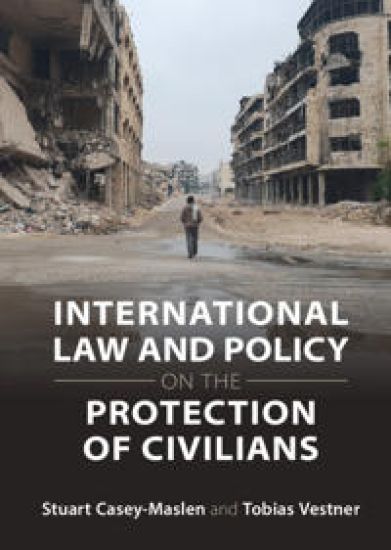
International Law and Policy on the Protection of Civilians

International Law and Policy on the Protection of Civilians

Stuart Casey-Maslen; Tobias Vestner

Cambridge University Press
2022
sidottu
This is the first comprehensive treatment of international law and policy on the protection of civilians in armed conflict. In addition to international humanitarian and human rights law, jus ad bellum, disarmament law, and international criminal law are all critical to civilian protection. The book offers in-depth analysis and explanation of the normative framework while also outlining and discussing the policies of concerned States and international and humanitarian organisations. The role of the United Nations as a key actor is considered along with regional organisations such as the African Union, the European Union, and NATO. Particular attention is given to those at direct risk of harm during armed conflict, including children, women, persons with disabilities, and LGBTI persons.
Police Use of Force under International Law

Police Use of Force under International Law

Stuart Casey-Maslen; Sean Connolly

Cambridge University Press
2018
pokkari
Policing is commonly thought to be governed by domestic legal systems and not international law. However, various international legal standards are shown to have an impact in situations where police use force. Police Use of Force under International Law explores this tension in detail for the first time. It critically reviews the use of force by law enforcement agencies in a range of scenarios: against detainees, during protests, and in the context of counterterrorism and counterpiracy operations. Key trends, such as the growing use of private security services, are also considered. This book provides a human rights framework for police weaponry and protection of at-risk groups based on critical jurisprudence from the last twenty years. With pertinent case law and case studies to illustrate the key principles of the use of force, this book is essential reading for anyone interested in policing, human rights, state use of force or criminology.
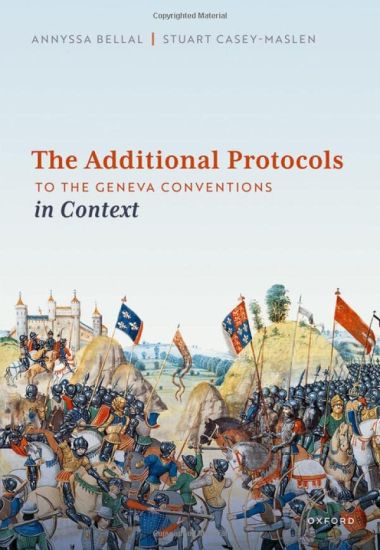
The Additional Protocols to the Geneva Conventions in Context

The Additional Protocols to the Geneva Conventions in Context

Annyssa Bellal; Stuart Casey-Maslen

Oxford University Press
2022
sidottu
The Additional Protocols to the 1949 Geneva Conventions remain a landmark in the development of international humanitarian law. The first two Additional Protocols were adopted by states in 1977. These protocols encompass the rules governing the treatment and protection of those in the power of an enemy, as well as the conduct of hostilities. Crucially, they address non-international armed conflicts and wars of national liberation. In 2005, a third additional protocol designating an additional distinctive humanitarian emblem was adopted in controversial circumstances. The Additional Protocols to the Geneva Conventions in Context interprets the key rules and issues of the Additional Protocols and considers their application and implementation over the past forty years. Taking a thematic approach, the book examines subjects including the protection of women, armed non-state actors, relief operations, and prohibited weapons. Each chapter discusses the pertinence of existing laws, the challenges raised by the rules in the Additional Protocols, and what more could be done to better protect civilians. This book also considers whether new technologies, such as offensive cyber operations and autonomous weapons, need new treaty rules to regulate their application in armed conflict.